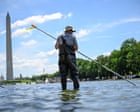
The water between the Lincoln Memorial and the Washington Monument looks like pea soup, and the freshly painted bottom is flaking off like an old sunburn. Naturally, there's a furious scramble to point fingers. Donald Trump says it's the work of shadowy saboteurs wielding industrial blades and destructive chemicals. Environmental scientists say it's basic biology.
If you're trying to figure out why a high-profile $14.2 million federal makeover ended up looking like a neglected backyard hot tub within a single week, you aren't alone. Tourists are staring at a murky green mess. The administration is vowing to put people in prison for years. But if you look past the Truth Social posts and look at the actual physics of shallow water, the real culprit isn't a team of stealthy vandals. It's a combination of bad chemistry, rushed timelines, and a stubborn refusal to work with nature.
The Dream of Old Glory Blue
The trouble started in April when the administration decided the historic 2,000-foot-long basin needed to be prepped for the nation's 250th anniversary. Historically, the bottom of the Lincoln Memorial Reflecting Pool has been a neutral, muddy gray. It was designed that way on purpose by architect Henry Bacon back in the 1920s. A gray bottom acts like a mirror, catching the sky and cleanly duplicating the monuments on its surface.
But the new plan called for something flashier. The administration wanted the pool lined with a dark navy coating dubbed "American flag blue," or officially, Old Glory Blue.
To get it done in what was called "Trump speed" before the July 4 celebrations, the government bypassed the standard competitive bidding process. They handed a no-bid contract to Atlantic Industrial Coatings, a Virginia-based business that had never won a federal contract before. Labor unions raised red flags immediately, questioning the safety protocols and the wisdom of skipping experienced contractors. The administration pushed ahead anyway, eager for a quick, visual win.
When the pool was first refilled, the look was striking. For a brief second, it worked. Then, biology took over.
Why the Water Turned Green
Within days of the grand reopening, the crisp blue water shifted into an unmistakable hue of bright green. The administration initially claimed the water was crystal clear, but the cameras didn't lie. It was an algae bloom.
Specifically, aquatic ecologists who sampled the water confirmed a massive spike in algae from the genus Desmodesmus. It isn't toxic, but it is incredibly aggressive.
When you scrub down a massive concrete basin, disturb the surrounding soil, and fill it with fresh municipal water under the baking June sun, you create a perfect incubator. The pool is shallow. The sun cooks it all day. Rushing the refilling process likely threw off the water's natural nutrient balance, giving the dormant algae spores a massive shot of adrenaline.
Instead of accepting that a shallow, sun-drenched concrete pond will naturally grow algae until its ecosystem stabilizes, the administration went to war with the pond. They deployed crews with vacuum lines, skimmers, and heavy doses of hydrogen peroxide to kill the bloom. They even deployed "advanced nanobubbler technology" to pump oxygen into the water.
That massive chemical intervention solved one problem but triggered a much bigger mechanical failure.
The Peeling Paint Nightmare
As the chemicals did their work, massive sheets of the expensive blue rubber lining began detaching from the concrete floor. Giant, ragged flakes of dark blue coating started floating to the top, looking less like a national monument and more like a shedding snake.
This is where the vandalism narrative caught fire. On social media, the president claimed that saboteurs had taken a blade to the pool, slicing a 250-foot gash into the brand-new liner and pouring corrosive chemicals into the water to destroy the project. US Attorney Jeanine Pirro went on Fox News to promise full prosecution for anyone messing with the monument.
Law enforcement did make arrests, but the details paint a bizarre picture. One of the primary "vandals" hauled away in handcuffs was David Hearn, a 67-year-old three-time Olympic canoeist from Maryland. Hearn was out on a 64-mile bicycle ride when he stopped to look at the mess. Seeing a piece of the blue lining flapping around in the water, the retired athlete reached in out of pure curiosity to feel the material.
Hearn didn't have a knife. He didn't have chemicals. He touched a piece of paint that was already falling apart, got yelled at by a park worker, let go, and was promptly detained by National Guard troops and US Park Police for five hours.
The structural truth is simple. When you apply an industrial coating to wet or improperly cured concrete, or when you blast a freshly cured lining with aggressive algae-killing chemicals under high pressure, the bond fails. The water pressure gets underneath the micro-tears, and the lining simply lifts off the floor. You don't need a 250-foot knife to ruin a paint job; you just need poor adhesion and bad chemistry.
What Happens Now
The reflecting pool is currently slated to be completely drained, scraped, and repaired. The administration says the repairs will happen immediately, but draining 6.7 million gallons of water and restarting a delicate curing process takes time that the July 4 calendar doesn't really offer.
If you're following this saga, ignore the theatrical claims of political sabotage. The real lessons here are practical, hands-on truths about project management and civil engineering.
- Respect the cure times: Rushing industrial coatings to meet a political deadline almost always guarantees a chemical bond failure.
- Work with the ecosystem: Expecting a shallow, open-air body of water to remain a sterile, vibrant blue without massive, ongoing ecological management is a fantasy.
- No-bid shortcuts cost double: Bypassing experienced federal contractors to move at top speed usually results in doing the job twice.
Watch the water level over the next week. If the pumps start running and the pool empties out again, you'll know the chemical war was lost, and the engineers are finally taking over from the politicians.