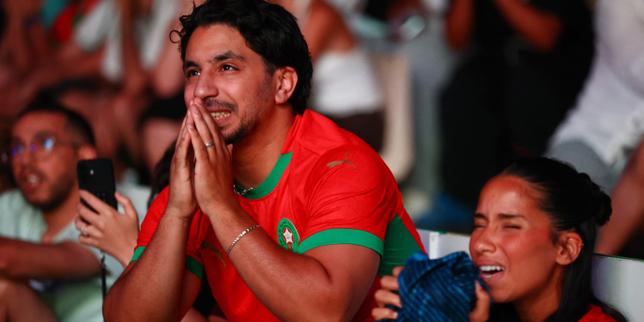
The honking started before the final whistle blew in Qatar. On the Champs-Élysées, the air smelled like a mix of burning rubber, cheap flares, and winter cold. If you walked through Paris that December night in 2022, you didn't just see a crowd. You saw a living, breathing identity crisis wrapped in two different flags.
When France beat England and Morocco took down Portugal on the exact same day, history didn’t just knock on the door. It smashed it open. For the first time ever, the reigning champions were going to face the ultimate underdog of the tournament in a World Cup semi-final. But this wasn't just another soccer match. For millions of Franco-Moroccans, it felt like an emotional ambush. Recently making waves lately: The Brutal Truth Behind Pakistan Judicial Crisis.
Media outlets rushed to frame this as a dangerous flashpoint. Pundits on late-night talk shows spent hours debating whether the streets would burn. They worried about loyalty. They questioned integration. They looked at a massive community of dual citizens and assumed a battlefield was being drawn.
They got it completely wrong. Further details on this are covered by NBC News.
The Myth of the Divided Loyalty
If you listen to the talking heads, you’d think being Franco-Moroccan means you’re constantly split clean down the middle, like a piece of paper torn in half. It's a lazy narrative. It assumes that love for one culture automatically subtracts from another.
The reality on the ground was far more complex, joyous, and messy than any neat political theory. Take a look at the actual celebrations that filled French cities after those quarter-final victories. People weren't fighting in the streets of Paris, Marseille, or Lyon. They were passing flags to each other through car windows.
Lilia, a thirty-six-year-old Paris resident, summed it up perfectly while waving both flags on the avenue that night. She joked to reporters that the upcoming match felt exactly like her father playing a game against her mother. You don't root for one parent to destroy the other. You just want to watch the game and celebrate that everyone is at the table.
This wasn't a crisis of identity. It was an abundance of it. Franco-Moroccans didn't feel torn apart; they felt twice as alive. Their two teams had just conquered their respective paths to become the final four best squads on the planet. It was an unprecedented moment of cultural validation, even if it came with a heavy dose of emotional vertigo.
Decoupling Sport From Historical Trauma
You can't talk about France and Morocco without talking about colonialism. The protectorate era left deep scars, complicated legal structures, and generations of migration that shaped modern French society. When the semi-final matchup became official, those historical ghosts were instantly dragged back into the spotlight.
But watch how the younger generation handles this weight. They don't carry it the way the old guard does. For third-generation Franco-Moroccans, supporting the Atlas Lions isn't an act of aggression against France. It's a reclamation of pride.
Morocco’s run wasn't just a sports victory. It was a historic breakthrough for Africa and the Arab world. To see a team from the Global South play with that level of tactical discipline, defensive brilliance, and raw heart sent shockwaves through the diaspora. It proved that the old hierarchies could be flipped on the pitch.
At the same time, these same fans grew up idolizing Kylian Mbappé. They wear the Les Bleus jersey because it represents the diverse, multi-ethnic France they live in every day. The French national team has long been a mirror of the country’s colonial history and its immigrant reality. Think back to the 1998 "Black, Blanc, Beur" team. The modern squad is no different.
So when the two teams faced off, it wasn't a war between enemies. It was a mirror looking at another mirror. The players themselves showed this clearly. Mbappé and Achraf Hakimi aren't just world-class athletes; they’re best friends who play together at Paris Saint-Germain. Their post-game embrace, swapping jerseys in the tunnel, did more to explain the reality of Franco-Moroccan relations than a thousand newspaper editorials ever could.
What the Clean Narratives Miss About the Diaspora
Politicians love clean lines. They want you to check a single box. The Franco-Moroccan experience doesn't fit into a box, and that terrifies people who demand absolute assimilation.
During that week in December, the atmosphere in the banlieues—the working-class suburbs surrounding Paris—was electric. It wasn't tense. It was a festival. Families were cooking traditional Moroccan tagines while keeping the TV tuned to French sports commentary. Kids were running around in green and red jerseys while their parents wore the blue of France.
The anxiety didn't come from within the community. It was projected onto them from the outside. The French government deployed over a thousand police officers to the Champs-Élysées alone on the night of the quarter-finals. The underlying message was clear: we don't trust your joy. We think your excitement is a threat to public order.
That institutional suspicion hurts. It forces people into defensive crouches. When you're constantly asked to prove your loyalty to the republic, a soccer match becomes a high-stakes test you never asked to take. The mixed feelings didn't come from a lack of love for France. They came from the exhausting knowledge that no matter how much you celebrate, your citizenship is still viewed through a lens of suspicion by a large segment of the population.
Moving Past the Binary Trap
Stop looking at dual identity as a problem to solve. It’s an asset. The fans who celebrated both victories on that cold December night weren't confused. They knew exactly who they were. They were navigating a unique space that belongs entirely to them.
If you want to understand the modern diaspora, you have to stop using the vocabulary of the past. It's not about choosing a side. It's about expanding the boundaries of what it means to belong to a place. You can love the country that raised you, educated you, and gave you a livelihood, while fiercely honoring the roots, language, and culture of your ancestors.
The World Cup eventually moved on. France won the semi-final, Morocco earned the respect of the entire globe, and life returned to normal. The flags were packed away. The car horns stopped blaring. But the cultural shifts that crystallized during that week didn't disappear.
If you're still treating dual identity as an issue of national security or a psychological dilemma, you're missing the point entirely. The kids on the streets of Paris showed us the blueprint. They wore both flags, chanted in two languages, and claimed their right to happiness on their own terms.
Step out of the opinion pages and look at the actual lives being lived in the neighborhoods. Stop trying to police the boundaries of belonging. The next time a sporting event brings these intersections to light, don't look for conflict where there is only a celebration of dual heritage. Let people hold both flags without asking them to explain why.