You probably think moving walkways are a modern airport convenience invented to save tired travelers from sprinting to Gate B42. You'd be wrong by more than a century. Long before concrete terminals and rolling suitcases existed, fairgoers at the 1893 World's Columbian Exposition stepped onto a wooden, two-speed moving sidewalk that carried them straight toward the famous Peristyle.
It wasn't just a quirky Victorian novelty. The Multiple Speed Railway Company built a legitimate mass-transit prototype over Lake Michigan, proving that continuous-motion transit could haul thousands of people without stopping. For a more detailed analysis into similar topics, we recommend: this related article.
If you've ever studied late-nineteenth-century engineering, you quickly realize the 1893 fair was less of a party and more of a high-stakes proving ground. Alongside George Ferris's massive wheel and Nikola Tesla's alternating current demonstrations, architects and engineers were trying to solve a brutal logistics problem. Millions of visitors needed to get from steamboats docking out in Lake Michigan across a long wooden pier and into the White City's monumental Peristyle plaza.
Standard trains had to stop, load, and accelerate again. That wasted time and created massive bottlenecks. For further context on the matter, in-depth reporting can also be found on The Verge.
How the Two-Speed Moving Sidewalk Actually Worked
Most modern airport travelators move at a single, sluggish pace—usually around 1.5 to 2 miles per hour—because stepping from a stationary floor onto anything faster will knock an unsuspecting pedestrian flat on their back. The engineers behind the 1893 Chicago moving sidewalk, Max E. Schmidt and Joseph Lyman Silsbee, solved this physics problem with a clever two-step platform system.
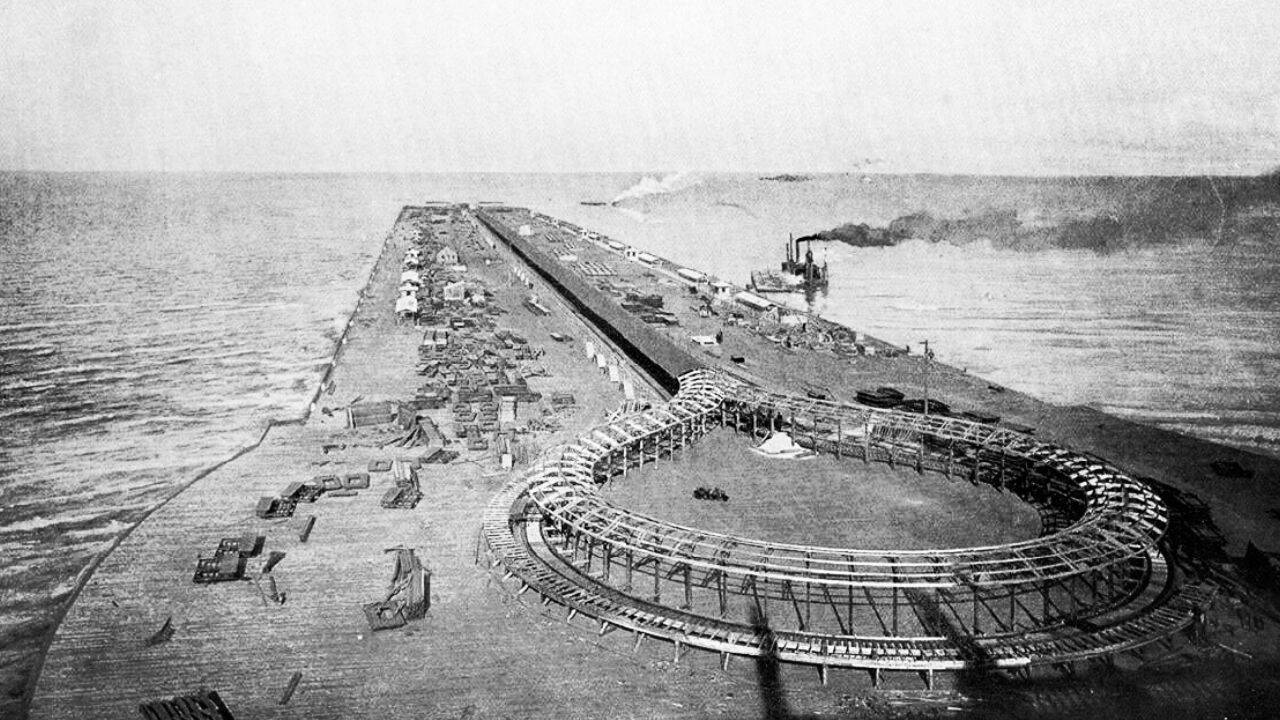
Instead of forcing people to make one giant leap, they built an elevated wooden loop on the Casino Pier extending out into Lake Michigan. It consisted of two parallel, continuous platforms running side by side.
Here's how a passenger boarded without breaking an ankle:
- First, you stepped from the stationary wooden pier onto a slow-moving platform traveling at roughly 3 miles per hour. That's basically a brisk walking speed, easy enough for anyone in heavy Victorian woolens and leather boots to handle.
- Next, once you found your balance, you stepped sideways onto a second, parallel platform moving at 6 miles per hour.
- Because the speed differential between the two belts was only 3 miles per hour at each transition, your body barely registered the inertia shift.
Once on the fast track, you didn't even have to stand. The 6-mph platform was lined with wooden benches where visitors could sit down, catch the lake breeze, and watch the neoclassical columns of the Peristyle grow larger as they glided toward the shore. If you wanted to get there even faster, you could walk forward along the 6-mph deck, effectively traveling at 9 miles per hour without breaking a sweat.
The Engineering Behind the Multiple Speed Railway
It looks simple on paper. In reality, building a continuous loop nearly a mile long over open water in 1893 was an absolute headache.
The system didn't use modern rubber belts over rollers. Those materials didn't exist at the scale required to carry hundreds of tons of human cargo. Instead, the Multiple Speed Railway operated like a continuous, endless train.
Beneath the wooden decking sat a network of steel rails, axles, and overlapping flexible steel plates that allowed the platforms to bend smoothly around the tight turnaround loops at either end of the pier. Electric motors powered the slow platform directly through standard wheels and axles.
The fast platform used a brilliant mechanical trick called differential gearing—specifically, flexible steel bands running over the tops of the slow platform's wheels. Because the top edge of a rolling wheel moves forward at twice the speed of its axle, resting the upper track directly on the wheel rims automatically doubled its velocity to 6 miles per hour. No second set of motors required. Just pure, elegant mechanics.
I've spent years digging through nineteenth-century transit patents, and honestly, the sheer nerve of Schmidt and Silsbee still amazes me. They weren't testing this in a quiet railyard. They bolted it onto pilings over Lake Michigan and invited thousands of tourists to ride it on opening day.
What Happened on the Pier to the Peristyle
The Peristyle was one of the architectural centerpieces of Daniel Burnham's White City. Designed by Charles B. Atwood, this massive classical colonnade stood 60 feet tall, spanned the entrance to the Grand Basin, and was topped by the famous Columbus Quadriga sculpture. For visitors arriving by Lake Michigan steamers, the Peristyle was their very first jaw-dropping look at the fairgrounds.
The moving sidewalk ran directly along the 2,500-foot Casino Pier, connecting the steamboat landing straight to the Peristyle entrance. For five cents a ride, fairgoers avoided a hot, exhausting half-mile trek down crowded planks.
Did everything run smoothly? Not entirely.
Early in the fair's run, heavy crowds and mechanical friction caused delays, and critics in the Chicago press were quick to mock the contraption whenever it stalled. Lubrication on the overlapping plates was a constant battle against lake humidity and dust. Yet once the crews dialed in the tension and maintenance schedules, the system worked remarkably well. Contemporary engineering journals noted that the walkway could theoretically move over 30,000 people per hour—a capacity that would make modern subway planners weep with envy.
Why Didn't Two-Speed Sidewalks Replace Subways
If the 1893 moving sidewalk was so efficient, why aren't we stepping onto 6-mph platforms down Fifth Avenue or Michigan Avenue right now?
After Chicago, Schmidt actually took the concept global. He built an upgraded, three-speed version (running at roughly 2.6, 5.2, and 7.8 miles per hour) for the 1900 Paris Exposition Universelle, where it carried millions of passengers across the fairgrounds. He spent the next two decades lobbying New York City transit officials to install a subterranean moving sidewalk beneath 34th Street and Broadway.
He failed, and the reasons come down to harsh urban realities rather than bad engineering:
- Liability and safety fears. Victorian and early twentieth-century crowds were remarkably agile, largely because people were used to hopping on and off moving horse-drawn streetcars. Modern municipal insurers, however, have zero tolerance for elderly passengers, toddlers, or distracted phone-scrollers tripping across a 3-mph shear zone.
- Maintenance costs. A single broken axle or warped plate in a continuous-loop railway shuts down the entire line. Unlike a subway system where you can pull one damaged train car into a siding, a continuous platform is one giant, interconnected machine.
- Enclosed tunnel economics. Elevated walkways worked great in open-air exposition grounds, but putting them underground meant digging wide, expensive tunnels just to house side-by-side platforms. Standard subway trains packed more people into narrower bores over long distances.
Where You Can Explore This History Today
Most of the White City burned down in 1894 or was demolished shortly after the fair closed, including the Peristyle and the Casino Pier. You can't ride Schmidt's two-speed sidewalk anymore, but you can still trace its footprint and examine the original engineering records if you know where to look.
If you're visiting Chicago, head down to Jackson Park on the South Side. Stand near the eastern edge of the lagoon by the Museum of Science and Industry—the sole surviving major building from the 1893 fair—and look east toward Lake Michigan. That shoreline is right where the grand Peristyle once stood, and the waters just beyond it held the pilings for the Multiple Speed Railway.
For primary technical drawings, patent diagrams, and period photographs of passengers riding the benches along the pier, check the digital archives of the Chicago History Museum and the Newberry Library, or pull up the 1893 issues of Scientific American and Engineering News, which documented the mechanical wheel-rim drive system in detail. Knowing how those two wooden decks operated makes every mundane airport travelator you step onto today look like a very timid descendant of a much bolder idea.