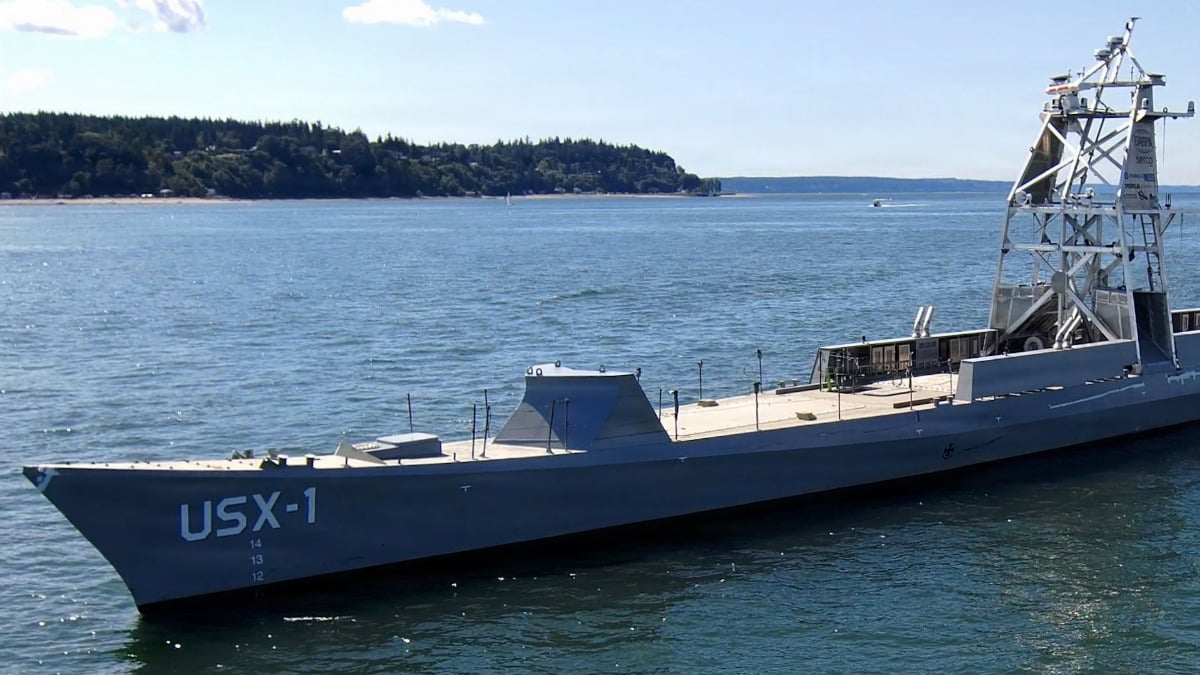
The Pentagon wants dozens of robot cargo boats. The defense establishment is salivating over the prospect of autonomous supply runs in the Pacific. They look at the map, see thousands of miles of open water, and think a fleet of unmanned, algorithm-driven barges will magically solve the brutal reality of wartime logistics.
They are wrong. They are building a multi-billion-dollar shooting gallery. Also making headlines lately: Why DoorDash is Replacing Menu Scrolling With Photos and Prompts.
The current consensus among defense contractors and military planners is dangerously naive. The narrative says that by removing human crews from logistical vessels, we eliminate risk, slash operational costs, and create an unblinking, indefatigable supply chain. It sounds elegant in a PowerPoint presentation. It fails completely when the shooting starts.
I have spent years analyzing maritime supply lines and watching defense tech startups burn through capital on autonomous hardware. The blind spot here is massive. Military logistics is not Amazon Prime with a gray paint job. Further information on this are detailed by The Verge.
The Fatal Flaw of the Unmanned Supply Chain
Naval theorists love to talk about the "tyranny of distance" in the Indo-Pacific. To counter it, the Defense Department wants small, autonomous vessels to slip through contested waters to resupply isolated outposts. The logic is that if a robot boat gets sunk, no Americans die.
Here is the nuance they missed: removing the human crew does not make the vessel stealthy. It makes it helpless.
A cargo ship, no matter how automated, emits a massive thermal and acoustic signature. It is a slow-moving steel box. In a conflict with a near-peer adversary possessing sophisticated satellite imagery, drone swarms, and over-the-horizon radar, these autonomous supply ships will be detected almost immediately.
Once detected, an unmanned vessel is a sitting duck.
The Cost-Imbalance Reality
- The Drone Boat: Costs roughly $20 million to $50 million to build, pack with high-end sensors, and load with critical ammunition or fuel.
- The Anti-Ship Missile: Costs about $500,000 to $1 million.
- The Math: An adversary can fire three or four precision munitions at every single autonomous cargo boat we deploy and still win the economic war by a factor of ten.
We are not building a resilient supply network. We are providing the enemy with cheap target practice.
The Maintenance Myth of the Machine
The tech sector has convinced the military that software can replace grease, sweat, and wrenches. It is a lie.
Anyone who has ever spent time on a blue-water transit knows that ships break constantly. Marine environments are brutal. Saltwater corrodes electronics. High seas strain mechanical linkages. Marine growth clogs cooling intakes. Diesel generators throw valves.
On a manned ship, a third assistant engineer down in the pit fixes these issues with baling wire, a blowtorch, and sheer willpower. On a robot boat, a clogged fuel filter means the entire vessel dead-sticks in the water.
Imagine a scenario where a dozen autonomous cargo boats leave Hawaii bound for the First Island Chain. Within 48 hours, three of them suffer minor mechanical anomalies—failures that a human sailor could fix in ten minutes with a socket wrench. Instead, these multi-million-dollar assets sit adrift, waiting to be captured by enemy boarding parties or sunk by a stray mine.
Autonomous systems can navigate. They cannot repair themselves. Until we have androids that can rebuild a fuel pump in a sea state 5, humanless cargo ships are a fantasy.
Cyber Warfare and the Ghost Fleet Takeover
The Pentagon assumes it will maintain a secure, high-bandwidth datalink to these vessels to monitor their progress and override their programming if necessary. This assumes a permissive electromagnetic environment. It ignores everything we know about modern electronic warfare.
In a real fight, GPS will be jammed, spoofed, or blinded completely. Satellite communications will be degraded.
"When you sever the data umbilical cord of an autonomous vessel, you don't get a rogue warrior. You get an expensive piece of driftwood."
If the autonomous boat relies on internal inertial navigation, it will drift off course over long distances. If it relies on AI vision systems to navigate by landmarks or celestial tracking, it can be easily fooled by spoofing techniques or simple smoke screens.
Worse, an unmanned ship is an open invitation for hostile boarding. If an enemy special operations team boards a manned supply ship, they face armed resistance. If they board an autonomous cargo boat, they just need to plug a laptop into the central bus. We are essentially delivering crates of advanced Tomahawk missiles and spare F-35 parts directly to the enemy, wrapped in a bow, with no one on board to pull the scuttling plug.
Dismantling the Premise: The Real Logistics Fix
The military is asking the wrong question. They are asking, "How do we move supplies without putting sailors at risk?"
They should be asking, "How do we reduce the need to move supplies in the first place?"
The fixation on high-tech hardware platforms is a distraction from the unsexy work of true operational resilience. Instead of spending billions on a vulnerable fleet of robotic targets, the capital should be diverted into three specific, unglamorous areas.
1. Pre-Positioned Foraging and Additive Manufacturing
We need to stop shipping every single widget across 6,000 miles of ocean. Outposts must be equipped with industrial-grade 3D printing capabilities and local raw materials to manufacture their own spare parts on demand. If a unit can print its own drone components and vehicle parts, the logistical burden drops exponentially.
2. Extreme Decentralization
Instead of dozens of medium-sized robot boats, the military should invest in thousands of low-tech, expendable, semi-submersible micro-drones. Things no larger than a jet ski that travel just below the surface, carrying only a few hundred pounds of medical supplies or ammunition. They are too small to be worth an expensive anti-ship missile, too low to the water to be easily spotted by radar, and numerous enough that losing 70% of them doesn't compromise the mission.
3. The Ugly Truth About Vulnerability
We must accept that logistics in war requires human risk. The most successful logistical operations in history—like the Ho Chi Minh trail or the Red Ball Express—did not rely on pristine, automated efficiency. They relied on redundancy, human adaptability, and the willingness to take losses.
Putting humans on ships keeps those ships alive. Humans solve problems that algorithms cannot even categorize.
The Defense Acquisition Trap
Why is the Pentagon pushing so hard for this flawed concept? Follow the money.
Defense primes cannot make massive margins by telling the military to buy simpler things or to better manage their existing inventory. They make money by selling complex, proprietary software architectures wrapped in autonomous hulls. They sell the allure of a bloodless, automated war.
It is a corporate grift that endangers national security. The moment the first missile takes out an autonomous barge, causing millions of dollars of critical equipment to sink to the bottom of the Philippine Sea without a single shot being fired in defense, the entire concept will collapse.
Stop trying to automate the maritime supply chain. Fix the consumption model, build small and ugly, and stop treating the Pacific Ocean like a Silicon Valley testing pond.
If we send an army of robots to do a sailor's job, we are just giving the enemy a front-row seat to a tech wreck.