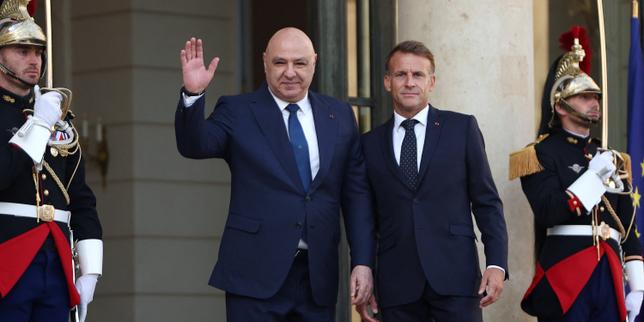
Emmanuel Macron stood in the gilded halls of the Palais de l Elysée alongside two monarchs of vastly different fortunes, orchestrating what official communiques termed a breakthrough in international aid for Lebanon. Lebanese President Joseph Aoun and Jordanian King Abdullah II gathered in Paris under chandeliers that have witnessed centuries of European statecraft. Yet behind the polished handshakes and carefully staged photo opportunities lies a starkly different geopolitical landscape. Paris wants to project influence in the Levant. Beirut needs cash to keep its lights on. Amman worries about the spillover effects of a fractured state on its own precarious borders.
Diplomacy in the French capital follows a predictable rhythm. Press conferences feature words like solidarity, stability, and reform. But the structural reality of Lebanon in the current era defies easy fixes. Decades of institutional decay, compounded by banking sector collapses and systemic corruption, have turned foreign aid into a high-stakes guessing game. Western capitals refuse to write blank checks to a government that has routinely failed to implement basic transparency measures. The summit in Paris was less a rescue mission and more an exercise in managing expectations while trying to prevent total state implosion.
Understanding why Emmanuel Macron convened this specific trio requires looking past the rhetoric of fraternal support. France maintains a historic, complex attachment to Lebanon, viewing the Mediterranean nation as a crucial outpost of Francophonie and cultural leverage. For Macron, projecting diplomatic gravitas abroad remains a reliable way to distract from domestic political friction at home. Hosting regional heavyweights burnishes his credentials as a statesman capable of moving international levers when traditional UN channels bog down in procedural paralysis.
King Abdullah II brings a very different calculus to the table. Jordan sits directly on the fault lines of regional instability. Amman carries the immense logistical and economic weight of hosting hundreds of thousands of refugees while dealing with narcotics trafficking networks operating out of southern Syria. For the Jordanian monarch, securing Lebanon is not about historical sentimentality or economic investment. It is a matter of immediate national security. A collapsing Lebanon further destabilizes a volatile neighborhood, threatening Jordan's own fragile equilibrium.
Meanwhile, President Joseph Aoun navigates an impossible tightrope walk in Beirut. The Lebanese state lacks the sovereign authority to enforce comprehensive reforms demanded by the International Monetary Fund. Factional politics paralyze decision-making, leaving institutions hollowed out and heavily reliant on external lifelines. When Aoun speaks in Paris of international coordination, he is appealing for breathing room. The Lebanese economy functions on remittances, informal cash networks, and whatever scraps of foreign assistance slip through the bureaucratic gridlock.
The core friction point in any international aid package for Lebanon involves conditionality. Donors demand forensic audits of the central bank, judicial independence, and a credible restructuring plan for a banking sector that wiped out the savings of an entire generation. Lebanese political elites, entrenched in sectarian power-sharing agreements, resist these demands because structural reform threatens their patronage networks. This dynamic creates a perpetual stalemate. Paris offers a platform for coordination, but coordination cannot substitute for political will within Beirut itself.
Look closely at the mechanics of international summits and a recurring pattern emerges. Pledges are announced with great fanfare, accompanied by impressive figures measured in millions or billions of euros. Months later, disbursements stall because administrative benchmarks were never met. Skeptics in diplomatic corps refer to this cycle as humanitarian theater. It allows Western governments to look like they are acting while protecting their taxpayers from funding black holes.
The presence of Jordan in these trilateral talks underscores a regional reality that European diplomats often underestimate. Security in the Levant is indivisible. You cannot stabilize Beirut while ignoring Damascus or the porous smuggling routes that feed regional militias. King Abdullah understands that border security and humanitarian aid are deeply intertwined. If the international community fails to address the root causes of economic failure in Lebanon, the burden will inevitably spill over into Jordanian territory, straining an already overburdened kingdom.
Publicly, the French presidency frames these engagements as proactive leadership. Privately, diplomats concede that the ceiling for what Paris can achieve alone is remarkably low. France lacks the financial muscle of the European Union as a collective bloc and the raw geopolitical leverage of the United States. What Paris provides is convening power. It serves as a diplomatic salon where difficult conversations can occur away from the blinding lights of the United Nations Security Council.
Evaluating the outcome of the Paris summit requires stripping away the diplomatic jargon. No new magic funding source materialized in the rooms of the Elysee. No corrupt officials suddenly surrendered their hidden assets because a European president raised an eyebrow. What occurred was a holding action. It bought a few more weeks or months of diplomatic momentum for a nation that has spent years lurching from one existential crisis to the next.
As the motorcades departed the Elysee and the cameras packed away their equipment, the streets of Beirut remained choked by traffic, economic anxiety, and the quiet resilience of ordinary citizens who have learned to survive despite their government. The grand architecture of international summits offers the illusion of control, but the true fate of the region will be decided not in gilded Parisian salons, but in the gritty, unglamorous struggle for institutional survival on the ground.