Call it rage. Call it trauma. Call it a society waiting to heal.
You will be wrong on all three counts.
Every time smoke rises over a Paris boulevard or a banlieue housing block, the commentary machine goes straight into melodrama. A headline announces that what looks like fury is actually deep pain. Another assures you that France simply needs years of patience, dialogue, and social repair before the fractures close.
That story is soothing. It flatters people who like to think politics is group therapy. It is also analytical laziness dressed up as empathy.
Street violence in Paris is rarely blind emotion exploding out of nowhere. Most of the time, it is structured signaling, spatial politics, and institutional friction colliding in real time. And the idea that a complex modern state "heals" like a sprained ankle misreads how public order, labor markets, policing, and urban geography actually work.
What "Rage" Misses About Street Disorder
"Rage" is a convenient word for observers who do not want to distinguish between an outburst and an incentive.
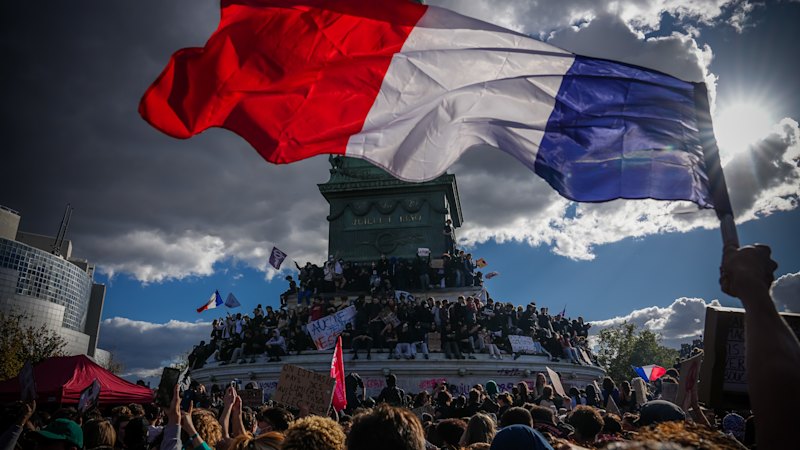
True rage is chaotic, short-lived, and indiscriminate. Watch what actually happens during major Parisian unrest—whether pension battles, cost-of-living clashes, or peripheral urban riots—and you see something far more legible. Targets are chosen. Perimeters are tested. Cameras are courted. Certain intersections become stages because their symbolism is already built into the city's street grid.
Sociologist Charles Tilly spent decades mapping contentious politics and showed that collective violence rarely sits apart from routine claim-making; it grows out of the same grievances, networks, and opportunities as strikes, petitions, and marches. When conventional channels feel slow, unresponsive, or rigged, escalation becomes a bargaining tool. Not everyone throwing a projectile has a manifesto, of course. Opportunism rides right behind grievance. Young men with few economic prospects settle old scores with local authorities. Provocateurs look for clashes that make the evening news.
Still, calling the whole thing "rage" flattens distinct mechanics into one mood. A union picket that turns violent over labor reform is negotiating power under strain. A peripheral neighborhood clash after a police encounter involves territorial policing, generational alienation, and municipal neglect. Treating both as raw emotional release tells you how the scene felt on television. It tells you very little about what caused it or what happens next.
Why "Healing" Is the Wrong Metaphor
"Healing" sounds wise. That is why lazy writers love it.
Put a human body in a cast and time does most of the work. Put a strained urban system in a cast and nothing heals on its own. Cities do not possess an immune system that quietly knits broken institutions back together while everyone takes a deep breath.
Over years of advising public-sector teams, civic coalitions, and institutional leaders on crisis response and organizational turnaround, I have seen leaders burn millions of dollars on "listening tours," brand resets, and feel-good reconciliation summits that never touched a single operational bottleneck. People confused a warm press release with structural change. Six months later, the exact same friction points snapped again because the incentives, staffing models, and decision loops had never changed.
Public policy works the same way. If youth unemployment in outer districts remains stubbornly high, if transit links lag behind housing density, if courts are backlogged, or if police units face chronic strain and mutual distrust, time does not cure those conditions. Time compounds them. A society does not slowly heal from structural mismatch. It either reforms the mechanics or adapts to a higher baseline of friction.
The Geography Built Into the Map
To understand street violence in Paris, look at the map before you look at the slogans.
Paris is famously divided between a dense, affluent, museum-grade core and peripheral municipalities—the banlieues—where large postwar housing estates (grands ensembles) were built to absorb working-class and immigrant populations. Urbanists and sociologists, from Loïc Wacquant to observers of French housing policy, have long pointed out how spatial concentration turns economic disadvantage into an address.
When jobs, high-performing schools, cultural capital, and accessible public services cluster in one zone while concentrated housing and fewer entry-level opportunities sit outside the périphérique, everyday life starts feeling segregated even where formal laws are uniform. Add aggressive stop-and-search dynamics or tense encounters with law enforcement, and a local incident can ignite fast because the underlying fault line is already under tension.
Imagine a scenario where two neighborhoods have identical unemployment rates, yet one has mixed-income housing, frequent transit, and active local businesses while the other is cut off by highways and rail lines with shuttered storefronts. Which one turns a flashpoint into a multi-night standoff? The isolated one every single time. Geography does not invent conflict by itself, but bad urban design acts like dry kindling.
Four Questions People Keep Asking the Wrong Way
When street clashes hit Paris, search feeds fill up with predictable questions. Most of them smuggle in a flawed premise.
Are the protests really about one specific policy?
Rarely. A pension bill, a fuel tax, a policing incident, or a university rule acts as the spark, not the entire fuel tank. When people carry years of frustration over stagnant real wages, rising housing costs, or feeling locked out of decisions made in distant ministries, a single policy becomes a coat rack for everything else. Treating the spark as the whole fire leads to cosmetic concessions that fail to calm the street.
Does cracking down harder restore order?
Heavy policing can clear a square for the night, yet force alone has limits as a long-term strategy. Overly broad or heavy-handed tactics can inflame residents who already feel treated as suspects rather than citizens, turning a contained flare-up into a wider legitimacy crisis. Conversely, letting sustained property destruction or lawlessness run unchecked erodes basic trust in the state's ability to protect ordinary people and small shopkeepers. Order requires both credible enforcement and restraint—a balance easy to preach and hard to execute under pressure.
Will France ever move past this cycle of unrest?
"Moving past" implies a finish line that does not exist in democratic politics. France has a long tradition of confrontational street mobilization—strikes, blockades, demonstrations—that treats the street as a legitimate arena of political pressure alongside the ballot box. Periodic friction is part of the political culture. What changes is the intensity and frequency, which depend on economic mobility, institutional trust, and how well leaders govern between crises.
Can dialogue and social programs fix it on their own?
Dialogue helps when people are talking past each other; it fails when people have real material conflicts or zero faith that anything will change. Social programs matter when they are well-targeted, well-run, and paired with real economic opportunity. When programs are underfunded, fragmented, or layered on top of broken incentives, they look like theater.
The Real Trade-Off Nobody Wants to Own
Here is the part that makes polite commentators squirm: fixing the conditions behind recurring unrest requires trade-offs that almost no coalition wants to pay for.
Better urban integration takes sustained public investment, zoning courage, and patience across electoral cycles—while politicians are judged on quarterly headlines and budget deficits. Stronger economic mobility requires labor and business reforms that threaten entrenched protections on one side and ask for real accountability on the other. Safer, fairer policing requires better training, clearer oversight, and support for frontline officers—without turning every patrol into a political football.
There is also a risk in taking a hard-nosed, structural view too far. If you strip away all talk of emotion and trauma, you can sound cold or dismissive of real human grief and anger when someone gets hurt or a community feels humiliated. Real people do feel rage. Real families do grieve. Ignoring the human temperature in the room is just another kind of blindness.
The mistake is letting the feeling replace the diagnosis.
A city does not calm down because someone writes a poignant essay about its soul. It calms down when people see a credible path to work, fair treatment under the law, functional public services, and leaders willing to fix broken machinery instead of reciting comforting clichés.
Stop waiting for Paris to heal. Start looking at what is actually broken.