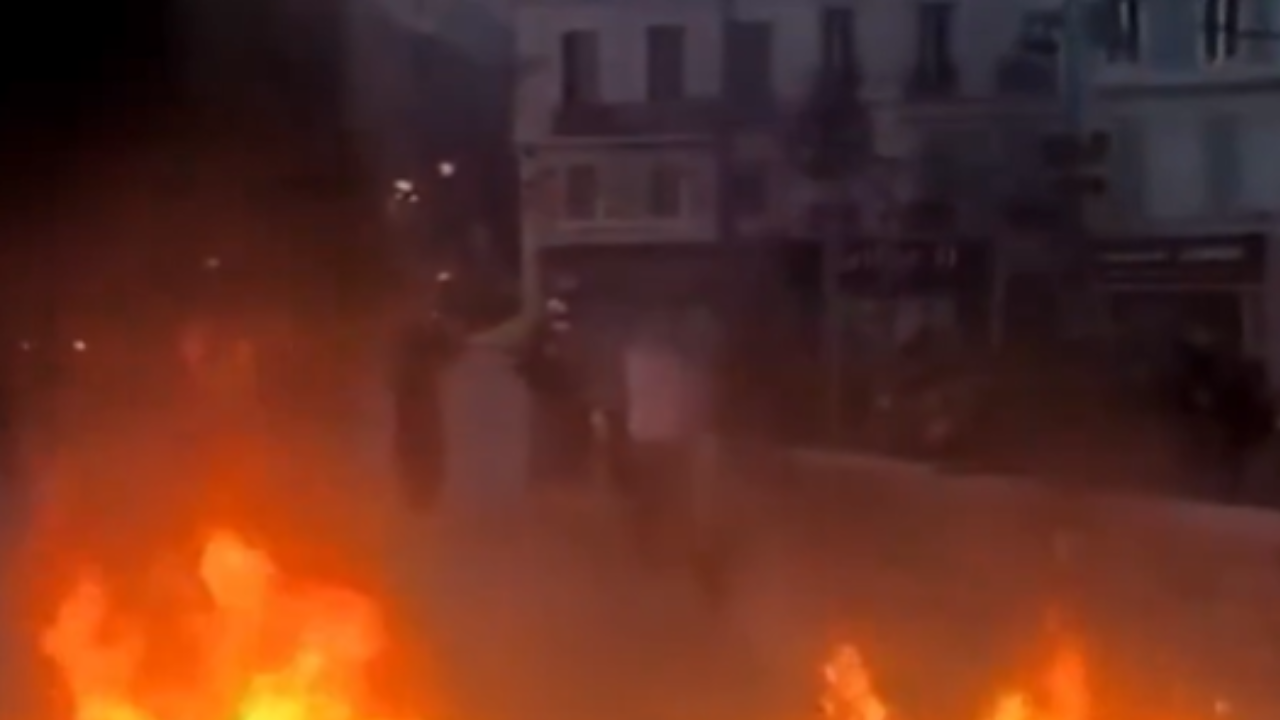
Smoke smells the same in every language.
It carries the acrid bite of melted rubber, the sour tang of wet ash, and the sharp metallic sting of tear gas clinging to the back of your throat long after the sirens fade. If you have ever stood on a wet cobblestone street at two in the morning while a storefront window shatters three blocks away, you know that chaos is never an abstraction. It is not a talking point. It is a heavy, vibrating pressure in your chest that makes you check the locks on your doors twice and wonder how fragile the rules of polite society really are.
That visceral, primal fear is the exact nerve the White House tried to strike when it pointed a finger across the Atlantic, looked at the burning barricades of France, and asked American voters a loaded question.
This is the future you want?
On the surface, the political theater was simple. Ahead of a high-stakes midterm election, administration officials seized upon footage of violent protests in France—streets choked with smoke, riot police clashing with demonstrators, luxury shops looted—and weaponized those images against the Democratic Party. The message was blunt, engineered for the rapid-fire scroll of social media and the boiling outrage of cable news. Vote for our opponents, the narrative warned, and the cobblestone chaos of Paris will arrive on your suburban cul-de-sac.
It is an old trick. Politicians have been importing foreign nightmares to win domestic arguments since the days of the pamphleteers.
Yet, when you strip away the campaign slogans and look closely at what was actually happening on the ground in France versus what was being argued in Washington, a startling disconnect emerges. To understand why this rhetorical sleight of hand works so well—and why it obscures the real issues facing both nations—we have to step out of the briefing room and look at the mechanics of fear, the truth about the French unrest, and the quiet vulnerability of the people watching from their living rooms.
The Architecture of a Transatlantic Scare
Consider a hypothetical voter named Arthur.
Let us place Arthur in a modest living room in Ohio, forty miles outside Columbus. It is Tuesday evening. He has worked ten hours managing logistics for a mid-sized distribution warehouse, his knees ache from concrete floors, and his grocery bill has climbed thirty percent over the past two years. He turns on the television while eating dinner. On the screen, a clip plays on a loop. A car is overturned on a wide European boulevard, flames licking at the night sky. Seconds later, the chyron at the bottom of the screen pivots seamlessly to American domestic policy, linking the mayhem in Paris to the tax proposals and energy policies of Washington Democrats.
Arthur does not have three hours to cross-reference European fiscal policy. He has twenty minutes before he falls asleep in his armchair.
What Arthur feels in that moment is not a nuanced appreciation for comparative geopolitics. He feels a sudden, cold tightening in his stomach. He thinks about his daughter’s college tuition, the rising cost of diesel, and the creeping sensation that the institutions meant to keep order are losing their grip. When a powerful voice from the White House tells him that the fire on his screen is the direct result of a specific political ideology, the connection feels intuitive.
Fear.
It bypasses the analytical brain entirely.
In psychology, this is known as the availability heuristic—our tendency to judge the likelihood of an event based on how easily vivid examples come to mind. When you flood a voter’s field of vision with burning cars, the brain does not ask for a footnote explaining the French pension system or the history of European fuel taxes. It simply registers danger and looks for someone to blame.
The White House communications team understood this instinct intimately. By framing the French riots as a cautionary tale about "left-wing policies," they were not offering an economic analysis. They were holding up a funhouse mirror, distorting a complex European crisis into a simple domestic warning.
What Was Actually Burning in France
To see where the political spin breaks down, you have to look at the spark that actually lit the fuse in France.
The unrest that the White House cited did not begin in a vacuum, nor was it a simple referendum on American-style liberalism. Depending on which wave of French protests you examine—whether the sprawling Gilets Jaunes (Yellow Vests) movement that erupted in late 2018 or the subsequent, explosive demonstrations over retirement age hikes and policing—the roots are distinctly, stubbornly French.
Take the Yellow Vests. In November 2018, hundreds of thousands of working-class men and women put on the high-visibility fluorescent vests every French motorist is legally required to keep in their glove compartment. They did not take to the roundabouts because of a radical socialist agenda. In fact, many were protesting an eco-tax on diesel fuel—a policy championed by President Emmanuel Macron, a centrist former investment banker who had campaigned on pro-business reforms and labor market deregulation.
Look at the irony in that equation.
In the White House’s telling, the French riots were proof of what happens when progressive policies run amok. Yet, on the ground in rural France, the protesters were furious at a government they viewed as elitist, out of touch, and indifferent to the rural working class who had no choice but to drive forty miles to work every day. They were angry that taxes on fuel were rising while wealth taxes on the richest French citizens had been slashed.
Later waves of unrest carried their own unique, volatile DNA. When millions marched against raising the retirement age from 62 to 64, they were defending a post-World War II social contract that Americans—who routinely work into their late sixties with far thinner safety nets—can scarcely imagine. When riots broke out in the banlieues, the impoverished suburbs ringing major French cities, they were driven by decades of systemic segregation, high youth unemployment, and raw fury over fatal police shootings.
None of this fits neatly onto a bumper sticker in suburban America.
France has a centuries-old tradition of street protest—a political culture where the strike and the barricade are viewed not as anomalies, but as standard tools of civic negotiation. From the storming of the Bastille in 1789 to the student uprisings of May 1968, taking to the streets is woven into the republic’s muscle memory. Comparing a Saturday afternoon clash on the Champs-Élysées to the legislative debates of the U.S. Congress is like comparing a thunderstorm in the Alps to a drought in Arizona. The weather patterns simply do not share the same atmosphere.
The Invisible Stakes of the Political Echo Chamber
You might wonder why any of this matters. Politics has always been a rough-and-tumble sport, full of exaggeration, selective editing, and guilt by association. If the White House stretches the truth about Paris to score points before the midterms, isn't that just business as usual?
It is not. And the reason lies in what happens to a democracy when we replace real arguments with borrowed nightmares.
When political leaders use foreign crises as blunt instruments against domestic rivals, two quiet tragedies unfold. First, we lose the ability to diagnose our own actual problems. If every economic anxiety in Ohio is explained away by pointing to a burning trash can in Marseille, nobody has to do the hard, unglamorous work of fixing supply chains, lowering healthcare costs, or repairing crumbling bridges. Spectacle replaces substance.
Second, and far more dangerous, we begin to see our neighbors not as fellow citizens with different ideas, but as existential threats.
Think back to Arthur in his armchair. If he is told repeatedly that the people living across town—the ones with the opposite yard signs—are actively trying to import anarchy and ruin his way of life, how does he treat them at the grocery store the next morning? How does he talk to his brother-in-law at Thanksgiving?
I have spent years watching how political language curdles into real-world hostility. You see it in the subtle tightening of jaws at school board meetings, the sudden silence when a sensitive topic comes up at a neighborhood barbecue, the way people begin sorting themselves into ideological bunkers. It is a slow erosion of trust. We stop debating whether a specific tax credit works or how to fund local police departments, and we start fighting a phantom war against apocalyptic outcomes that neither side actually wants.
To be clear, voters have every right to worry about public safety, inflation, and the direction of the country. Those fears are not manufactured. When a small business owner sees crime rates tick up in their city, or when a retiree watches their savings lose purchasing power, their frustration is real and justified. Dismissing those concerns as mere paranoia is just as dishonest as exploiting them with footage from Paris.
The tragedy is that voters deserve an honest conversation about those anxieties—not a theatrical distraction.
How to Read the Smoke Signals
So, how do you navigate a media landscape designed to keep your pulse racing? When a politician holds up a crisis from halfway around the world and demands that you panic, how do you separate the signal from the noise?
It helps to think of political messaging like a magic trick. A good illusionist relies on misdirection—getting you to stare intently at their left hand while their right hand slips the coin into their pocket. Whenever a leader uses dramatic, emotional imagery from an unrelated crisis to attack an opponent, ask yourself what you are not being shown.
Look at the context behind the clip. Who is actually protesting in that video, and what specific law or event triggered their anger? More often than not, you will find that the reality on the ground is messy, localized, and completely detached from the partisan battle lines drawn in Washington.
Check the policy receipts. If an administration claims that an opponent’s platform will lead to economic collapse or civil unrest, look at the actual legislation on the table. Compare the historical track record of similar policies in the United States rather than relying on dramatic analogies from abroad.
Pay attention to your own nervous system. Notice when a headline or a speech is engineered to make you feel helpless, cornered, or furious. Authentic leadership usually invites you to think, weigh trade-offs, and engage in the slow work of problem-solving. Demagoguery, regardless of which party practices it, always demands that you react immediately out of fear.
The Morning After the Barricades
In Paris, the morning after a major protest follows a remarkably consistent ritual.
Before the sun fully clears the rooftops, fleets of municipal trucks roll down the boulevards. Workers in green jumpsuits sweep away the broken glass, scrub the graffiti off limestone facades, and haul away the charred remnants of the night before. By eight o'clock, the bakeries are open. Commuters step over wet patches on the pavement with briefcases in hand, grabbing an espresso at the counter before descending into the Metro. The city absorbs the shock, repairs the surface, and continues the complicated, endless business of governing itself.
The real story of France is not that it is collapsing into anarchy, nor is it a blueprint for American ruin. It is the story of a fierce, fractious democracy wrestling with the exact same pressures straining the rest of the developed world: an aging population, the painful transition away from fossil fuels, widening inequality, and the anger of working people who feel left behind by globalization.
Those are our problems, too. They do not carry a French passport, and they cannot be solved by pointing a finger across an ocean.
The next time a glowing screen shows you a fire burning three thousand miles away and asks if that is the future you want, look past the flames. Look at the quiet street outside your own window, the neighbors walking their dogs, and the real, unglamorous work waiting to be done right here at home.


