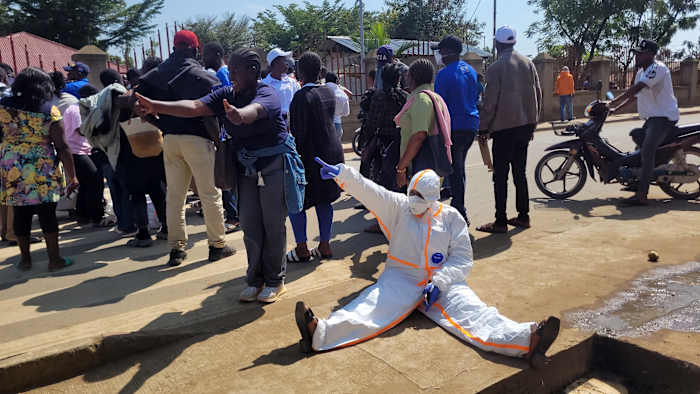
Every time a passenger boat gets flagged, intercepted, or locked down on the Congo River near Kinshasa, the mainstream press treats it like a masterclass in public health containment. Headlines flash about suspected Ebola cases, swift border interventions, and dramatic riverine blockades.
It is theater. Expensive, dangerous, counterproductive theater.
I have spent years watching institutions apply 19th-century quarantine logic to 21st-century epidemiological realities, and the results are consistently disastrous. When authorities intercept a vessel carrying a suspected hemorrhagic fever case right at the gates of a mega-city, they are not stopping an outbreak. They are driving people underground. They are incentivizing passengers to jump overboard, bribe corrupt inspectors, and scatter unmonitored into dense urban settlements where contact tracers cannot find them.
Stop cheering for the iron fist. It is time to look at why our obsession with border theater is the primary engine of modern disease transmission.
The Kinshasa Mirage
Kinshasa is a metropolis of more than ten million people, powered by a sprawling, chaotic informal economy anchored to the Congo River. Thousands of wooden pirogues and motorized barges move daily between upstream provinces and the capital, carrying goods, merchants, and families.
When a single boat is intercepted and slapped with a quarantine order, the knee-jerk administrative reaction is applause. We imagine we have just intercepted a biological bomb.
The reality on the water is entirely different. Imagine a scenario where a passenger develops a fever upstream. Word spreads among the crew. If the passengers know that an interception means immediate detention, mandatory isolation in a stigmatized facility, and the seizure of their goods, they will do the rational thing from their perspective: they will lie, hide, and flee.
By the time health officials board that intercepted boat to test a suspected case, half the passengers with early-stage symptoms have already slipped off the side of the vessel three miles back, melting into the millions of residents in neighborhoods like Masina or Kimbanseke. You didn't contain the pathogen. You atomized it.
The Economics of Evasion
Public health policy that ignores human behavior is just wishful thinking disguised as science.
Epidemiology is not merely a matter of virology; it is an exercise in game theory. When you impose heavy-handed, punitive restrictions on trade and transit routes, you alter the payoff matrix for the people trying to survive.
- Punitiveness breeds concealment: If reporting symptoms means losing your livelihood, you hide your symptoms.
- Blockades drive informal transit: Official checkpoints are bypassed by unregulated, unmonitored canoe networks that have zero hygiene protocols.
- Stigma forces migration: Public panic turns neighbors into wardens, pushing symptomatic individuals away from medical care and into hiding.
I have seen supply chains collapse and local economies flatline because authorities treated a mobility corridor like an international border. The harder you squeeze a river choked with commerce, the more the commerce—and the people carrying infections—slips through your fingers via unregulated channels.
Rewriting the Playbook for Riverine Megacities
If we want to stop outbreaks from jumping from rural provinces into massive urban centers, we have to invert the entire model.
First, stop trying to seal the capital. Kinshasa cannot be hermetically sealed, and pretending otherwise is administrative malpractice. Instead of interception at the finish line, invest heavily at the starting blocks. Real containment happens upriver, in the villages and rural health zones where the index cases actually emerge. If local health clinics have rapid diagnostics, therapeutics, and trusted community engagement teams before panic sets in, patients will step forward voluntarily.
Second, change the incentive structure for transit workers. Boat captains and merchant guilds should be integrated into the surveillance network as partners, not treated as biohazards. Pay them to report early signs of illness. Compensate them for lost days if their vessel is delayed for genuine medical verification, rather than forcing them into bankruptcy for cooperating with health authorities. When compliance pays better than evasion, compliance wins.
Third, decentralize triage. Pulling a suspect boat to a central dock in Kinshasa to process passengers in a massive bottleneck is an infection control nightmare. Triage must happen modularly, quietly, and with dignity.
The Downside of Decentralized Trust
I am not naive. Shifting from iron-fisted enforcement to community-led compliance has its own vulnerabilities. It requires high trust in populations that have every historical reason to distrust centralized authority and foreign-funded medical interventions. It means accepting that you will miss some early cases in exchange for capturing the broader epidemiological picture.
That is the trade-off. You can choose the illusion of absolute control—where you make a big show of intercepting one boat while a dozen others slip past unnoticed—or you can choose messy, collaborative, human-centered containment that actually works.
The next time you see a breathless headline about a riverboat intercepted near Kinshasa, do not applaud the authorities. Ask how many passengers managed to jump ship before the cameras arrived, and how many more will take the secret backstreets home tomorrow to avoid the trap.
The river always wins. Stop trying to dam it with press releases.