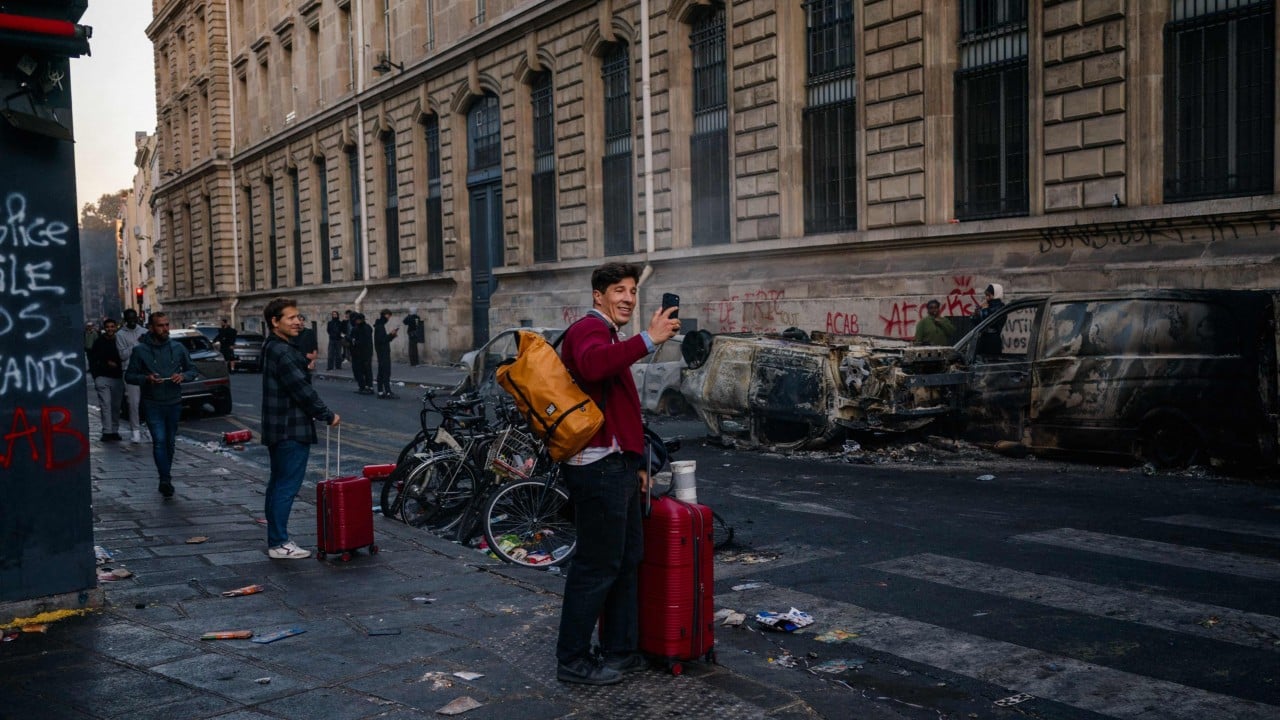
Every time sirens wail in Paris or tear gas drifts across a boulevard in Lyon, travel writers churn out the exact same story. France unrest sparks travel jitters for Southeast Asian tourists. Headlines ring alarm bells. Group chats fill with urgent warnings. Travelers hesitate.
It makes tidy copy. It is mostly lazy projection.
Watching a viral clip of a burning trash bin in a suburban square does not mean your hotel in the Marais is a war zone. Yet coverage of civil disorder routinely treats France as a single, uniform pressure cooker where every street corner is at flashpoint. When analysts claim that domestic protests automatically crush inbound demand from Bangkok, Kuala Lumpur, Singapore, Jakarta, or Manila, they confuse loud television footage with real booking behavior.
I have spent years in travel distribution, airline route planning, and destination marketing watching operators panic over political noise. I have seen tour wholesalers slash allocations, freeze ad spend, and write off entire European seasons because a strike hit rail lines or pension reforms brought thousands into the streets. Most of the time, the travelers who actually cancel were already looking for an excuse—or were booking the wrong kind of trip from the start.
Let us define the terms before going any further. Civil unrest refers to localized public demonstrations, strikes, blockades, or clashes between protesters and security forces. Destination risk is the actual probability that a specific traveler on a specific itinerary suffers physical harm, severe disruption, or financial loss. Conflating the two is how smart operators make expensive mistakes.
The Myth of the Panicked Southeast Asian Traveler
Conventional reporting treats Southeast Asian outbound travelers as a single skittish bloc that bolts at the first sign of street friction. That framing underestimates a region whose travelers navigate dense urban chaos, sudden transit shifts, and unpredictable weather every single week.
A traveler from Ho Chi Minh City or Jakarta is not shocked by crowds, rerouted buses, or political street theater. What rattles travelers—from any region—is ambiguity. If a tour guide cannot explain why a train is delayed, or if a hotel concierge shrugs when a museum closes early, anxiety spikes. When operators communicate clearly and build buffers into schedules, friction drops sharply.
More importantly, Southeast Asian demand into France is not monolithic. First-time group travelers chasing photo stops at major landmarks react very differently from repeat independent visitors, luxury shoppers, students, or families visiting relatives. Broad generalizations about "travel jitters" flatten real behavioral splits into a single melodrama.
Look at how headlines frame every French protest. Every march becomes an existential threat to tourism. Every union walkout becomes a collapse of hospitality. If that narrative were true on a literal level, France would empty out every time a labor dispute flares up. Instead, millions keep arriving, eating, shopping, and moving through neighborhoods untouched by the day's headlines.
Asking the Wrong Question About Risk
Most coverage asks: Are protests in France scaring away Southeast Asian tourists?
That is the wrong question. The sharper question is: Which segments of Southeast Asian demand are sensitive to specific types of disruption, and how long do those effects last?
When people type "Is France safe for tourists right now" or "Should I cancel my Paris trip due to protests" into search bars, they are usually reacting to recency bias. A clip filmed three miles away feels like it is happening outside your lobby. Yet distance, timing, and geography in a major city matter enormously.
Consider a thought experiment. Imagine a scenario where a large demonstration takes place on a Saturday afternoon near Place de la République in Paris. Two travelers from Singapore are in the city that same weekend. One is booked on a rigid, tight-connection schedule relying on a specific commuter line through a contested junction. The other has flexible walking plans centered on the Left Bank, museum slots booked ahead, and zero need to cross the protest corridor. Both face the same citywide news coverage. Their real-world friction is worlds apart.
That distinction rarely makes the news because nuance does not get clicks like fear.
Why Headlines Lag Behind Real Travel Mechanics
Travel decisions do not move on the same clock as breaking news alerts. Long-haul flights from hubs like Changi, Suvarnabhumi, or KLIA require planning, visa appointments, leave approvals, and fare commitments. Short-term street unrest can rattle nervous prospects in the moment, especially those considering near-term departures. Medium- and long-term travel behavior responds to deeper forces: airfare pricing, exchange rates, visa processing speeds, and word of mouth from friends who actually went.
When a story frames unrest as permanent chaos, it distorts expectations in both directions. Travelers imagine barricades everywhere. Suppliers overreact by pulling inventory or freezing campaigns.
Heavyweights in tourism research and risk management—such as the World Travel & Tourism Council and global travel risk analysts—have long pointed out that political protests tend to produce sharp, short-lived perception dips rather than permanent collapses in destination appeal, provided core infrastructure remains functional and traveler safety is protected. The gap between media spectacle and ground reality is often widest during the first seventy-two hours of a flare-up.
Still, claiming that unrest never hurts trips would be reckless. I am not arguing that protests are harmless fun. Let us be honest about the real downsides of taking a contrarian stance here.
If you shrug off every demonstration as media hype, you can get burned. A nationwide transit strike can strand travelers for hours. Blocked highways can wreck tight transfers between cities or airports. Isolated clashes can turn volatile fast if someone wanders into a flashpoint out of curiosity or bad luck. Travel insurance fine print can get messy if an advisory shifts or a carrier cancels flights. Ignoring real operational friction is just as foolish as panicking over a single photograph.
How Smart Travelers and Operators Actually Handle Friction
If you are planning a trip from Southeast Asia to France—or running travel products for that market—stop treating every protest headline like an evacuation order. Start managing concrete logistics.
- Audit your transit dependencies. Avoid razor-thin connections on days when major union actions or demonstrations are scheduled. Build slack before flights and trains.
- Separate neighborhood reality from viral clips. Check exact locations, metro closures, and municipal advisories rather than judging an entire country by one street corner.
- Lock in flexible bookings where possible. Refundable rates, adaptable itineraries, and clear communication channels turn potential headaches into minor detours.
- Watch the real bottlenecks. Visa lead times, flight seat availability, and hotel pricing often shape trip viability far more than a street march two boroughs over.
- Never play spectator near clashes. Even peaceful protests can shift quickly. Keep moving, follow local instructions, and leave crowd control to authorities.
Operators who serve Southeast Asian travelers earn real loyalty not by pretending unrest never happens, nor by fanning panic for engagement. They earn it by giving straight facts, honest contingencies, and calm execution when plans bend.
Stop letting angry streets dictate lazy narratives about an entire region's travelers. Check the route map, pack some patience, and book smart.