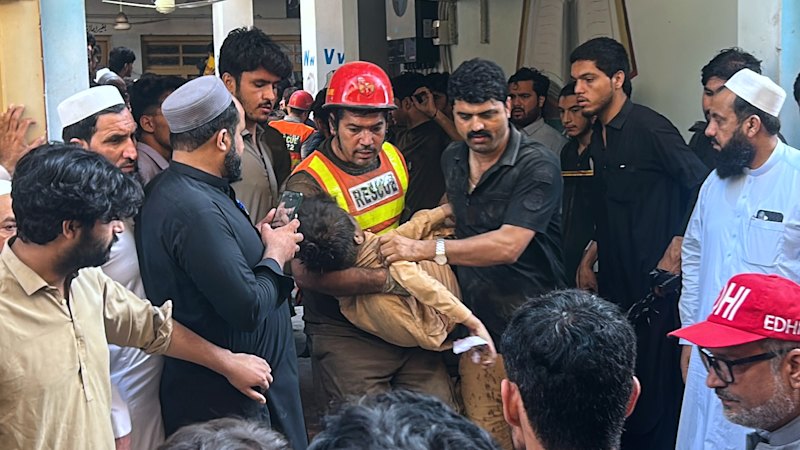
Dozens of children and a teacher died when a school roof collapse in Pakistan struck a private classroom building in Peshawar on October 15, 2026, turning a routine morning lesson into a cascading structural failure that crushed students beneath two floors of debris. Preliminary reporting and official statements put the initial death toll around 28 students and a teacher, with subsequent tallies rising into the low-to-mid 30s and dozens more injured as rescue crews and neighbors dug through the rubble.
Tragedy struck again, and once more the warning signs had been there.
When a roof caves in on children sitting at desks, standard wire reports treat the disaster as a sudden shock. After decades covering building failures, regulatory blind spots, and post-disaster inquiries across South Asia, I can tell you it almost never starts on the day the concrete gives way. It starts months or years earlier with vertical load creep, substandard materials, uninspected extensions, and a market that rewards cheap square footage over structural margin.
Anatomy of a Progressive Collapse
Concrete slabs and brick masonry do not fail at random. They fail when dead weight and live load exceed what aging columns, under-reinforced beams, and poorly cured concrete can carry.
In the Peshawar collapse at the Al-Khair Education Centre in the Afridi Abad area, police and rescue officials pointed to a weak underlying structure carrying excess weight on top, with an upper roof giving way onto the floor below and bringing down two storeys onto students in their classrooms. Picture a progressive collapse like dominoes stacked vertically rather than in a row. Once a primary support member or overloaded roof deck loses capacity, the load redistributes to neighboring elements that were never engineered to take it. One failure triggers the next until the stack pancakes.
When a light-frame or lightly reinforced roof deck drops onto a lower floor already straining under classroom occupancy, the impact load multiplies the static weight in a fraction of a second.
Engineers call this dynamic amplification. A slab that barely holds a steady load can snap under the sudden kinetic shock of falling masonry and timber from above. By the time neighbors and emergency responders arrive with spades and bare hands, the survival space inside a collapsed classroom often shrinks to narrow voids along walls or beneath desks.
To understand how a concept like dead load creep works in everyday terms, consider a hypothetical example. Suppose a two-room single-storey structure was built with thin masonry walls and minimal steel reinforcement, designed only to carry a basic roof covering. Years later, an owner adds a heavier roof slab or extra masonry construction on top to expand capacity without reinforcing the footings or columns below. Nothing falls on day one. The building sits there looking functional until moisture, thermal expansion, concrete fatigue, or a packed classroom pushes stress past the breaking point.
The Economics Behind Substandard Construction
Why do school operators and builders take risks that invite catastrophic failure? Follow the money, not the press releases.
Across Pakistan, rapid urban growth and intense demand for affordable education have pushed thousands of private schools and tuition centers into dense neighborhoods. Low-cost private schools fill a real gap where families seek English-medium instruction or neighborhood access at modest monthly fees. Yet thin profit margins create fierce pressure to keep capital costs down at every stage of construction.
When steel rebar, cement mixes, or mortar ratios are cut to trim expenses, the structural safety factor shrinks quietly. You cannot see under-cured concrete or undersized reinforcement bars simply by walking past a freshly painted facade. A building can look neat from the street while carrying hidden weaknesses inside its columns and roof slabs.
| Failure Factor | What Happens on Site | Why It Goes Unchecked |
|---|---|---|
| Excess Top Weight | Extra masonry or heavier roofing is added over an existing structure. | Incremental additions happen piece by piece without a new structural load check. |
| Substandard Materials | Lower-grade cement, weak mixes, or skimped reinforcement reduce strength. | Cost savings are immediate; structural weakness stays hidden until failure. |
| Residential Conversion | Houses or half-finished buildings are repurposed as schools or tutoring centers. | High demand for school space outpaces registration and safety vetting. |
| Deferred Repairs | Cracks, dampness, or sagging beams are ignored while classes continue. | Closing classrooms for repairs cuts revenue and disrupts families. |
That economic reality also explains why tragedies keep recurring in adjacent corners of the education sector. Earlier in 2026, a roof collapse at a tutoring center in Lahore killed 14 children, with preliminary accounts indicating the facility was unregistered and operating inside a privately owned residential building. Different city, different month, same structural vulnerability.
Why Safety Audits Fail Between Disasters
Every major collapse produces a familiar sequence of announcements. Officials express sorrow, order emergency medical care, promise inquiries, and call for safety inspections across schools.
Following the October 2026 Peshawar tragedy, authorities ordered structural safety checks and inquiries, with a subsequent review blaming the owner over substandard construction materials while pointing to negligence by government departments. Yet accountability reports frequently stop short of naming specific officials facing disciplinary action or giving clear status updates on promised province-wide inspections.
Paper compliance is not structural safety; a stamp on a file does not hold up a concrete slab.
In my experience covering municipal enforcement after disasters, three structural bottlenecks repeatedly stall post-tragedy audits:
- Fragmented jurisdiction: Responsibility for zoning, building permits, school registration, and routine safety checks often sits across separate agencies that rarely share live data.
- Severe inspection capacity: Thousands of schools, annexes, and tuition rooms operate across fast-growing cities, leaving small inspection teams overwhelmed once the initial media spotlight fades.
- Closure dilemmas: Ordering an unsafe school shut sounds straightforward on paper, until officials confront the lack of immediate alternative classrooms for hundreds of displaced children.
There is also a genuine gray area that tidy policy slogans ignore. Aggressive crackdowns that shutter every questionable building overnight without offering low-cost relocation or financing support can drive operators further underground or leave children out of school altogether. Real reform requires pairing strict enforcement with practical pathways to upgrade buildings safely.
What Real Prevention Demands
A counter-argument often heard after a collapse is that building codes already exist on paper, so the problem is simply bad actors breaking the law. That is half true at best. Codes written for ideal conditions mean very little if local builders lack affordable structural engineering guidance, if material quality goes unverified, or if routine maintenance warnings from families and neighbors are brushed aside.
Families near the Peshawar site reported prior concerns about structural risks before the roof gave way. When ordinary residents spot cracks, sagging ceilings, or heavy additions going up over classrooms, their warnings deserve rapid engineering triage rather than bureaucratic inertia.
Preventing the next school roof collapse in Pakistan does not require complex theories. It requires mandatory structural load assessments for any multi-storey school or building carrying added roof weight, publicly tracked inspection registries that publish pass, repair, or closure statuses rather than vague pledges, and targeted retrofit grants or low-interest loans so owners can reinforce weak structures instead of gambling on another school term.
Until authorities publish verifiable inspection completion rates and enforce structural sign-offs before a single extra brick is laid above a classroom, every child sitting under an unverified roof remains one weak beam away from disaster.