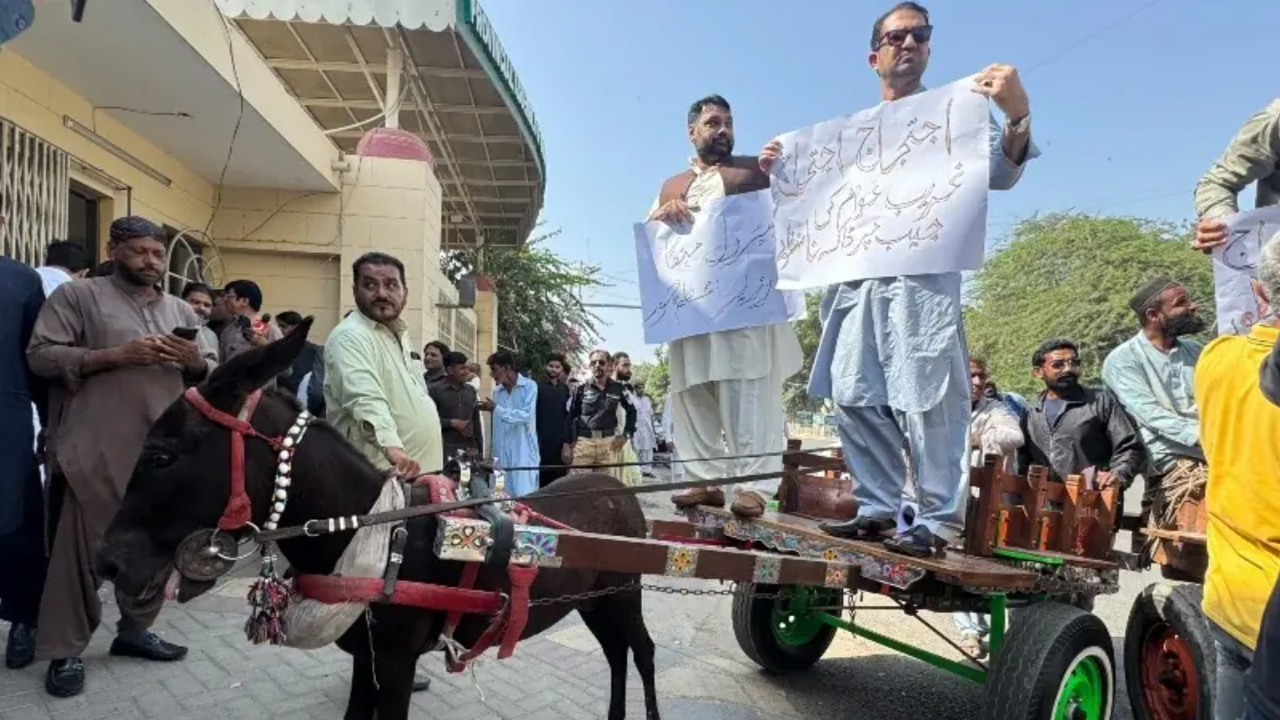
When petroleum costs climb to levels that break ordinary household budgets, politicians usually stick to issuing stern statements or holding indoor press conferences. But recently, lawmakers from the Pakistan Tehreek-e-Insaf (PTI) party decided on a different visual entirely. They rode straight to the Sindh Assembly riding donkey carts.
It wasn't just a political stunt meant to grab headlines. It was a blunt message directed at a federal administration struggling to manage a brutal cost-of-living crisis. With petrol touching Rs 390.79 per litre and high-speed diesel reaching Rs 424.92 per litre, driving standard vehicles felt out of touch to the opposition members staging the protest.
The Reality Behind the Cart Ride
You have to look at the numbers to understand why a donkey cart resonated so deeply with the public. Following the latest revisions, heavy government taxes and duties accounted for a massive chunk of fuel costs—levying roughly Rs 114 per litre on petrol and about Rs 100 per litre on diesel.
For everyday Pakistanis, these aren't abstract economic figures. When fuel prices spike, the cost of everything else follows immediately. Public transport fares jump, delivery trucks charge more to move goods, and basic food items become expensive to harvest and transport.
PTI lawmakers, led by figures like MPA Sajjad Ali, used the cart ride to highlight how out of reach standard mobility has become for wage earners. Pulling up to the assembly gates on wooden carts with placards in hand was an intentional contradiction: elected officials temporarily adopting the transport of last resort to protest policies they argued were impoverishing the common citizen.
Government Response and Wider Austerity
The protest coincided with a broader scramble by federal authorities to contain public anger. Alongside shifting fuel prices, the government brought back strict austerity measures. Markets were ordered to shut down early by 9:00 PM, and fuel allocations for official government vehicles were slashed by 50 percent for a three-month trial.
While officials defended these steps as necessary adjustments to global market volatility and import pressures, critics argued the burdens fell disproportionately on low-income workers rather than state machinery. Prime Minister Shehbaz Sharif's administration also floated relief packages aimed at older motorcycles, auto-rickshaws, and small 800cc vehicles, trying to cushion the blow for daily commuters. Yet, for many households, targeted relief schemes have felt too small and too late against systemic inflation.
Why Symbolic Protests Still Matter
Skeptics often dismiss political theatrics like riding animals to parliament buildings as empty noise. But symbolic protests capture public frustration in a way that dry parliamentary debates never do. When fuel prices hover near PKR 400, ordinary people don't want complex macroeconomic explanations; they want relief at the pump.
Until structural economic reforms take hold and ease energy import vulnerabilities, stunts like the Sindh Assembly donkey cart ride will remain a stark reminder of the financial pressures squeezing ordinary families.
PTI Lawmakers Ride Donkey Carts to Sindh Assembly Over Fuel Prices
This video provides footage and live reporting of the PTI lawmakers arriving at the Sindh Assembly on donkey carts to protest soaring fuel prices.