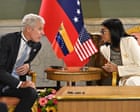
Every mainstream pundit and editorial board is currently having a collective meltdown over the White House energy arrangement in Caracas, whining about coercion, sovereignty, and nineteenth-century imperialism. They call it gunpoint diplomacy. They clutch their pearls over interim leaders cutting deals under duress. They act as if international relations used to be a charming tea party governed by international law and mutual respect.
They are completely, fundamentally wrong.
The lazy consensus dominating the news cycle is that Washington broke a functioning, rules-based global order to seize sixty-five billion barrels of crude. That narrative misses the entire reality of how global energy markets actually operate. The mistake isn't that a superpower is leveraging its hard power to secure resources; the mistake is pretending that energy hasn't always flowed down the barrel of a geopolitical gun.
Let us dispense with the fairy tales immediately.
The Sovereignty Myth That Keeps Failing
For decades, the standard diplomatic script insisted that sovereign nations have absolute ownership over their natural resources, regardless of how thoroughly corrupt local regimes trash the infrastructure. Look at what happened in Venezuela under Chavismo. The state-run giant PDVSA was converted into a personal piggy bank for a corrupt ruling class, turning the country with the largest proven oil reserves on earth into a humanitarian wasteland.
When analysts scream about violations of the Venezuelan constitution, they are treating a collapsed narco-state like it is Switzerland. Imagine a scenario where a local management team drives a multi-trillion-dollar corporation into total bankruptcy, defaults on every debt, starves its workforce, and points loaded weapons at anyone who objects. In the corporate world, creditors oust the board, take over the assets, and install professional operators. That is not a violation of law; that is basic receivership.
Energy security does not care about your legalistic feelings. When Energy Secretary Chris Wright flies to Caracas to defend an arrangement giving US oversight to production lines, the critics foam at the mouth about deals struck with unelected figures. They ignore the alternative: leaving sixty-five billion barrels of heavy crude completely offline or permanently mortgaged to foreign adversaries like Beijing and Moscow.
The choice was never between pristine democratic self-determination and brutal American coercion. The choice was between chaotic, sanctioned stagnation and hard-nosed commercial extraction managed by a superpower that can actually fix the broken pipelines.
Commerce Replaces Conflict By Force
The conventional critique claims this arrangement is unprecedented banditry. History says otherwise. Pax Americana has always relied on hard anchors to keep global trade moving. From the British Royal Navy securing shipping lanes in the nineteenth century to modern security umbrellas over the Strait of Hormuz, energy has never been bought and sold in a frictionless free market. It moves because a dominant military power guarantees that it moves.
When the White House talks about replacing conflict with commerce, the weak-kneed observers scoff. They call it hypocrisy. But look at the mechanics. Pumping billions of dollars of private capital into derelict Venezuelan oilfields does more to stabilize the northern coast of South America than a decade of empty UN resolutions and toothless sanctions ever did.
The domestic political pressure driving this inside the United States is transparent. Lowering global crude prices ahead of midterm elections requires immediate supply injections that only heavy-handed state intervention can unlock. Pundits can moralize all they want about the optics of dealing with compromised local tycoons, but moralizing does not heat homes or power industrial grids. Pragmatism does.
Why The Critics Are Terrified Of Results
The loudest opposition to this arrangement is not coming from human rights advocates who care about ordinary citizens. It is coming from two distinct camps who stand to lose everything:
- The domestic political opposition in Caracas who just realized their American benefactors are cutting direct business deals rather than staging a romantic, Hollywood-style democratic revolution for them.
- Global competitors in Beijing and Moscow who spent decades locking up Latin American reserves through predatory loans, only to watch a decisive show of American muscle clear them out of the western hemisphere in a single afternoon.
When you look at the mechanics of the deal—securing a twenty percent slice at production cost with majority board oversight—you are looking at a masterclass in strategic resource acquisition. It is raw, it is unapologetic, and it completely bypasses the useless multilateral bureaucracy that paralyzes Western foreign policy.
Stop treating international trade like a Model UN debate. Power precedes law, and energy flows to the entities capable of extracting it safely and efficiently. Venezuela is open for business because Washington forced the door off its hinges. Get used to it.