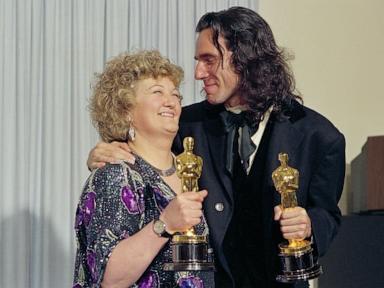
Hollywood obituaries follow a tedious, predictable script. When a titan passes, the machinery of mainstream media rushes to distill a lifetime of sweat, rejection, and artistic brilliance into a single piece of gold-plated metal. The recent coverage surrounding Brenda Fricker is a textbook example of this intellectual laziness. "First Irish actress to win an Oscar." That is the headline you see everywhere. It is a reductive, flat-earth approach to cultural reporting that completely misunderstands the mechanics of a real acting career.
Reducing Brenda Fricker to a 1990 Academy Award for My Left Foot does not honor her. It insults her. It frames her entire existence through the lens of American validation, as if her decades of brilliant, grueling work in theatre, British television, and independent cinema were merely a prelude to a single night at the Dorothy Chandler Pavilion.
The industry consensus insists that the Oscar is the pinnacle of an actor's life. That consensus is wrong. For character actors of Fricker's caliber, an Academy Award is often an anomaly, an accidental collision between a corporate marketing campaign and a performance too undeniable to ignore. The real legacy is found in the dirt, the grind, and the refusal to be consumed by the Hollywood machine.
The Fraud of the Definitive Performance
Every major outlet points to her portrayal of Mrs. Brown in My Left Foot as her definitive work. This is the first lie of mainstream film criticism. It is easy to point to a trophy-winning role and declare it the peak. It requires zero effort.
In reality, the peak of an actor's craft is found in their ability to sustain a career across decades without the benefit of vanity projects or leading-role privileges. Fricker was a master of the invisible art. Look at her work as Megan Roach in the BBC medical drama Casualty. For years, she anchored a weekly television show with a grounded, unglamorous realism that taught an entire generation of British and Irish viewers what authentic acting looked like.
Television work like Casualty or her deeply unsettling performance in the 1991 miniseries Brides of Christ requires a level of emotional stamina that a two-hour feature film simply cannot demand. In a film, you have a closed narrative arc. You prepare for a single burst of production. In long-running television, you must maintain the psychological integrity of a character through changing writers, shifting directors, and years of broadcast schedules. To rank a single film role above that sustained mastery is a fundamental misunderstanding of the medium.
Hollywood Does Not Understand Irish Art
The obsession with the Oscar win betrays a deeper colonial hangover in arts journalism. The narrative implies that Irish art only achieves true validity when it is stamped with approval by the American academy.
Let us examine the numbers. The Academy of Motion Picture Arts and Sciences is a private club dominated by West Coast industry professionals. Its voting habits are notoriously swayed by multi-million-dollar publicity campaigns, personal favors, and historical biases. When Fricker won in 1990, she did so because her performance broke through the noise of American studio blockbusters. But the win did not change the structural reality of how Hollywood treats international character actors.
After the win, Hollywood did what it always does with older, non-traditional women: it tried to turn her into a caricature. They put her in Home Alone 2: Lost in New York as the Central Park Pigeon Lady. While that role holds nostalgic value for millions, it represents the exact limitation of the Hollywood imagination. They took an actress capable of conveying immense, unspoken grief and reduced her to a seasonal plot device.
The real work—the dangerous, sharp, uncompromising work—continued back in Europe. Film critics who ignore her performances in The Field or her devastating work in Albert Nobbs are choosing to look at a postcard instead of the actual geography.
The Myth of the Oscar Bump
There is a corporate myth that an Academy Award secures an actor's financial and creative freedom. I have tracked the trajectories of dozens of character actors who stepped onto that stage, took the trophy, and walked right back into the same brutal audition rooms they thought they had left behind.
An Oscar for a character actress over forty is not a golden ticket; it is often a gilded cage. Studios do not suddenly start writing complex, multi-dimensional lead roles for middle-aged women because they won a supporting trophy. Instead, the industry demands that the actor maintain a certain prestige while refusing to offer the financial compensation or creative control that should accompany it.
Fricker herself was brutally honest about this reality. She openly admitted that the Oscar did not bring a magical influx of wealth or flawless scripts. It brought pressure. It brought expectation. It brought an army of superficial commentators who only wanted to talk about one night in March 1990. The true triumph of her career is not that she won the award, but that she survived the aftermath of winning it without losing her artistic identity.
Dismantling the PAA Narrative
When people search for information on legendary actors, the "People Also Ask" sections reflect the superficiality of modern celebrity culture. The questions are always the same:
- How many Oscars did she win? One. And it is the least interesting thing about her filmography.
- What was her net worth? A vulgar question designed to measure artistic value by capitalist metrics.
- Why did she stop acting? Because she refused to participate in a culture that treats aging women as disposable commodities.
Let us answer the premise of these questions honestly. If you measure an actor's worth by their trophy cabinet or their bank account, you are completely illiterate in the language of cinema. The metric that matters is influence.
Ask any working actor in Dublin, London, or New York about Brenda Fricker, and they will not talk about the red carpet. They will talk about her economy of movement. They will talk about her ability to command a scene while sitting perfectly still, letting the emotion register entirely in the set of her jaw or the tone of her voice. They will talk about her refusal to overact, a discipline that is incredibly rare in an industry that rewards volume over depth.
Imagine a scenario where an artist spends fifty years mastering the violin, playing in every major hall across Europe, interpreting the most complex compositions known to humanity. Then, one day, they play a simple, catchy tune at a high-profile corporate gala and receive a plaque from the CEO. If the obituary focuses entirely on that plaque, the obituary has failed. That is exactly what the media is doing to Fricker.
The Danger of Nostalgia
The current wave of obituaries is driven by a cheap, unearned nostalgia. It is easy to celebrate an icon once they are gone. It costs nothing to write a glowing tribute to a pioneer when you no longer have to fund their projects, watch their difficult films, or listen to their uncomfortable truths.
Fricker was not a comforting figure. She was sharp. She was fiercely independent. She spoke out about the isolation of fame, the cruelty of the industry, and the neglect of older artists. By sanitizing her legacy into a neat, triumphant narrative of "local girl makes good in America," the press erases her radical edge. They turn a fierce, uncompromising artist into a safe, consumable monument.
Stop looking at the golden statue. Turn off the clips of the acceptance speech. If you want to understand the genius of Brenda Fricker, look at the blank spaces between her lines. Look at the way she played women who had been beaten down by life but refused to surrender their dignity. That is where the truth lies. The rest is just Hollywood marketing.