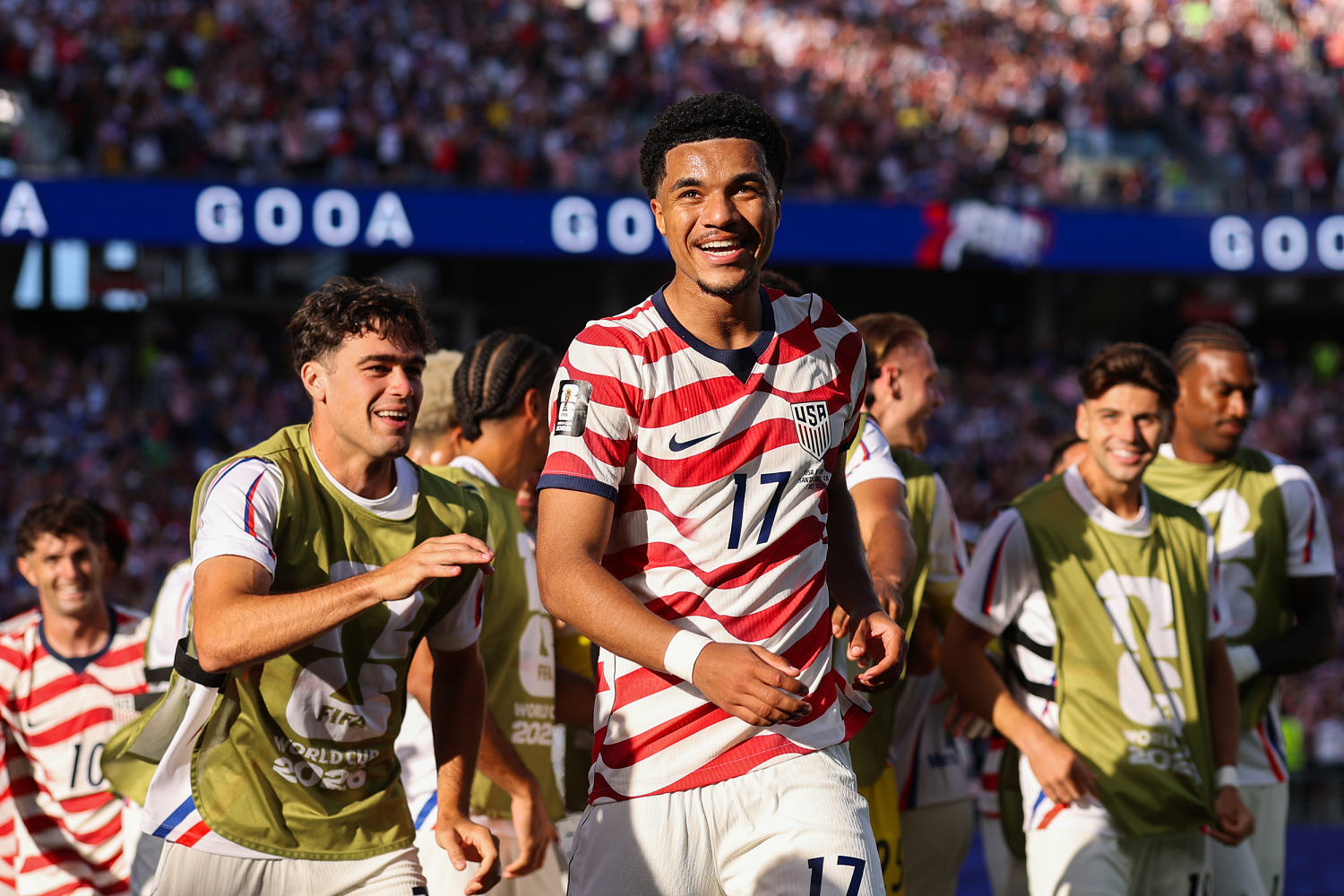
The collision of hyper-scaled sports infrastructure and modern experiential attention mechanics creates a highly predictable framework for analyzing economic and athletic returns. Underneath the sensational headlines detailing the United States Men’s National Soccer Team advancing to the Round of 16 in the 2026 FIFA World Cup and concurrent physical activation stunts executed by digital creators over Manhattan, lies a shared structural truth. Both events demonstrate how systems operate under peak stress, whether that stress is tactical fatigue on a pitch or the cost function of physical attention arbitrage in urban centers.
The Performance Dynamics of Knockout-Stage Logistics
The United States Men’s National Soccer Team achieved entry into the tournament's Round of 16 via a 2-0 victory against Bosnia and Herzegovina in San Francisco. Analyzing this progression requires isolating two core operational components: conversion efficiency under high defensive blocks and the structural impact of squad discipline.
Folarin Balogun and Malik Tillman provided the necessary mechanical solutions in the 45th and 82nd minutes respectively. The match served as a clinical case study in defensive degradation. When an opponent deploys a low block—characterized by sustained structural compactness within their defensive third—the attacking side faces diminishing marginal returns on standard lateral ball circulation. The breakthrough occurred through vertical disruption, forcing defensive re-alignments under compressed timelines.
However, the operational framework was nearly compromised by a critical breakdown in individual discipline. Folarin Balogun received a straight red card in the 63rd minute following a video assistant referee review. This expulsion introduced a severe constraint mismatch:
- Spatial Deficiency: The loss of an advanced outlet reduced the team's ability to stretch the opposing backline horizontally.
- Energy Expenditure Volatility: The remaining ten players were forced to cover an estimated 10% to 15% more ground per capita to maintain defensive coverage zones.
- Tactical Re-indexing: The strategic objective immediately shifted from expansive possession to a low-risk, mid-block containment strategy, optimizing for defensive solidity while relying exclusively on transition counters to secure the second goal.
This transition highlights a fundamental principle in tournament operations: physical endurance acts as a hard ceiling on tactical flexibility. The team's capacity to absorb this structural imbalance and find a late goal through Tillman demonstrates a high degree of system resilience.
The Cost Function of Urban Attention Arbitrage
Simultaneously, the physical stunt executed by creators in New York City highlights the evolving economics of experiential marketing. Traditional digital advertising suffers from severe ad-blindness and deteriorating return on ad spend across major algorithms. Consequently, brand capital is flowing back toward high-risk, sky-high physical spectacles designed to serve as primary content engines for digital distribution.
This architecture relies on three primary variables:
- The Arbitrage Ratio: The financial investment required to secure structural access, liability coverage, and local permits against the subsequent organic impressions generated when the content hits vertical-video networks.
- The Hazard Premium: The calculated risk of municipal or platform censorship. Physical stunts that push regulatory boundaries create a high-friction environment but yield disproportionate engagement spikes due to the perception of scarcity and danger.
- The Multiplier Effect: The rate at which secondary media outlets amplify the original stunt, shifting the cost per thousand impressions down toward zero as major morning roundups syndicate the imagery.
The mechanical execution of a high-altitude stunt over Manhattan operates identically to a short-squeeze in financial markets. The creators temporarily monopolize local visual real estate, forcing digital platforms to algorithmically distribute the resulting media due to sudden velocity surges in user engagement. The limitation of this model is its rapid decay curve; physical shock value deprecates faster than narrative-driven digital campaigns, requiring continuous escalation to achieve identical cognitive capture.
Strategic Allocation of Capital in High-Stakes Environments
The intersection of world-class athletic performance and decentralized attention generation reveals a critical takeaway for enterprise operators. Success in both arenas is governed by risk mitigation frameworks and resource optimization under volatile conditions.
The US national team faces Belgium next in Seattle for the Round of 16. The tactical constraint introduced by Balogun's red-card suspension forces an immediate roster re-alignment. The coaching staff must deploy an alternative attacking configuration that mimics Balogun's high-pressing metrics without exposing the central midfield to counter-transitions. This requires deep data profiling of substitute assets to match the physical profile of the Belgian defensive line.
Concurrently, brands looking to replicate the high-altitude engagement seen in New York must calculate the structural breakdown of physical media capital. The recommendation for asset allocation is clear: distribute capital away from static sponsorship assets and toward asymmetric, high-impact experiential activations that natively generate multi-platform media assets. The physical footprint must exist solely as a studio for digital scale.