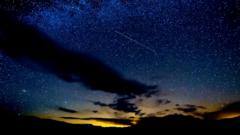
Successful observation of the Eta Aquariid meteor shower depends on the intersection of three variables: orbital mechanics, atmospheric transparency, and human physiological adaptation. While casual observers often view meteor showers as random occurrences, the Eta Aquariids are a predictable result of the Earth’s intersection with the debris field of 1P/Halley. Maximizing the detection of these high-velocity particulates requires a systematic approach to timing and spatial orientation.
The Mechanics of the 1P/Halley Debris Field
The Eta Aquariid stream consists of remnants shed by Halley’s Comet during its previous perihelion passages. These particles, primarily silicates and ices ranging from the size of a grain of sand to a small pebble, occupy a specific orbital path. As Earth passes through this stream, the relative velocity of the particles entering the atmosphere is approximately 66 kilometers per second.
This high entry velocity produces a distinct visual signature. Eta Aquariids are characterized by high luminosity and a high frequency of persistent trains—ionized gas trails that remain visible for several seconds after the initial flash. The radiant, or the point from which the meteors appear to originate, is located near the star Eta Aquarii in the constellation Aquarius.
The Latitude Constraint
The observation window is strictly governed by the position of the radiant relative to the local horizon. Because Aquarius is a southern firmament constellation, observers in the Southern Hemisphere experience a significant advantage.
- Southern Hemisphere Dynamics: The radiant rises higher in the sky, often reaching an altitude of 50 to 60 degrees before dawn. This reduces atmospheric extinction—the dimming of light by the Earth's atmosphere—allowing for a higher hourly rate of visible meteors.
- Northern Hemisphere Dynamics: For observers north of the equator, the radiant remains low on the horizon. This geometry forces meteors to travel longer paths through the dense lower atmosphere. These "earthgrazers" are fewer in number but often produce long, colorful streaks that skim the horizon.
Quantifying the Peak Zenithal Hourly Rate
The Zenithal Hourly Rate (ZHR) is the standardized metric used to calculate the number of meteors an observer would see under ideal conditions (a clear, dark sky with the radiant directly overhead). The Eta Aquariids typically peak at a ZHR of 50 to 60.
The actual observed rate ($n$) is rarely equal to the ZHR. It is modified by several factors:
- Cloud cover: Total or partial obstruction of the field of view.
- Light pollution: Measured by the Bortle Scale; higher levels of ambient light wash out fainter meteors.
- Radiant altitude: As the radiant moves away from the zenith, the visible count drops.
The peak usually occurs between May 5 and May 6. However, the stream is broad, meaning elevated activity levels are present for several days on either side of the peak. Unlike some showers with sharp, short-lived peaks, the Eta Aquariids offer a plateau of opportunity, making the surrounding mornings viable for observation if weather conditions are unfavorable during the primary peak.
The Biological Bottleneck: Dark Adaptation and Peripheral Vision
The limiting factor in meteor detection is often not the sky, but the observer’s eyes. Human scotopic vision (vision under low-light conditions) requires significant time to activate fully.
Rhodopsin Regeneration
When the eye is exposed to bright light, the photopigment rhodopsin is bleached. Recovery takes time. To achieve peak sensitivity:
- A minimum of 20 to 30 minutes of total darkness is required.
- Any exposure to white light—such as a smartphone screen or a car headlight—instantly resets this biological clock.
- Red light filters should be used for any necessary illumination, as red light has a lower impact on rhodopsin levels.
The Role of Rod Cells
The human retina is populated by cone cells (color and detail) and rod cells (light sensitivity). Rods are concentrated in the periphery of the retina. Consequently, staring directly at the radiant is a suboptimal strategy. Effective observers utilize "averted vision," looking slightly away from the radiant to allow the more sensitive rod cells to detect the faint motion of a meteor.
Site Selection and Environmental Optimization
The primary objective in site selection is the minimization of the "Light Dome" effect caused by urban centers.
Topographical Considerations
High-altitude locations are superior for two reasons. First, there is less atmosphere between the observer and the meteor, reducing scattering. Second, mountain ranges can act as physical barriers against light pollution from distant cities.
Field of View Requirements
Obstructions such as trees or buildings effectively reduce the "effective sky area." An ideal site provides an unobstructed 360-degree view, but if forced to choose, prioritize the eastern and southeastern horizons where the radiant rises.
Technical Integration: Observation Equipment
While meteor showers are fundamentally "naked-eye" events, certain technologies can enhance the data collection or experience.
- Wide-Field Imaging: Utilizing a DSLR or mirrorless camera with a fast (f/2.8 or wider) wide-angle lens allows for long-exposure captures. This compensates for the human eye's inability to "stack" light.
- Star Map Applications: Use these to locate Aquarius, then switch the device to "night mode" (red interface) to preserve dark adaptation.
- Meteor Echo Detection: For those hindered by cloud cover, FM radio signals can be used. When a meteor ionizes the atmosphere, it can momentarily reflect distant FM radio signals. Tuning to a dead frequency from a distant station and listening for "pings" is a proven method for counting meteors regardless of visibility.
Scheduling the Observation Window
The Earth’s rotation determines the timing. We are located on the "windshield" of the Earth as it moves through space during the pre-dawn hours. This is when the planet’s forward motion "sweeps up" the debris.
For the Eta Aquariids, the window opens approximately two hours before local sunrise. Earlier than this, the radiant is below the horizon. Later than this, astronomical twilight begins to brighten the sky, rapidly decreasing the signal-to-noise ratio of meteor streaks against the background sky.
The Lunar Phase Factor
The 2024-2026 cycles for the Eta Aquariids vary in their compatibility with the lunar phase. A bright moon acts as a natural source of light pollution. When the moon is in a gibbous or full phase, the effective ZHR drops by up to 80%. Successful planning requires checking the moonrise and moonset times to identify a "dark window" between the moon setting and the start of twilight.
Execution Framework for Peak Performance
To maximize detection rates, execute the following protocol:
- Logistics: Arrive at a Bortle 1-4 site 60 minutes before the radiant rises.
- Thermal Management: Metabolic rate drops during stationary observation. Use a layering system and an insulated ground pad or reclining chair to prevent heat loss, which causes shivering and degrades visual focus.
- Field of View: Lie flat on your back. This allows the maximum amount of the sky to fall onto the retina. Focus on a point approximately 45 degrees away from the radiant.
- Hydration and Glucose: Cold-weather observation increases caloric burn. Maintaining blood glucose levels supports the high metabolic demand of the retina's dark-adaptation process.
The most critical strategic error observers make is "chasing" meteors—moving their eyes toward a flash they just saw. Because meteors are transient, your eyes should remain fixed on a specific area of the sky. Trust the peripheral vision to alert you to motion, then allow the brain to process the streak's vector.
Identify the nearest dark-sky park or wilderness area with a clear southeastern horizon. Monitor the short-term cloud cover forecasts via satellite imagery (GOES or similar) starting 48 hours before the peak. If the primary peak night shows >30% cloud cover, shift the observation window to the preceding or following morning, as the data indicates a broad enough peak to yield significant results within a 72-hour margin.