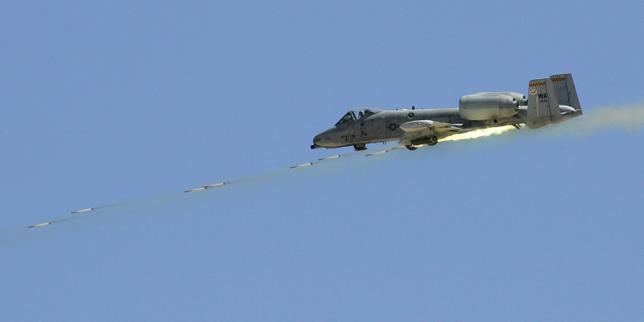
The survival of the A-10 Thunderbolt II in contemporary peer-to-peer or asymmetric conflicts depends not on its original design for Soviet tank columns, but on a fundamental shift in the cost-exchange ratio of aerial warfare. While the airframe is an aging platform, its integration into the "antidrone" mission profile represents a calculated optimization of low-altitude loitering capabilities and high-volume kinetic output against the proliferation of Unmanned Aerial Systems (UAS). The pivot from "tank killer" to "drone interceptor" is a structural response to the vacuum left by sophisticated, high-altitude stealth platforms that are over-engineered and too expensive for the attrition-based reality of drone swarms.
The Structural Mechanics of the A-10 Pivot
The transition of the A-10 into a counter-UAS (C-UAS) role is driven by three distinct operational variables: loiter persistence, weapon density, and the cost-per-intercept. Modern fifth-generation fighters operate at high speeds with limited internal carriage for the specific type of small-scale munitions required to neutralize cheap, slow-moving drones. The A-10 addresses these deficiencies through a specialized flight envelope.
- Aerodynamic Alignment: The A-10’s straight-wing design allows for stable flight at speeds as low as 120 knots. This matches the velocity profiles of many Medium-Altitude Long-Endurance (MALE) and tactical drones, which faster jets often overshoot, leading to narrow engagement windows.
- The GAU-8/A Avenging Factor: The 30mm rotary cannon provides a high-volume, low-cost solution for neutralizing Group 3 and Group 4 UAS. Where a missile intercept might cost $2 million, a burst from the GAU-8 costs a fraction of that, shifting the economic advantage back to the defender.
- Hardpoint Versatility: The 11 pylons on an A-10 permit a dense mix of electronic warfare (EW) pods, APKWS (Advanced Precision Kill Weapon System) laser-guided rockets, and Sidewinder missiles, allowing a single platform to act as a multi-layered interceptor.
Economic Distortion of Modern Air Defense
Current air defense doctrines suffer from a "negative cost-curve." When a state actor uses a multi-million dollar interceptor to down a $20,000 Shahed-style loitering munition, the defender loses the war of attrition regardless of the tactical success. The A-10's reconversion is a strategic attempt to fix this imbalance.
The GAU-8 cannon serves as a kinetic filter. By utilizing the APKWS—essentially a Hydra 70 rocket converted with a laser-guidance kit—the A-10 can engage drones at a distance of several kilometers. This creates a tiered defense system where the A-10 occupies the "middle-tier" of air defense, sitting between short-range ground systems and high-altitude, long-range interceptors.
This model relies on the concept of Kinetic Efficiency. A kinetic interceptor must be cheap enough to be expendable but precise enough to ensure a single-shot kill. The A-10’s ability to carry up to 38 APKWS rockets provides a capacity for mass engagement that a stealth fighter simply cannot replicate due to internal bay constraints.
Technical Vulnerabilities and the Contested Airspace Reality
Ignoring the limitations of the A-10 would be an analytical failure. The aircraft was designed for a low-threat environment once initial SEAD (Suppression of Enemy Air Defenses) operations were complete. In a theater like Iran or Eastern Europe, the presence of modern S-300 or S-400 systems renders the A-10 highly vulnerable.
The "antidrone" mission is therefore only viable under specific environmental conditions. To operate effectively, the A-10 must be integrated into a larger Integrated Air Defense System (IADS). Its role is not to penetrate deep into enemy territory but to serve as a mobile, airborne sentry within friendly or contested airspace where the primary threat is asymmetric drone incursions rather than high-end surface-to-air missiles (SAMs).
- Electronic Warfare Dependency: Without a dedicated jamming escort or upgraded internal EW suites, the A-10 is a "loud" target.
- The Infrared Signature: Unlike modern designs that mask heat signatures, the A-10’s dual TF34 engines are prominent targets for Man-Portable Air Defense Systems (MANPADS).
- Sensor Limitation: To kill drones, the pilot needs to see them. The A-10’s original radar is non-existent; it relies on external pods like the Sniper or LITENING. The bottleneck here is the pilot’s cognitive load and the sensor’s ability to track small, slow-moving targets against ground clutter.
The Logistic of Adaptation: Modernizing the Warthog
The US Air Force has historically attempted to retire the A-10 to free up funds for the F-35. However, the emergence of drone-heavy warfare in Ukraine and the Middle East has provided a stay of execution. The current modernization efforts focus on the "Carbon" or "Sentry" upgrades, which include the integration of the ADL (Apex Data Link).
This data link allows the A-10 to receive target coordinates from ground-based radar or AWACS (Airborne Warning and Control System) without the pilot needing to acquire the target visually. By turning the A-10 into a "missile truck" or "cannon platform" for a network-centric system, the military maximizes the utility of the airframe while mitigating its lack of onboard advanced sensors.
Scaling the Model to Western Armies
The "Warthog Example" serves as a blueprint for Western militaries that have focused too heavily on high-end, low-capacity assets. The lesson is not necessarily to buy 50-year-old planes, but to prioritize Capacity over Complexity for the C-UAS mission.
Western defense procurement usually favors the "Swiss Army Knife" approach—one plane that does everything. The A-10’s success in this new niche suggests that specialized, lower-cost "Tier 2" aircraft (like the Super Tucano or Textron Scorpion) might be more effective at managing the drone threat than a fleet of F-35s.
This creates a structural tension in defense spending. To adopt the A-10 model, an army must be willing to maintain a diversified fleet rather than a unified one. The cost of maintenance for an aging fleet is high, but it is often lower than the strategic cost of losing a high-end asset to a swarm of cheap drones.
Strategic Forecast: The Attrition-Lead Defense
The reconversion of the A-10 is a bridge to the future of autonomous air defense. Within the next decade, the role currently filled by the A-10 will likely be transitioned to "Loyal Wingman" style drones—unmanned, high-firepower platforms designed to intercept other drones.
Until those platforms are fully operational and scalable, the A-10 remains the only Western asset with the specific combination of low stall speed, high magazine capacity, and ruggedness required to survive the low-altitude drone-saturated battlefield. The tactical play for Western commanders is to stop viewing the A-10 as a ground-attack relic and start treating it as a mobile, kinetic node in a distributed air defense network.
The final evolution of the A-10 will likely involve the removal of the human pilot. Converting the remaining A-10 airframes into "Q-A-10" drones would eliminate the risk of pilot loss in high-threat environments while retaining the platform's devastating kinetic capacity. This represents the ultimate optimization of the airframe: a high-mass, low-cost interceptor for a high-volume, low-cost threat.
Commanders must prioritize the integration of A-10 units into regional air defense hubs immediately, focusing on the APKWS and GAU-8 as the primary tools for neutralizing Group 3 UAS threats before they can reach high-value targets. This requires immediate software updates to allow seamless data-sharing between ground-based drone-detection radars and the A-10’s cockpit.