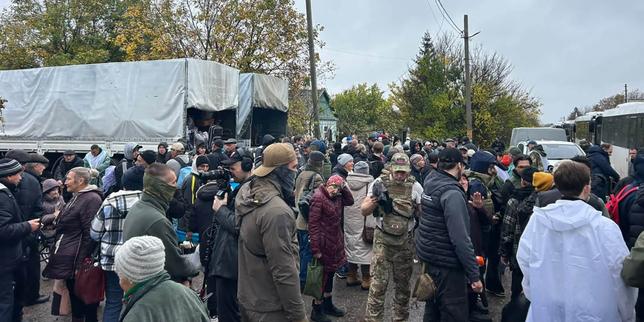
When an occupying authority declares a humanitarian mission "finished" in a devastated, frontline municipality like Oleshky, it is not issuing a logistical status report—it is executing an informational and administrative boundary-setting maneuver. Located on the Russian-occupied left bank of the Dnipro River in Ukraine's Kherson region, Oleshky sits directly opposite Ukrainian-controlled Kherson city, making it an active artillery corridor and a persistent zone of acute civilian vulnerability following the June 2023 destruction of the Kakhovka hydroelectric dam. Statements from Russian human rights commissioner Tatyana Moskalkova claiming the completion of humanitarian operations in such a theater illustrate a fundamental divergence between state-directed relief declarations and the empirical realities of sustained civilian need under military occupation.
To evaluate the validity and strategic purpose of declaring a humanitarian mission complete in an active conflict zone, analysts must separate kinetic logistics from information warfare. Standard international humanitarian law (IHL), governed by the Fourth Geneva Convention, dictates that an occupying power bears the continuous duty of ensuring food, medical supplies, and public health infrastructure for the civilian population to the fullest extent of the means available to it. A humanitarian requirement in a depopulated, flood-damaged, and shelled urban center does not reach a natural conclusion while hostilities persist within artillery range. Instead, an official declaration of completion serves three distinct operational functions: administrative closure, narrative control, and access denial.
The Three Mechanics of State-Declared Humanitarian Closure
In contested territories where independent verification is restricted, state-affiliated human rights offices operate less as independent ombudsmen and more as instruments of sovereign administration. When Moskalkova's office announces the termination of a humanitarian phase in Oleshky, the statement operates through three specific mechanisms.
The Transition from Emergency Relief to Nominal Normalization
Declaring a mission finished signals to domestic audiences and administrative bureaucracies that the acute crisis phase—triggered by catastrophic flooding and frontline displacement—has been resolved. By shifting the classification of Oleshky from an active disaster zone to a stabilized administrative unit, the occupying authority reduces its obligation to allocate extraordinary emergency logistics. In practice, this shifts the burden of survival onto residual local municipal structures and remaining civilians, even when basic utilities like electricity, potable water, and healthcare remain severely degraded.Information Gatekeeping and Verification Asymmetry
Oleshky remains largely inaccessible to independent international observers, including the International Committee of the Red Cross (ICRC) and United Nations agencies, due to active combat operations along the Dnipro riverfront and strict movement controls imposed by Russian military authorities. Without third-party auditing, the occupying state holds a monopoly on baseline metrics. Claiming a mission is complete establishes an official baseline that cannot be falsified externally without high-risk satellite analysis or fragmented reporting from local networks.Legitimizing Restricted Access
Once an authority declares that humanitarian needs have been met and the mission is concluded, any subsequent request by external or non-state actors to enter the zone can be framed as redundant or as a security violation rather than an urgent relief necessity. This creates a bureaucratic barrier that reinforces military perimeter security along the left bank of the Dnipro.
Geography and Attrition as Logistical Bottlenecks
Understanding the reality on the ground in Oleshky requires examining the physical constraints dictating supply chains along the Dnipro River. Oleshky is situated in a low-lying floodplain separated from Ukrainian-held territory by the river channel and marshlands. Because the city lies within direct range of mortars, tube artillery, and first-person-view (FPV) drones operating from the right bank, any movement of heavy transport vehicles carries high attrition risk.
This tactical environment creates a structural bottleneck for sustained aid delivery:
- Last-Mile Vulnerability: While bulk supplies can be moved to staging depots further east in the Kherson oblast—such as Skadovsk or Henichesk—moving goods the final kilometers into Oleshky requires navigating exposed road networks under constant aerial surveillance.
- Demographic Skew: Following the 2022 invasion, the 2023 Kakhovka dam breach, and continuous shelling, Oleshky's pre-war population of roughly 24,000 contracted sharply. Those who remain are disproportionately elderly, mobility-impaired, or lacking the financial resources to relocate. This demographic profile increases per-capita medical and logistical requirements while decreasing the local population's capacity for self-organization.
- Infrastructure Degradation: The 2023 flooding submerged vast sections of Oleshky, contaminating groundwater, destroying residential heating systems, and eroding roadbeds. Unlike sudden-onset natural disasters in peaceful regions, post-flood reconstruction in Oleshky has been largely paralyzed by proximity to the front line.
Under these conditions, a short-term distribution of food parcels, bottled water, or basic medical kits cannot resolve systemic deprivation. It merely provides a temporary buffer before depletion forces a renewed crisis.
Distinguishing Verified Facts from Institutional Claims
Rigorous conflict analysis requires separating verifiable physical conditions from unverified official narratives. When evaluating live-blog reporting on official Russian statements regarding Oleshky, three distinct evidentiary tiers apply.
Verified Operational Facts:
- Oleshky remains under Russian military occupation and lies directly on the active line of contact along the Dnipro River.
- The municipality suffered severe structural and environmental damage from the Kakhovka dam collapse in June 2023, compounded by ongoing artillery exchanges.
- Independent international humanitarian organizations do not have unhindered, continuous access to the town to conduct comprehensive needs assessments.
Stated Institutional Positions:
- The office of the Russian Commissioner for Human Rights asserts that targeted humanitarian operations in the area have concluded, implying that immediate relief objectives have been achieved.
- Official state channels frame these operations as successful state-led interventions addressing the needs of local residents.
Analytical Hypotheses:
- The declaration of mission completion likely reflects the conclusion of a specific, bounded logistical campaign—such as a finite distribution of winter supplies or relocation stipends—rather than the restoration of livable urban conditions.
- The announcement serves to insulate Russian administrative officials from domestic criticism regarding the living conditions of civilians in annexed territories by formally closing the file on the acute emergency.
Evaluating Humanitarian Claims in Restricted Conflict Zones
Analysts, journalists, and policy planners assessing announcements from state-controlled humanitarian bodies in active war zones must apply a standardized verification protocol rather than reproducing official press releases at face value.
- Audit the Definition of "Completion": Determine whether the announcing body defines completion by inputs delivered (e.g., tonnage of aid dispatched, number of evacuation buses run) or outcomes achieved (e.g., functional water treatment, restored hospital capacity, sustained caloric security). State actors consistently substitute input metrics for outcome metrics to declare premature success.
- Cross-Reference Against Kinetic Activity: Map the dates of claimed humanitarian operations against open-source intelligence (OSINT) data on shelling, drone strikes, and troop movements. Sustained high-intensity combat in a municipality directly contradicts claims of normalized civilian administration.
- Track Secondary Displacement Indicators: Monitor outbound civilian movement toward deeper rear areas (such as Crimea or Russia) or third-country transit routes. Continued outflow of residents following a "completed" humanitarian mission indicates persistent structural failure in basic life-support systems.
- Assess Third-Party Access: Verify whether neutral international bodies (ICRC, UN OCHA) corroborate the status of the civilian population. Where access is denied to neutral observers, treat all state-issued humanitarian completion metrics as unverified administrative claims rather than empirical ground truth.
The Strategic Limitation of State-Led Relief Narratives
No administrative decree can override the physical realities of an active artillery zone. While the Russian human rights commissioner can declare a mission finished on paper, the underlying drivers of humanitarian need in Oleshky—destroyed infrastructure, an aging residual population, and daily kinetic attrition—remain unaltered.
For analysts and newsrooms covering the war in Ukraine, the operational protocol is clear: treat declarations of humanitarian completion in frontline occupied cities as indicators of shifting administrative policy and information management, never as evidence of civilian stabilization. Reporting must anchor every official claim to the verifiable physical constraints of the battlefield and explicitly note the absence of independent verification.