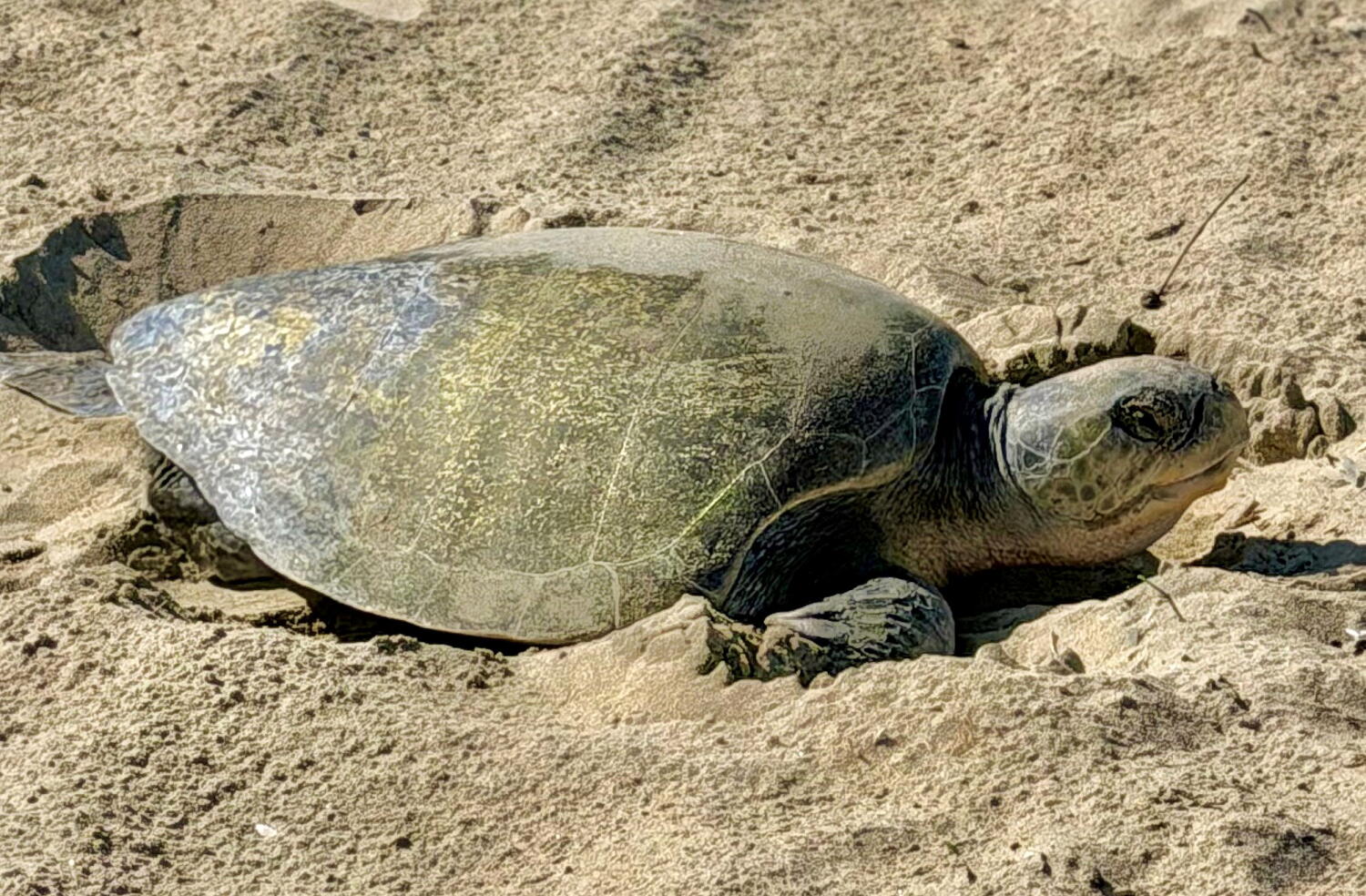
Marine biologists spend decades chasing patterns. They map thermal thresholds, track centuries-old migratory pathways, and document reproductive behavior with mathematical predictability. Nature, however, refuses to read the manual. When a lone sea turtle hauled herself ashore on a crowded Orange County beach to deposit a clutch of eggs, she shattered geographic assumptions held by West Coast conservationists for generations.
This was not a casual stroll. It was a biological distress signal written in the damp sand of Huntington Beach.
For decades, the eastern Pacific green sea turtle population inhabited a predictable range. Nesting grounds remained safely anchored thousands of miles to the south along the sun-baked coasts of Michoacán, Mexico, and the Revillagigedo Islands. California waters functioned as a seasonal feeding station, a cold-water pantry where subadults and adults fattened up on eelgrass beds near power plant outfalls or protected bays like San Diego's South Bay. The state's northern marine boundary served as an invisible thermal wall. Below fifteen degrees Celsius, reptilian metabolic processes slow to a dangerous crawl. Sea turtles do not breed in freezing water, and they certainly do not lay eggs where the sand remains too cold for embryonic incubation.
Then the ocean changed.
Marine heatwaves, colloquially dubbed "the blob" events and intensified by shifting global currents, transformed the California Current. Water temperatures off the Southern California bight ticked upward by degrees that matter profoundly to ectothermic marine life. Sand temperature dictates not only whether a sea turtle egg successfully incubates, but also the sex of the hatchling. When coastal sands warm, incubation periods shorten, and the thermal arithmetic of the eastern Pacific shifts. A female turtle swimming past Newport or Huntington Beach no longer encountered the thermal barrier that turned her ancestors back toward the tropics. She encountered an environment that felt, biochemically speaking, like home.
Local authorities and wildlife agencies scrambled when eyewitness reports surfaced. Beachgoers initially assumed a stranded animal or a prank. Instead, trained responders from organizations like the Pacific Marine Mammal Center and the California Department of Fish and Wildlife confirmed the extraordinary reality. A mature female had climbed the berm, dug a deep egg chamber with rhythmic flipper sweeps, and deposited a clutch of eggs before dragging herself back into the Pacific surf.
The immediate public reaction was celebratory, framed as a heartwarming wildlife milestone for urbanized Southern California shores.
Veteran marine ecologists view the event through a darker lens.
This nesting attempt represents ecological displacement rather than a triumphant range expansion. Sea turtles are slaves to spatial memory and evolutionary imprinting. A female returns to the general region where she hatched decades prior, guided by geomagnetic signatures embedded in her neural wiring during her initial crawl to the sea. For a green sea turtle to drop eggs on a Southern California municipal beach suggests a profound disruption in her internal navigation or an overwhelming physiological imperative to oviposit before her follicles resorb. When thermal cues override natal homing instincts, the species is telling us that historical boundaries are dissolving faster than conservation frameworks can adapt.
Consider the logistical nightmare of protecting a wild sea turtle nest on a stretch of sand flanked by multi-lane highways, midnight bonfires, and heavy municipal grooming equipment.
On traditional nesting beaches in Mexico or Costa Rica, local conservation groups establish protected sanctuaries, relocate vulnerable clutches away from storm surges, and monitor hatchling emergence with military precision. Huntington Beach lacks this infrastructure. The discovery triggered an emergency response plan involving perimeter fencing, 24-hour volunteer surveillance, and thermal monitoring of the sand column. Every degree fluctuation in the sediment threatened to cook or freeze the developing embryos. Urban light pollution posed an immediate secondary threat. When hatchlings finally emerge, their ancient instinct is to crawl toward the brightest horizon, which under natural conditions is the moonlit ocean reflection. On a Southern California beach, that horizon is often a string of Pacific Coast Highway streetlights or beachfront condominiums, leading disoriented neonates directly into traffic or storm drains.
The broader ecological picture involves cascading variables across the marine food web.
Green sea turtles are ecosystem engineers. By grazing heavily on eelgrass meadows, they maintain the health of nearshore habitats that serve as nurseries for commercially vital fish and invertebrate species. If warming waters draw breeding populations permanently into higher latitudes, the trophic dynamics of the Southern California Bight will undergo structural reorganization. Eelgrass distribution will shift, competition for benthic resources will intensify against resident marine mammals and seabirds, and interactions with commercial hook-and-line fisheries will multiply.
Fisheries entanglement remains an invisible hazard for these northern wanderers. California gillnet and trap fisheries operate in waters where sea turtles were historically rare. As individuals venture further north into temperate zones to forage or scout nesting sites, the probability of accidental bycatch spikes. A sea turtle entangled in commercial gear off the coast of Palos Verdes faces drowning or severe flipper trauma long before it ever reaches a nesting beach.
Wildlife officials and marine researchers now face a complex monitoring challenge. Was the Huntington Beach nesting event a statistical anomaly, a one-off error by a disoriented marine reptile pushed past her biological limits? Or does it mark the opening chapter of a permanent northward shift in the nesting range of eastern Pacific cheloniids?
Data collection along the coast has intensified. Aerial drone surveys scan the surf zone for the dark, rounded shapes of surfacing adults. Volunteers walk dawn patrols along Orange and San Diego county beaches looking for the distinctive, wide track marks of flippers in the dry sand. Every municipal lifeguard station from San Clemente to Malibu has received updated briefing materials on how to identify crawl patterns and report suspected nesting sites immediately.
The sand at Huntington Beach has cooled since that initial summer emergence, and the biological drama playing out beneath the surface serves as an uncompromising indicator species warning. The ocean is rewriting its own geography, and the marine life caught in the middle is improvising a survival strategy in real time.


