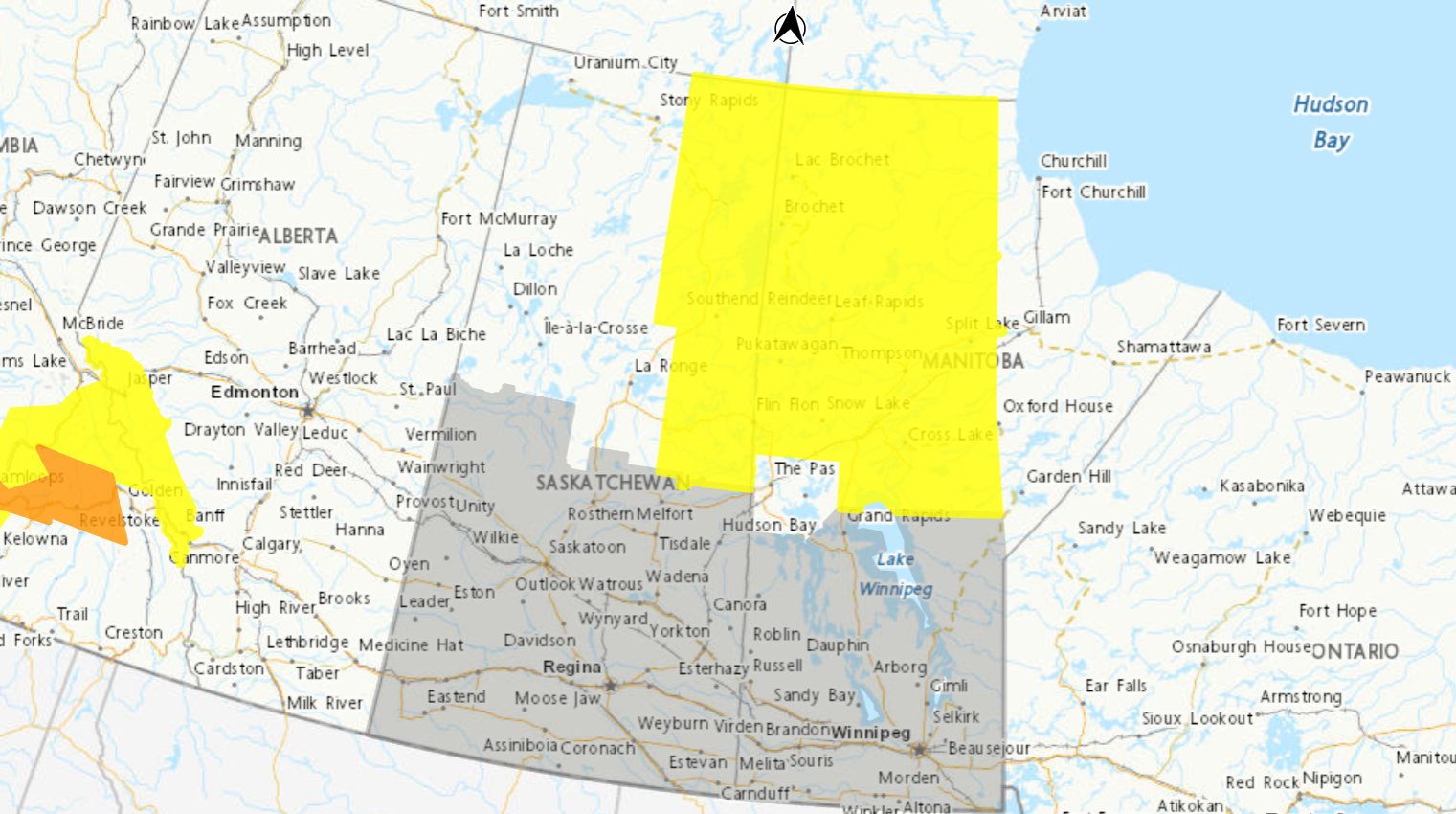
Meteorologists are panicking again. The weather anchors in Manitoba and Saskatchewan are breathlessly warning you about a "humidex of 45." They want you to lock your doors, crank the AC, and stare at their radar maps in terror.
It is a annual ritual of lazy journalism.
The media treats the humidex like an objective, scientific law handed down from the heavens. It is not. The humidex is a deeply flawed, Canadian-invented mathematical abstraction that frequently distorts actual risk. By fixating on a bloated headline number, public health officials and weather agencies are actually making people less safe. They are conditioning the public to fear a calculated index rather than understand how human thermodynamics actually function.
Let's stop treating a humidex of 45 like an unprecedented apocalypse and look at the actual physics of heat.
The Humidex is a Psychological Illusion
In 1965, Canadian meteorologists J.M. Masterton and F.A. Richardson created the humidex. It was designed to describe how hot the average person feels by combining air temperature and dew point.
Notice the word: feels.
The humidex is not a measurement of energy. It does not dictate the physical rate at which a body absorbs heat. Unlike the Wet-Bulb Globe Temperature (WBGT)—the rigorous standard used by the military, industrial hygienists, and athletic organizations—the humidex completely ignores wind speed and solar radiation.
Imagine standing in an open field in southern Manitoba with an ambient temperature of 32°C and a high dew point. The weather app tells you the humidex is 45. Now imagine a strong 35 km/h prairie wind kicks up. Your skin instantly begins evaporating sweat at a highly accelerated rate. You cool down significantly.
Yet, according to the official humidex, nothing changed. The number stays at 45.
Conversely, you could be standing in direct, unshaded sunlight with zero wind under a lower dew point, and the humidex might read a "safe" 36. In reality, the solar load is cooking your internal organs far faster than the windy day with the scary headline number. By ignoring wind and sun, the humidex gives people a false sense of security on dry, sunny days and creates unwarranted panic on overcast, humid days.
The Flawed Math of "Feels Like"
The equation used to calculate the humidex relies on an exponential curve related to vapor pressure. As the dew point rises, the index climbs aggressively.
Here is the problem: the human body does not respond to heat on an exponential mathematical curve. Human heat tolerance is governed by the sweat evaporation rate, which hits a hard physical ceiling determined by the air's moisture capacity. Once the air is saturated, a higher "feels like" number is meaningless. Your body cannot get "more wet."
When news outlets scream about a humidex of 45, they are treating a 70-year-old calculus shortcut as absolute truth. I have spent years analyzing public safety metrics during extreme weather events. The data shows that hospital admissions for heat-related illness do not track perfectly with spikes in the humidex. Instead, they track with prolonged ambient nighttime temperatures.
If the air temperature drops to 16°C at night, your house cools down, your body resets, and a high daytime humidex is manageable. But if the ambient temperature stays at 26°C all night, your core temperature never recovers. That is when people die. The humidex completely masks this vital distinction because it is focused entirely on the daytime peak headline.
The Dangerous Fallacy of Universal Comfort
The humidex assumes a standard baseline: an average adult, wearing light clothing, walking at a moderate pace, with no underlying health conditions.
This baseline is a dangerous myth.
- The Elderly: As we age, our sweat glands atrophy and our cardiovascular output decreases. An 80-year-old in Regina is in severe danger at an ambient temperature of 30°C, regardless of whether the humidex is 32 or 45.
- The Athlete: A runner training for a marathon in Winnipeg will generate massive internal metabolic heat. For them, a humidex of 38 can trigger heat stroke if the air is stagnant.
- The Laborer: A roofer working on a black asphalt shingles roof is experiencing a microclimate that is often 15°C hotter than the official airport thermometer reads.
By flattening the population into a single, arbitrary "feels like" metric, public health messaging fails everyone. It tells the vulnerable they are safe when they are not, and it tells the resilient to hide indoors when a simple modification of activity would suffice.
Stop Cranking the AC (You Are Making It Worse)
The standard advice during a prairie heat wave is simple: stay inside and run the air conditioning. This advice is short-sighted and structurally destructive.
When an entire city like Winnipeg or Saskatoon simultaneously maxes out its residential AC units, the local electrical grid groans under the load. Transformer failures follow. A sudden, uncontrolled blackout during a heat wave is infinitely more dangerous than the heat wave itself, as thousands of sealed, unventilated modern homes turn into literal greenhouses.
Furthermore, air conditioning actively prevents thermal acclimatization. The human body is remarkably adaptable. Within seven to fourteen days of exposure to higher temperatures, your body undergoes physiological shifts:
- Your blood plasma volume increases, allowing your heart to pump more blood to the skin for cooling without spiking your heart rate.
- You begin sweating earlier and at a lower core temperature.
- Your sweat becomes more dilute, preserving vital electrolytes.
When you live in a permanent 21°C artificial bubble, you completely halt this adaptive process. The moment you step outside to grab your mail, your unacclimatized cardiovascular system experiences a massive, shock-induced spike in stress.
Am I suggesting you suffer in a 35°C bedroom? No. But the absolute insistence on freezing indoor environments creates a population of biologically fragile individuals who cannot handle basic summer realities.
The Reality of Prairie Heat
Manitoba and Saskatchewan are continental climates. High heat and sudden humidity spikes from crop transpiration (the "corn sweat" phenomenon) are normal parts of the ecological cycle. They are not climate anomalies that require societal shutdowns.
The preoccupation with the humidex is a symptom of a broader culture that prefers sensationalized numbers over baseline scientific literacy. We do not need better weather alerts. We need better infrastructure and personal accountability.
How to Actually Handle Extreme Heat
Forget the weather app. Stop checking the humidex every twenty minutes. If you want to survive and thrive during a prairie summer, deploy tactics based on actual human physiology:
Track the Dew Point, Not the Humidex
The dew point is an absolute measure of moisture in the air. If the dew point is below 16°C, your sweat will evaporate efficiently, no matter how hot the air is. If the dew point crosses 20°C, evaporation slows down dramatically. That is your cue to reduce physical exertion, not the arbitrary humidex number.
Prioritize Air Movement Over Artificial Freezing
A high-velocity fan blowing directly across wet skin mimics the cooling effect of wind, dropping your skin temperature far more efficiently than sitting in stagnant, air-conditioned air. Use AC to keep your home at a reasonable 25°C to preserve grid stability and allow your body to maintain its natural heat adaptation.
Wet Your Clothes
Evaporative cooling does not care where the water comes from. If you must work outside in high humidity, douse your shirt in water. The ambient air will evaporate the water from the cotton fabric instead of forcing your body to deplete its own hydration reserves to produce sweat.
Monitor Heart Rate, Not Comfort
Your perception of comfort is easily fooled. Your heart rate is not. If you are working outside and your heart is hammering at 140 beats per minute while doing basic tasks, your core temperature is rising. Stop immediately, regardless of what the "feels like" index claims.
The media will continue to use the scariest numbers available to drive clicks and views. They will talk about 45 as if the air itself is boiling. Let them panic. Understand the physics, adapt your biology, and ignore the noise.


