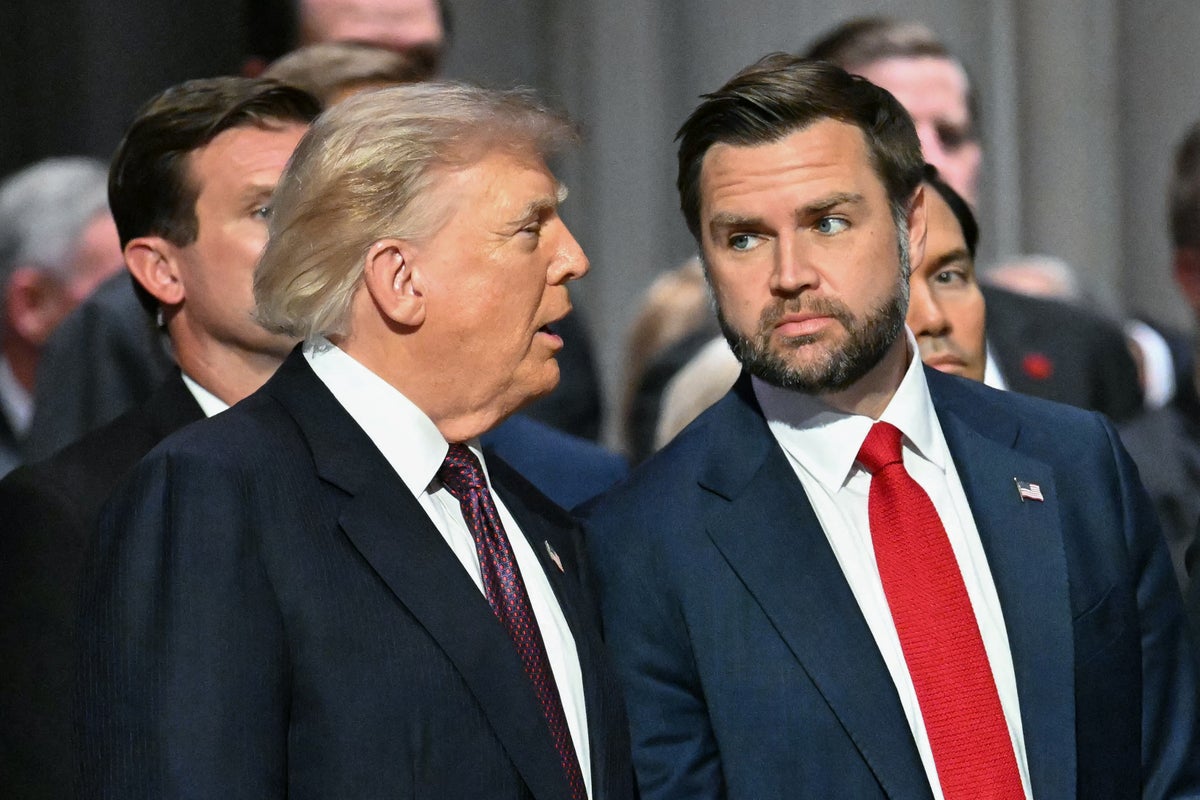
Every political commentator in Washington is currently hyperventilating over private remarks, closed-door donor briefings, and the parlor game of who inherits the keys to the kingdom. The lazy consensus in mainstream media argues that President Donald Trump anointing Vice President JD Vance behind closed doors or playing him against Secretary of State Marco Rubio is the primary narrative driving the future of the conservative movement.
They are wrong. They are looking at modern politics through an obsolete lens.
Pre-ordained successions do not work in populist movements. Treating the 2028 Republican primary like an Elizabethan royal court where a monarch passes a signet ring to a favored duke ignores every structural reality of modern political gravity.
The Fallacy of the Crown Prince
Political analysts love a clean hierarchy. They want a tidy narrative where donors, internal polling, and presidential nods dictate the next cycle. When reports surface that Trump told donors "we need to elect JD", the establishment treats it as a coronation blueprint.
This completely misunderstands how movements operate. Populism is decentralized, hyper-reactive, and fundamentally hostile to institutional gatekeeping. Megadonors like Ken Griffin backing Rubio or other factions trying to construct shadow coalitions are fighting a war from the last century. Money flows to momentum; momentum does not obey money.
Look at recent history. The establishment anointed favorites time and time again, only to watch primary voters shred those blueprints. Grassroots loyalty cannot be transferred via private Oval Office assurance. It must be earned in real-time, online, and through cultural combat.
The False Binary of Vance Versus Rubio
The media loves to frame 2028 as a cage match between Vance and Rubio. This creates a clean, digestible conflict for cable news segments. One represents the populist rust-belt realignment; the other represents traditional foreign policy hawk-dom and institutional staying power.
This binary is a ghost story.
Imagine a scenario where the geopolitical and economic landscape looks entirely unrecognizable by late 2027. Global supply chains shift, domestic inflation metrics move, and voter priorities mutate. In that environment, evaluating candidates based on their alignment to a 2024 coalition playbook is useless.
Vance occupies the populist vanguard, but his durability relies on whether economic nationalism delivers tangible wins for working-class households. Rubio commands institutional respect and foreign policy competence, but his ceiling is defined by whether the base still cares about traditional establishment guardrails. Neither man is locked into a fixed position because the terrain underneath them is constantly fracturing.
Why Endorsements Are Overrated
I have watched campaigns burn tens of millions of dollars trying to weaponize early endorsements, treating a nod from a principal like an absolute guarantee of victory. It is a fool's errand.
An endorsement is a megaphone, not a mandate. Trump knows this better than anyone—he treats the speculation as a tool to keep everyone off-balance, testing loyalty, extracting performance, and preventing any single camp from growing complacent. The idea that a single private utterance to a room full of financiers freezes the field is naive.
If a candidate cannot survive the chaotic crucible of an open primary, a crowded media environment, and decentralized digital warfare, an early seal of approval becomes an anchor rather than wind in the sails.
Stop treating 2028 like a succession plan. It is a demolition derby disguised as an election.