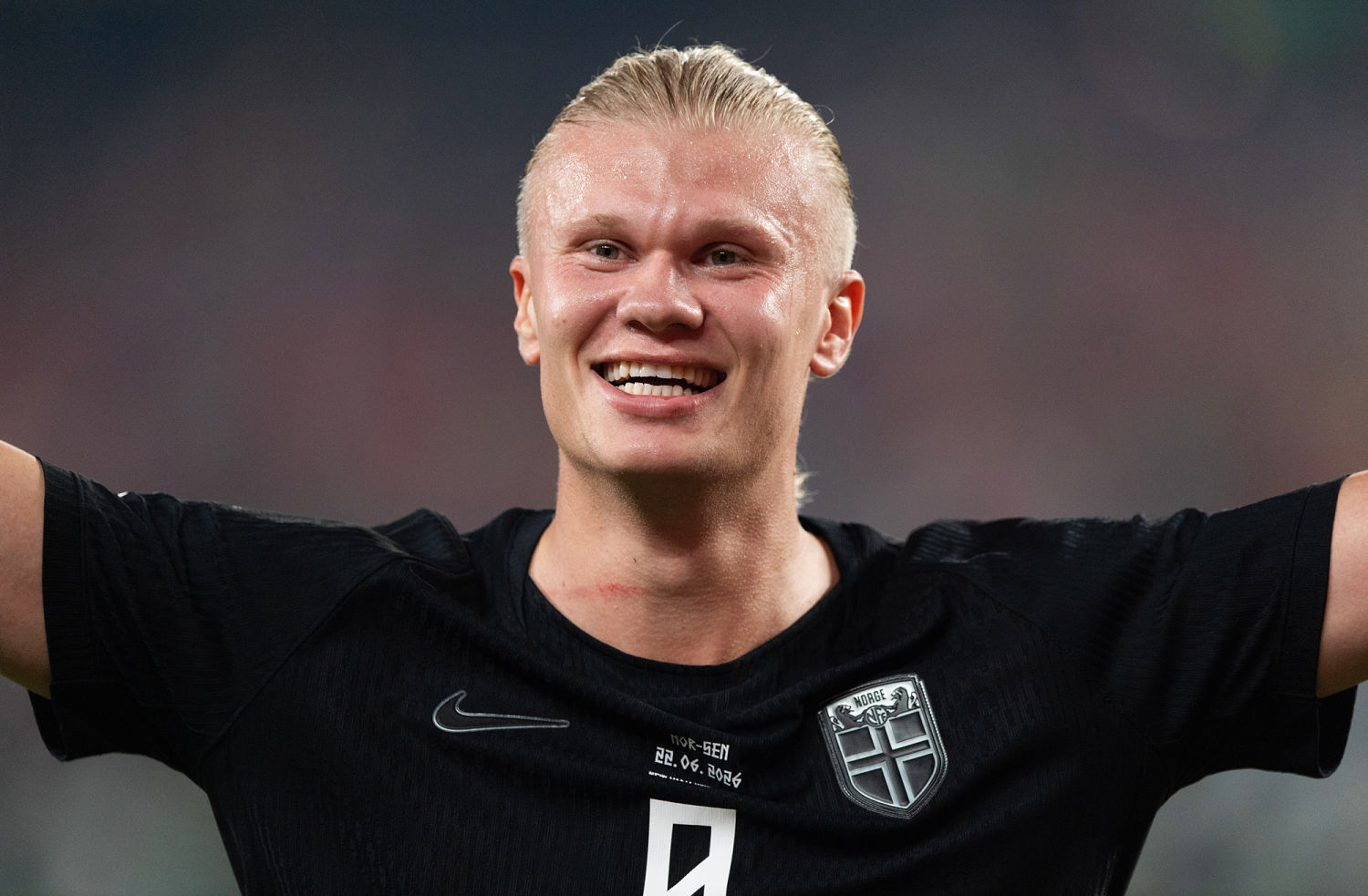
The mainstream sports press is lazy. They see a box score, they see Erling Haaland’s name next to a couple of goals, and they copy-paste the same tired narrative.
Erling Haaland powers Norway.
Haaland keeps pace in the Golden Boot race.
It is a comforting story for people who evaluate football solely through fantasy premier league points and spreadsheet metrics. It is also fundamentally wrong.
The obsession with individual goal tallies in international football masks a much harsher tactical reality. Haaland is not carrying Norway. In many ways, the structural demands of accommodating a hyper-specialized, low-touch striker are holding Norway back from becoming a cohesive international unit. The goals look great on a graphic. The actual tape tells a completely different story.
The International Tactical Tax
International football is not club football. This is the first principle that most casual observers fail to grasp.
In club football, a manager has ten months a year to drill intricate possession patterns, counter-pressing triggers, and specific spatial rotations. Pep Guardiola can build a multi-million-pound ecosystem designed exclusively to shield a striker from the buildup play, ensuring that when he does touch the ball, it is inside the penalty box.
International managers get a few weeks a year. They cannot build an elite, hyper-synchronized machine. Because of this limitation, international football inherently favors flexibility, defensive solidity, and midfielders who can adapt to chaotic, unstructured environments. Look at the teams that actually win international tournaments. They do not rely on static, low-touch focal points. They rely on fluid front lines, defensive resilience, and tactical adaptability.
When Norway takes the pitch, the entire tactical ecosystem is bent to accommodate Haaland.
Every attacking sequence is hurried to find him early. Every transition is rushed. The midfield is forced to bypass sustained possession to feed a vertical run that opposition center-backs in a deep block already anticipate.
By forcing the play through a singular focal point, Norway becomes wildly predictable. A disciplined mid-block can neutralize the entire system simply by cutting off the passing lanes from deep positions and letting Haaland stand isolated upfront.
The Manchester City Illusion
People look at Haaland’s goalscoring record in England and assume it translates linearly to the international stage. It does not.
At Manchester City, Haaland operates within a system that routinely sustains 70% possession. He can afford to have eight touches in ninety minutes because those eight touches occur in the highest-value zones on the pitch, generated by the collective gravity of five world-class creators occupying the half-spaces.
Norway does not possess that gravity. Even with Martin Ødegaard pulling the strings from midfield, the drop-off in technical security across the rest of the pitch is steep.
When you drop a low-touch, high-efficiency finisher into a team that lacks total structural dominance, you create an economic deficit on the pitch. You are playing with ten men during the buildup phase. If the midfield cannot consistently progress the ball into the final third through sustained possession, the striker becomes a luxury item that the team cannot afford.
Consider the physical reality of international tournament football. Games are tight. Spaces are constricted. Refs let more contact go. In these environments, a striker who cannot drop deep, retain possession under pressure, and bring his wingers into the play becomes a structural liability.
The Golden Boot Distraction
The media loves the Golden Boot race because individual rivalries sell clicks. It turns a complex team sport into a simplified, linear race between two or three recognizable superstars.
But chasing individual scoring titles is actively detrimental to tournament success.
When an entire national federation and media apparatus center the narrative around whether one player is keeping pace with foreign rivals, it warps the decision-making on the pitch. Wingers look for the low-probability cross to the back post instead of recycling possession. Midfielders force vertical passes through tight windows instead of probing the flanks.
Imagine a scenario where a nation boasts one of the most physically gifted athletes in the history of the sport, yet repeatedly fails to qualify for major tournaments or crashes out early because the collective tactical floor is lowered to raise one individual’s ceiling. That is not a hypothetical. That has been the reality of Norway’s golden generation for years.
The data shows that flat-track bullying lesser nations in qualification groups inflating a player's statistics does not translate to breaking down elite defensive structures in knockout football. Scoring a hat-trick against a fatigued, lower-tier nation looks spectacular on a resume, but it offers zero utility when you face a compact, elite defensive pairing that denies space behind the line.
Dismantling the Consensus
Go ahead and look at the common arguments from the defender class. They will point to the raw goals-per-game ratio. They will scream about the sheer gravity Haaland possesses, arguing that he draws defenders away to free up space for teammates.
Let's look at that argument critically. Who is actually capitalizing on this supposed space?
Norway’s secondary scorers are starved for consistent service because the attacking philosophy is completely asymmetric. When your entire tactical identity is based on feeding a singular transition monster, your wingers become track stars instead of creators. Your full-backs stop overlapping because they are terrified of the counter-attack when possession is inevitably turned over during a forced vertical pass.
True tactical gravity requires a player to move the ball, create overloads, and manipulate defensive shapes through short-passing combinations. Standing between two center-backs and waiting for a long ball does not create space; it merely fixes the defensive line in a deep block, which is exactly where modern, organized defenses want to stay.
The modern obsession with maximizing individual output has blinded people to how team dynamics function. Football is an ecosystem of interconnected dependencies, not a collection of isolated statistical achievements.
Norway will continue to struggle at the highest level of international football until they stop playing like a support act for a superstar and start playing like a balanced, pragmatic international team. The goals will keep coming against weaker opposition, the media will keep writing the same lazy headlines, and the underlying structural flaws will remain completely unaddressed. Stop looking at the golden boot standings and start watching the actual structure of the match. The truth is right there on the tape.