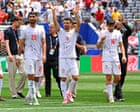
A standard security clearance form is a bloodless thing. It asks for dates of birth, passport numbers, addresses, and employment histories, reducing a human life to a series of checkboxes on a government server. But when those forms belong to the members of the Iranian national soccer team, the cold ink of bureaucracy collides head-on with decades of geopolitical deep freeze.
The Department of Homeland Security operates on a ledger of risk. For years, that ledger has dictated that visas for Iranian citizens are subject to extreme scrutiny, lengthy administrative delays, and a thick wall of diplomatic silence. Yet, behind the closed doors of Washington's policy rooms, a quiet exception was carved out. The US government quietly cleared the runway for Team Melli—the Iranian national football team—allowing them to enter the United States weeks ahead of the upcoming World Cup. Meanwhile, you can read similar events here: India Is Scabbing the Cradle: The Dangerous Illusion of the Under-19 Prodigy.
On paper, the decision is a logistical concession. The official reasoning points to standard sports diplomacy, acclimatization needs, and training schedules. But beneath the press releases lies a different story. It is a story about the terrifying, beautiful ability of a game to force a temporary ceasefire in a cold war that has outlived the childhoods of the men playing on the pitch.
Consider a 24-year-old midfielder from Tehran. For his entire life, the United States has been a silhouette of sanctions, political rhetoric, and distant tension. For an American customs officer at JFK or LAX, Iran has been a point of origin flagged for mandatory extra screening. When that player steps up to the biometric scanner, the machine doesn't care that he can bend a free kick into the top corner from thirty yards out. It sees a passport from a nation locked in a perpetual standoff with the West. To explore the bigger picture, we recommend the excellent article by Sky Sports.
The decision by Homeland Security to expedite this entry is an admission of an uncomfortable truth. Sometimes, the rigid machinery of national security must bend to accommodate the chaotic, unpredictable theater of human culture.
Sports diplomacy is not a new invention. It is an ancient reflex. In 1971, the American ping-pong team was invited to Beijing, thawing relations between the US and China before Richard Nixon ever set foot in the country. In 1998, when the United States played Iran in the World Cup in France, the Iranian players handed white roses—the symbol of peace—to their American counterparts before kickoff. They stood together for a joint team photograph, a brief, fragile image of unity that looked completely impossible from a reading of the morning's headlines.
But that was France. This is different. This time, the tournament is on American soil.
To understand why an early arrival matters so deeply, you have to look past the tactical advantages of getting over jet lag or adjusting to the humidity of an American summer. The real stakes are psychological. The moment the Iranian team lands, they enter a fishbowl. They will be surrounded by diaspora communities, media scrums, political activists, and security details. Every press conference will be a minefield. Every question will tempt a headline that has nothing to do with sport.
By granting early entry, the government didn't just give a sports team time to practice. They gave them time to breathe. They allowed the initial shockwave of their arrival to dissipate before the whistle blows.
The human element of this decision stretches far beyond the roster of twenty-six players. It reaches into the stands. For thousands of Iranian-Americans, this match represents a profound, agonizing collision of identities. Imagine an immigrant who fled the revolution decades ago, raised children in Chicago or Los Angeles, and built a life out of American brick and mortar. When Iran plays on American turf, which side of the stadium do they sit on? What flag do they wave when both anthems play?
The stadium will not just be a sports venue. It will be a pressure cooker of memory, grief, pride, and hope.
There is a distinct vulnerability in admitting that a game matters this much. It feels trivial to talk about a ball crossing a white line when the world is fractured by real conflicts, real borders, and real suffering. Security experts will tell you that a football match changes nothing. The sanctions will remain. The diplomatic channels will stay frozen. The geopolitical chess board will look exactly the same the morning after the final whistle.
They are right, of course. A match cannot rewrite a treaty.
But it does something else, something far more subversive. It forces us to look at the adversary and see a reflection. When an Iranian striker goes down with a hamstring cramp in the eighty-fifth minute, and an American defender stretches out his leg to help him recover, the grand narratives of global politics collapse into a simple act of human empathy. For ninety minutes, the abstract monsters we build out of cable news segments are replaced by real men, sweating through polyester jerseys, chasing a piece of leather across a field of grass.
The Department of Homeland Security didn't just approve a stack of travel visas. They approved a window of vulnerability. They gambled on the idea that for a few short weeks, the shared language of a global game could outwhisper the roar of political hostility.
As the tournament approaches, the training camps will fill up, the tactical diagrams will be drawn, and the security cordons will tighten around the stadiums. The paperwork is finished. The stamps are on the passports. The players are on their way.
When the match finally begins, and the stadium lights cut through the summer dusk, the flags will wave and the anthems will echo through the rafters. For ninety minutes, the world will stop to watch twenty-two men chase a ball under the watchful eyes of millions. And in that brief, suspended moment, the borders will vanish, the history will fade, and the only thing left will be the terrifying, beautiful uncertainty of the next pass.
.jpg?width=1200&auto=webp&trim=25%2C0%2C25%2C0)