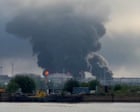
The Baltic winter does not compromise. In mid-January, the Gulf of Finland turns into a jagged sheet of grey ice, and the wind off the water carries a wet, bone-deep chill that settles into the historic stones of St. Petersburg. For decades, this city prided itself on being Russia’s window to Europe—a place of grand palaces, classical ballet, and immense, quiet wealth. Even as conflict raged thousands of miles to the south, the city remained largely insulated, wrapped in a comfortable blanket of distance.
At the Petersburg Oil Terminal on the edge of the frozen harbor, the night shift was just another exercise in defying the cold. Towering cylindrical vats held millions of gallons of fuel, the lifeblood of an empire’s export economy. Massive tankers sat at the berths, their hulls scraping against the pack ice. To the workers on the catwalks, the war in Ukraine was something that happened on television screens, a distant tragedy playing out in the mud of the Donbas or the steppes of Kherson.
Then came the hum.
It was a low, rhythmic buzzing, completely out of place among the heavy clanging of industrial machinery and the roar of the Baltic wind. It sounded like a displaced lawnmower, or a oversized, angry hornet.
Moments later, the sky tore open.
A single explosion shattered the midnight routine, sending a column of fire into the freezing air. It wasn’t a massive missile fired from a nuclear submarine or a strategic bomber. It was a fragile contraption of carbon fiber, wood, and a basic gasoline engine, guided by a satellite link. It had traveled more than 1,250 kilometers through some of the most heavily defended airspace on earth.
In that single, blinding flash, the geography of the conflict changed forever. The illusion of safety evaporated in the Baltic chill.
The Geography of Distance
To understand what happened at the St. Petersburg oil terminal, you have to understand the sheer psychological weight of distance in Russia. For centuries, the nation's vastness has been its ultimate shield. Invaders from Napoleon to Hitler found themselves swallowed by the endless horizon, their supply lines stretched to the breaking point.
When the current conflict began, that same vastness was used to comfort the Russian public. The fighting was localized. It was happening "over there," in the borderlands. If you lived in Moscow, and especially if you lived in St. Petersburg—Putin’s hometown, the cultural crown jewel—your daily life remained untouched. You could still sip espresso in trendy cafes on Nevsky Prospekt, buy imported goods through parallel import channels, and pretend the world hadn't fractured.
Ukraine changed that calculus not with multi-million-dollar Western weapons, but with domestic ingenuity born of desperation.
Consider the mathematics of a standard air defense network. A modern surface-to-air missile system is designed to detect and destroy high-fast targets: supersonic fighter jets, ballistic missiles, heavy bombers. They are massive, hot, and loud.
Now imagine trying to spot a drone that flies at the speed of a highway commuter, sits lower than the treetops, and possesses a radar cross-section no larger than a migratory goose. It slips through the gaps. It hugs the river valleys. It utilizes the terrain to mask its approach, traveling through the blind spots of multi-billion-dollar radar installations.
The flight path from the Ukrainian border to St. Petersburg is a grueling marathon. The drone had to cross hundreds of miles of Russian territory, bypassing the dense defensive rings surrounding Moscow, navigating around military airbases, and keeping just low enough to avoid detection by early-warning systems. For hours, the small craft droned on through the dark, its digital brain counting down the coordinates until the icy waters of the Gulf of Finland finally came into view.
The Invisible Workers Behind the Joystick
Far away, in an undisclosed location somewhere in Ukraine, a handful of young men and women sat in a dimly lit room, staring at glowing monitors. They don't wear traditional military uniforms covered in grease and mud. They wear hoodies and sneakers. They look like software developers or late-night gamers.
But the stakes of their digital environment are agonizingly real.
Let us look closely at a hypothetical operator—we will call her Anna. She represents a new class of warrior created by this conflict. Anna didn't spend years at a traditional military academy learning tank tactics. Two years ago, she was studying graphic design. Today, she is responsible for navigating an uncrewed aerial vehicle through an electronic warfare minefield.
As the drone flies north, the Russian military doesn't just rely on physical missiles to shoot it down. They flood the skies with invisible energy. Electronic warfare units emit powerful jamming signals designed to blind the drone’s GPS, to confuse its internal compass, to sever the tether between the craft and its human creators.
On Anna’s screen, the telemetry data fluctuates. The map twitches. A lesser system would lose its mind, spinning out of control into a forest or an empty field. But these drones are increasingly autonomous. When the GPS signal dies, the onboard software switches to optical navigation or inertial guidance, reading the contours of the earth beneath it like an ancient mariner charting the stars.
The human element here is not about pulling a trigger in a moment of adrenaline. It is about endurance. It is about sitting in a quiet room for six, seven, eight hours, watching a tiny dot move across a digital map, knowing that if you miscalculate the wind or fail to notice a sudden spike in signal interference, months of labor and thousands of dollars of scarce resources will vanish into nothingness.
Every kilometer gained is a quiet victory. Every bypassed radar station is a sigh of relief.
The Fragile Arteries of an Empire
Why St. Petersburg? The choice of target was neither random nor merely symbolic. It was a precise strike at the economic jugular.
Russia’s war effort relies entirely on its ability to sell fossil fuels to the rest of the world. When European markets closed their doors, Moscow diverted its oil and gas to the east and south, utilizing a vast network of ports to keep the cash flowing. The Petersburg Oil Terminal is one of the primary valves of this system. It processes refined products that eventually find their way to international buyers through a complex web of shadow tankers and ship-to-ship transfers.
When an oil terminal is hit, the damage isn't measured just in the cost of the destroyed storage tanks or the spilled fuel. The real cost is found in the sudden, crippling friction introduced into the system.
Insurance companies watch these events with cold, calculating eyes. The moment a port is designated as a combat zone, shipping insurance premiums skyrocket. Tanker captains, wary of steering their multi-million-dollar vessels into a harbor where explosives might rain from the sky, demand higher hazard pay or refuse the routes entirely. The logistics chain, once predictable and smooth, suddenly stutters.
By striking the Baltic infrastructure, Ukraine demonstrated that Russia no longer has safe harbors. The economic sanctuaries that funded the frontline troops were suddenly vulnerable to a weapon that costs less than a used car.
The Psychological Shift
The morning after the strike, the citizens of St. Petersburg woke up to a different city. The local news channels tried to downplay the incident, speaking of "falling debris" and "successful interceptions." But the videos circulating on Telegram told a completely different story.
Regular people, filming from their apartment windows on the outskirts of the city, captured the distinct sound of the drone's engine and the brilliant, terrifying fireball that followed.
The psychological shield had cracked.
For the average resident, the war was no longer an abstract geopolitical debate happening on a distant horizon. It was outside their windows. It was affecting the ports where their neighbors worked. It was forcing local airports, like Pulkovo, to temporarily suspend flights, stranding commuters and disrupting business.
This is the true objective of asymmetric warfare. It is not to match the enemy tank for tank, or soldier for soldier. It is to destroy the enemy’s sense of certainty. It is to force the adversary to reallocate precious resources—to pull air defense systems away from the front lines in Ukraine and deploy them around palaces, oil refineries, and power plants deep inside the homeland.
Every missile battery sent to protect a port in the north is one less battery defending a troop concentration in the south.
The Quiet Reality of the New Skies
The strike on the St. Petersburg oil terminal was not an isolated event, but a preview of a permanent change in modern conflict. The skies have become democratic. The monopoly on long-range strategic striking power, once held exclusively by superpower nations with massive industrial military complexes, has broken down.
It is a terrifying and humbling realization. A nation under siege, facing a vastly superior conventional military force, managed to build its own makeshift air force out of commercial electronics, fiberglass, and sheer willpower.
As dawn broke over the Gulf of Finland on the morning after the attack, the fires at the terminal were eventually brought under control. The black smoke drifted out over the grey, frozen sea, smudging the pristine Baltic horizon.
The workers returned to their shifts. The icebreakers continued to clear the shipping lanes. But the silence of the northern winter felt different now. Every time the wind picked up, or a distant engine revved on the city streets, people looked up at the grey clouds, listening for the faint, unmistakable hum of a machine that had traveled a thousand miles just to prove that distance is no longer a shield.