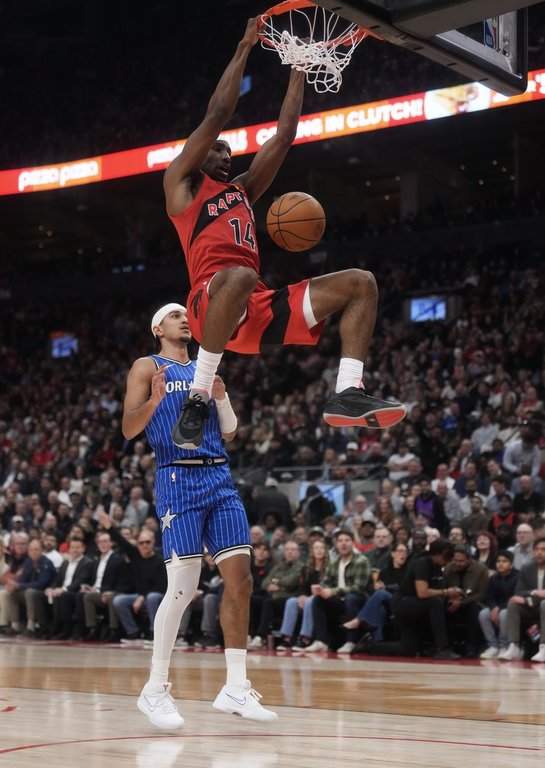
Twenty-eight points. A thirty-point blowout. One hundred and twenty-nine to ninety-nine.
If you only glance at the morning box score, those numbers look like sterile accounting. They sit neatly in columns, devoid of sweat, devoid of the deafening roar of nineteen thousand people finally letting go of a breath they had been holding for months. A standard recap will tell you that Scottie Barnes scored 28 points as the Toronto Raptors routed the Orlando Magic. It will list shooting percentages, rebound totals, and maybe a dry quote from the postgame podium about "executing the game plan." Recently making news in this space: The Thousand-Mile Echo of a Three-Second Joke.
It misses everything.
Because basketball, at its highest level, is never really about the ball going through the hoop. It is about weight. The crushing, invisible weight of expectation that settles onto the shoulders of a twenty-something kid told to carry an entire country's basketball identity. When Toronto dismantled Orlando by thirty points, the real story was not the margin of victory. It was the sudden, violent release of pressure. Additional details on this are detailed by ESPN.
The Architecture of Doubt
To understand why a Tuesday night blowout in the middle of a grueling eighty-two-game slog felt like a tectonic shift, you have to sit in the lower bowl when things are going wrong. I have spent too many winter nights in arenas where the air feels thick with collective anxiety. You can smell the stale popcorn and the sharp tang of floor wax, and beneath it all, a low hum of dread. Every missed jumper sounds louder. Every turnover echoes like a gavel slamming down on a verdict everyone is afraid to read aloud.
For weeks, watching the Raptors felt like watching someone try to run underwater.
Think about what happens to a young franchise cornerstone when the losses pile up. Let us imagine a hypothetical season ticket holder—call him Marcus—who takes the GO Train down to Union Station forty-one times a year. Marcus does not care about true shooting percentages or defensive rating differentials. He watches body language. For months, Marcus watched Scottie Barnes slump his shoulders after a missed whistle, argue with officials while the opponent sprinted back for an easy layup, and force passes into traffic that were not there. Marcus began to wonder, quietly at first, if the franchise had bet its future on a player who lacked the ruthless, unblinking focus required to be the best player on a championship contender.
That doubt is contagious. It seeps from the stands onto the hardwood.
Orlando arrived in Toronto carrying the exact opposite aura. The Magic have built their identity on length, friction, and defensive suffocation. Playing them is like trying to push through a wall of wet wool. They switch everything, crowd driving lanes, and punish hesitation with ruthless efficiency. On paper, this was a trap for a Raptors squad still trying to figure out who they are when the fourth quarter gets tight.
Instead, the trap snapped shut on the visitors.
Twenty-Eight Points of Pure Defiance
From the opening tip, something in Barnes’s posture had changed. The slouch was gone.
Watch how a dominant NBA forward controls a game, and you realize it has less to do with acrobatic dunks and more to do with geometry. Think of a basketball court as a crowded room where everyone is trying to move through the same narrow doorway. Most players try to squeeze through the gaps. Great players simply knock down the walls.
Barnes spent the night knocking down walls.
He did not settle for contested three-pointers early in the shot clock—the classic symptom of a tired or frustrated star. He lowered his shoulder, absorbed contact from Orlando’s massive frontcourt, and carved out space in the paint with methodical cruelty. When the Magic sent a second defender, he did not panic or throw a lazy lob toward the perimeter. He whipped crisp, two-handed lasers to shooters waiting in the corners, turning Orlando’s aggressive rotations against them.
By halftime, the math was already getting ugly for the Magic. By the end of the third quarter, the game was functionally over.
Here is where the numbers start telling a deeper truth. Scoring 28 points in a close game is impressive; scoring 28 points in a 129-99 rout—often sitting out the final stretch of garbage time while the bench mob runs out the clock—means you were operating at peak efficiency while the outcome was still in doubt. Every bucket carried maximum leverage. He shot with conviction, bullied his way to the free-throw line, and turned defensive rebounds into instant fast breaks before Orlando could even set their feet.
Look at the Raptors’ offensive flow during that stretch. When Barnes plays with pace, the entire roster transforms. Role players who usually look hesitant suddenly cut harder toward the rim because they know the ball will find them if they get open for half a second. Shooters catch the ball in rhythm, right in their shooting pockets, rather than having to contort their bodies to corral a wild pass.
One man's clarity becomes five men's confidence.
The Anatomy of a Blowout
People often ask why NBA blowouts happen between two teams of professional athletes who are separated by fractions of a second in speed and inches in vertical leap. How does a game between equals end at 129-99?
The answer lies in the psychology of momentum.
Basketball is a game of runs, and runs are fueled by belief. In the second quarter, Orlando missed three consecutive open looks from beyond the arc. Normally, a disciplined defensive team sprints back, builds a wall, and forces a tough shot. But when you are playing on the road against a crowd that is beginning to sense blood, missed shots feel heavier. You jog back half a step slower. You fail to communicate on a screen.
Toronto smelled that hesitation.
Suddenly, a six-point lead ballooned to fourteen. Orlando called a timeout, their coach barking instructions, trying to staunch the bleeding. It did not matter. Out of the huddle, Barnes stripped the ball near midcourt, took two massive strides, and threw down a dunk that shook the stanchion. The arena erupted—not with polite applause, but with a primal, guttural roar that rattled the rafters.
From that moment on, the Magic were no longer playing the Raptors. They were playing the scoreboard, the clock, and nineteen thousand screaming Canadians.
And the Raptors? They were playing with house money. The ball moved like a pinball, snapping from the top of the key to the wing to the baseline without ever touching the floor. Defenders rotated on a string, contesting every jumper, boxing out every rebound, and turning Orlando’s offense into a series of desperate, isolated heave-ups as the shot clock expired.
What History Tells Us About Turning Points
I will be honest with you: one regular-season win in November or March does not guarantee a playoff run. Anyone who has followed this league for more than a decade knows the trap of overreacting to a single night of hot shooting. The NBA calendar is a meat grinder. Tomorrow brings a flight to another city, another hotel room, another opponent desperate to prove something.
Yet, when you look back at the turning points of great franchises, they rarely arrive with a trumpet fanfare. They almost always look like an ordinary Tuesday night where a young star finally decides he is tired of losing.
Think back to the early years of Giannis Antetokounmpo in Milwaukee, or Jayson Tatum in Boston. Before the banners went up, there were dozens of messy, frustrating nights where their talent was obvious, yet their command of the game remained inconsistent. Then, slowly, the good nights began to outnumber the bad ones. They learned how to impose their physical will on a game even when their jump shot wasn't falling. They learned how to make their teammates better simply by demanding the attention of the entire opposing defense.
That is the threshold Scottie Barnes is standing on right now.
For Toronto, the stakes of this season have never been solely about wins and losses. This is a franchise caught between eras—the ghosts of the 2019 championship parade still lingering in the hallways while a brand-new core tries to write its own chapter. Fans in this city are smart, loyal, and deeply scarred by decades of sports heartbreak. They can forgive a lack of talent. They will never forgive a lack of heart.
When Barnes dropped 28 points on one of the league's toughest defenses, he did more than secure a victory. He answered a question that had been hanging over the franchise like a storm cloud. He proved that when the lights get bright and the physical toll mounts, he does not shrink from the contact. He seeks it out.
The Echo After the Buzzer
By the time the fourth quarter ticked down to its final two minutes, the outcome had been decided for half an hour. Both coaches had emptied their benches. Deep reserves were trading jumpers in front of a crowd that was already halfway up the aisles, pulling on winter coats and checking transit schedules.
Down on the Raptors' bench, Scottie Barnes sat with a white towel draped over his shoulders, leaning forward with his elbows on his knees. He wasn't scrolling through a tablet or staring blankly at the jumbotron. He was watching the end of the bench play, clapping furiously every time a rookie made a hustle play, barking out defensive coverages from the sideline as if the game were tied.
The scoreboard read 129-99. The arena lights began to brighten, washing out the dramatic shadows of the game into the harsh fluorescent glare of cleanup time. Ushers started sweeping popcorn boxes from beneath the seats. Outside, the cold wind off Lake Ontario waited to slap everyone back into reality.
Yet as fans filed out onto Bremner Boulevard, nobody was complaining about the weather, and nobody was worrying about tomorrow's standings. They were smiling, replaying the dunks, mimicking the passes, feeling that rare, electric warmth that only happens when a team reminds its city why they fell in love with the game in the first place.