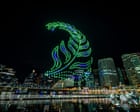
The wind off the water in late autumn carries a specific, biting chill, the kind that makes thousands of people huddle just a little closer together on the concrete apron of Sydney’s Circular Quay. They were waiting. Up above, the sky was a clean, ink-black canvas, scrubbed clear by the breeze. Below, the harbor mirrored the neon pulse of a city transformed by Vivid Sydney, an annual festival that turns concrete and glass into a playground of light.
Children sat on their parents' shoulders, pointing at the glowing sails of the Opera House. Couples shared hot chips, their faces illuminated by the ambient glow of a hundred art installations. The air smelled of salt, fried food, and expectation.
Then came the hum.
It is a sound you feel in your teeth before you register it with your ears—the collective pitch of hundreds of tiny, high-performance rotors spinning at thousands of revolutions per minute. To the crowd, it sounded like a swarm of digital cicadas waking up.
Imagine looking up at a constellation you’ve known your whole life, only for the stars to suddenly untether themselves from the cosmos and begin to dance. That is the promise of the modern drone show. It is choreography written in three dimensions, using flying computers instead of dancers. For the first few minutes, the performance was flawless. The drones grouped, shifted, and breathed in unison, painting massive, glowing shapes against the dark.
Then, the geometry broke.
It started with a slight wobble, a momentary hesitation in a line that should have been razor-sharp. To the untrained eye, it might have looked like a gust of wind catching a few rogue lights. But for the technicians staring at telemetry screens behind the barriers, the heartbeat of the show just stopped.
One by one, the lights blinked out. Not as part of the script, but with the sudden, violent finality of a blown fuse.
Then they began to drop.
They didn’t drift or hover. They plummeted. Heavy, battery-laden quadcopters slipped out of formation and hurtled toward the black water of Darling Harbour. Eighty-three distinct points of light, falling like spent matches.
Plop. Plop. Plop.
The sound of thirty thousand dollars’ worth of custom-engineered technology hitting the ocean surface is surprisingly quiet. It sounds like heavy raindrops falling into a swimming pool. From the boardwalk, the crowd gasped. The collective intake of breath was loud enough to drown out the remaining rotors. A few people cheered, assuming it was a spectacular, high-stakes finale—a simulation of a meteor shower, perhaps.
But the show didn’t reset. The remaining drones drifted back to their landing pads like a defeated army, and the sky went dark.
The aftermath of a public tech failure is rarely loud. It is a quiet scramble. Within hours, the announcement came down from the festival organizers: the remaining drone spectacles scheduled for the festival were canceled. Just like that, the signature event of the city's winter calendar was erased.
The immediate reaction from the public was a mix of confusion and mild amusement. The internet did what it always does, turning the incident into a cascade of memes. Videos of the tumbling lights were set to classical music, shared across social media platforms before the salt water had even fully corroded the circuit boards at the bottom of the bay.
But beneath the surface-level comedy of expensive gadgets taking an unauthorized swim lies a much deeper, more troubling reality about the technology we are increasingly relying on to entertain, protect, and monitor us.
We have become accustomed to the idea that technology is flawless because, most of the time, the software in our pockets works. Our phones auto-correct our typos, our mapping apps find the fastest route through traffic, and our streaming services predict exactly what we want to watch next. We have developed a blind, comfortable faith in the algorithms.
A drone show is the ultimate manifestation of this faith. It requires hundreds of autonomous machines to constantly communicate with a central computer and with each other. They must calculate their position down to the millimeter in real-time, accounting for wind speed, battery degradation, and air turbulence. It is a ballet of pure math.
When it works, it feels like magic. When it fails, it reminds us that code is fragile.
What went wrong in the skies over Sydney wasn't a mechanical failure. A propeller didn't snap; a motor didn't burn out. The culprits are almost always invisible: signal interference, GPS spoofing, or a single, catastrophic line of corrupted data that tells the drone it is no longer where it thinks it is. When a drone loses its spatial awareness, it faces a hard-coded choice designed by safety engineers. It can either drift aimlessly, risking a collision with a skyscraper or a crowd, or it can execute a "kill switch" command, cutting power and dropping straight down into a designated safe zone.
In this case, the safe zone was the harbor. The drones did exactly what they were programmed to do in an emergency. They sacrificed themselves to protect the people watching below.
There is a strange irony in that. The very failure that ruined the spectacle was actually a demonstration of flawless safety engineering. The system realized it was compromised, chose the path of least harm, and committed collective suicide in the water.
Yet, the cancellation of the entire event series speaks to a larger panic that ripples through industries whenever autonomous tech stumbles. We are eager to embrace the future, but we have zero tolerance for its growing pains. We want the magic, but we are terrified of the glitch.
Consider the people who spent months programming that specific light show. Every movement, every color transition, every beat of the music had been mapped out on a computer screen in a sterile office months before. For those engineers, watching those eighty-three lights fall wasn't just a financial loss; it was a public unraveling of their work. The emotional weight of a technical glitch is rarely discussed, but it is real. The panic in the control tent, the frantic tapping of keys, the realization that control has been utterly lost—that is a human horror story played out in front of thousands of spectators.
The event organizers faced an impossible choice the next morning. Do you risk running the show again, trusting that you’ve patched the bug, or do you pull the plug entirely? In our current culture, risk mitigation always wins. The financial cost of a canceled show is high, but the reputational cost of a drone hitting a spectator is existential.
So, the sky remains empty for the rest of the festival.
We are living in a transitional era. We are handing over the keys of our world to autonomous systems, bit by bit. We see it in the self-driving cars navigating the streets of San Francisco, the automated fulfillment centers sorting our packages, and the drones that will soon be delivering our medical supplies—or our pizzas.
Events like the Vivid Sydney drone crash are gentle warnings. They are reminders that the digital world we are building is resting on a foundation of immense complexity, and complexity is inherently unstable. The more moving parts a system has, the more ways it can break.
The next time you look up at a drone show, you won't just see a pretty picture. You will see the tension. You will see hundreds of tiny computers fighting against gravity, wind, and radio static, held together by nothing more than a fragile web of code.
As the crowds filtered away from Darling Harbour that night, walking back to the train stations and parking garages, the mood was different. The collective euphoria of the festival had been replaced by a quiet realization. People kept looking up at the empty sky, perhaps waiting for the stars to start falling again, or perhaps just realizing for the first time how much effort it takes to keep them up there.
Down in the dark, cold water of the bay, eighty-three drones sat on the muddy bottom, their lights completely extinguished, slowly being buried by the tide.