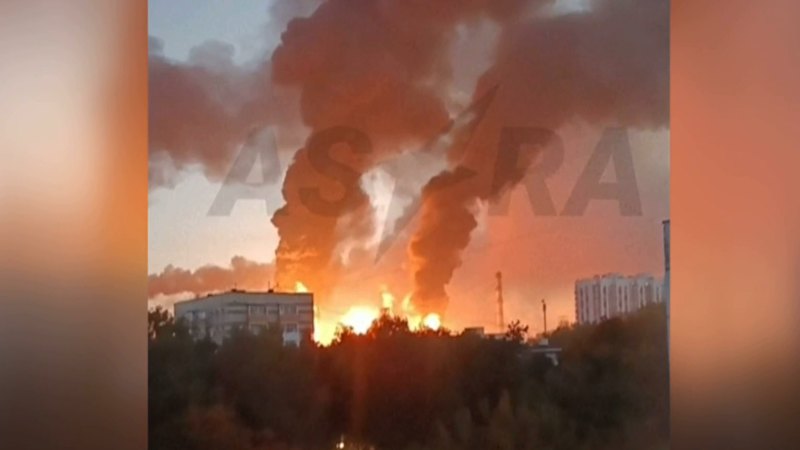
The coffee in the paper cup went cold hours ago. Oleksandr didn't drink it anyway. He stared at the glowing amber cluster of monitors inside the command post, his eyes tracking the thin, frantic green arcs tracing their way across a black digital map. Outside, the air of the Ukrainian night was crisp, silent, and heavy with the smell of distant damp earth. Inside, the only sound was the clicking of plastic keys and the low, rhythmic hum of cooling fans.
Then, the alarms began to sing.
Across the border, hundreds of miles away in the shadows of Russian logistics hubs, ammunition depots, and fuel storage facilities, the quiet darkness shattered.
History is rarely made by grand declarations in marble halls. More often, it is forged in the hum of a microprocessor soldering joint, in the dark grease under a mechanic's fingernails, and in the sudden, blinding flash of high explosives tearing through concrete at four in the morning. What unspooled across the night sky during the massive Ukrainian drone strikes was not merely an exchange of ordinance. It was a profound, violent shift in the physics of modern statecraft.
Consider the economics of steel and fire. For a century, military power was measured in the heavy, unyielding currency of multi-million-dollar fighter jets, lumbering bombers, and titanium-clad missiles. A state bought its dominance by the ton. But aviation fuel burns just as brightly when ignited by a device assembled in a converted Kyiv garage for the price of a used sedan.
Oleksandr knows this math intimately. Before the war, he wrote software for logistics firms, optimizing delivery routes for crates of shoes and auto parts. Now, his algorithms optimize vectors for low-flying composites loaded with shaped charges.
"People talk about technology like it's magic," he murmured, his fingers dancing across a mechanical keyboard without looking down. "It isn't. It's just geometry and desperation. When you are outgunned ten to one, you stop trying to build the best hammer. You start building a million small stones."
The scale of the coordinated operation stunned military attachés from Washington to Beijing. Drones—hundreds of them, humming like angry hornets on synchronized swarm logic—skimmed across the horizon under the cover of electronic warfare jamming. They did not fly high enough to trigger the heavy, radar-guided S-400 batteries designed to swat lumbering cruise missiles out of the stratosphere. Instead, they hugged the contours of the earth, dodging tree lines, slipping beneath primary radar lobes, and steering autonomously via encrypted inertial navigation systems when GPS signals vanished into the static hiss of Russian jamming umbrellas.
This is the invisible reality of the modern front line. It is fought not just in the trenches of the Donbas, but in the spectral realm of the electromagnetic spectrum. Every meter of altitude is contested space. Every frequency is a battlefield.
When the first wave struck the Engels air base deep inside Russian territory, the shockwave did not merely shatter windows; it fractured decades of military doctrine. Satellite imagery reviewed in the grey light of dawn revealed blackened husks of strategic bombers—aircraft designed during the Cold War to project nuclear terror across continents, now crippled by fiberglass drones guided by commercial microchips and battery packs shipped through third-party intermediaries.
The Kremlin's spokesmen called it terrorism. Western analysts called it asymmetric innovation.
On the ground in Kyiv, sitting in a dimly lit kitchen illuminated only by the blue glow of a laptop screen, Maria watched the social media channels erupt with low-resolution video clips. Grainy orange fireballs blossomed against the night sky. The sound of small-arms fire rattled uselessly from rooftop guard posts trying to hit shadows moving at a hundred miles per hour.
Maria is thirty-four. She used to design children's books. Now, she coordinates crowdsourced supply chains for civilian drone units, tracking micro-donations sent via cryptocurrency from diaspora communities in Toronto, London, and Berlin.
"At first, you feel terrified," she said, wrapping a woolen blanket tighter around her shoulders as the apartment building's generator thumped away in the courtyard below. "Then the terror turns into a strange, cold clarity. You realize that nobody is coming to save you with a magic wand. You have to survive with what you can build, patch together, and invent before the sun comes up."
That sentiment captures the psychological core of the current conflict. It is an industrial war fought at startup speed. While traditional defense contractors take seven years to draft a procurement proposal for a new radio handset, volunteer workshops in industrial parks outside Lviv iterate on firmware updates twice a week based on field telemetry sent via encrypted messaging apps from drone operators on the front lines.
The strategic implications ripple far beyond the borders of Eastern Europe. Every Pentagon strategist, every naval commander in the Taiwan Strait, and every defense minister in Europe is currently rewriting their tactical manuals. The era of the exquisite, fragile, hyper-expensive military platform is colliding head-on with the era of cheap, swarming, disposable autonomy.
If a fifty-thousand-dollar drone can neutralize a forty-million-dollar radar installation, the entire logic of force projection collapses. Nations can no longer afford to maintain large standing militaries built exclusively around elite, irreplaceable hardware. Quantity has found a terrifying new way to have a quality all its own, powered by silicon and shared code.
Yet, behind the geopolitics and the dry analysis of payload weights and blast radii lies a human cost that numbers can never quite capture.
Back at the command post, the green arcs on Oleksandr's screen finally stabilized. The primary wave had cleared. The damage assessments were beginning to trickle in through encrypted channels—confirms, misses, fires still burning in the distance.
He leaned back in his chair, rubbing his bloodshot eyes with the palms of his hands. The room smelled of ozone, stale tobacco, and cheap instant coffee.
Across the room, a young soldier barely out of his teens was quietly humming a folk tune, cleaning the grease off a spare battery terminal with a rag. Outside, the first pale streaks of dawn began to bleed through the eastern windowpanes, painting the gray concrete of the courtyard in shades of bruised violet and cold steel.
The sky over the steppe grew quiet again. But nothing would ever be the same.


