Saltwater does not usually taste like copper. But standing on the bridge of a vessel cutting through the midnight gloom of the Gulf of Oman, the air carries a distinct metallic tang. It is the smell of burning crude, of compressed panic, of a global economy tethered by a very thin, very fragile thread to a stretch of water most people could not find on a map until something blew up.
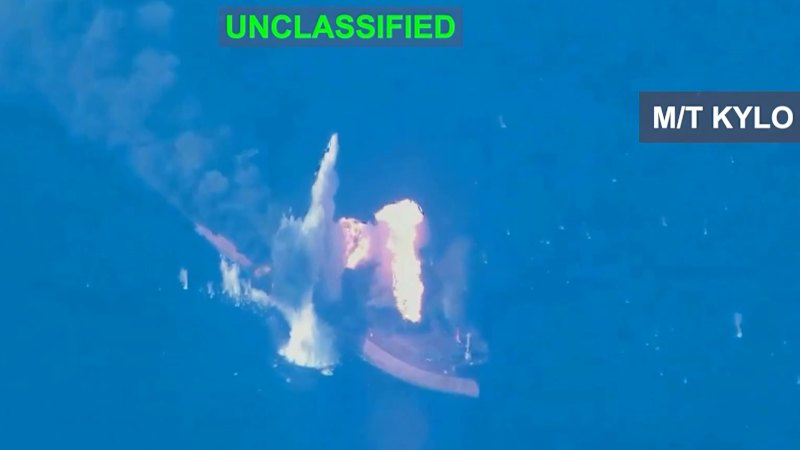
Let us be entirely clear about what happened on that ordinary night, stripped of the antiseptic jargon of defense briefings. The United States military did not merely "blast a trio of Iranian oil tankers." They detonated the illusion that maritime trade is a permanent, guaranteed feature of modern civilization. Three vessels, laden with millions of barrels of sanctioned oil, turned into roaring torches against the black horizon. Steel buckled. Bulkheads screamed. And four thousand miles away, the price of a gallon of gasoline ticked upward by fractions of a cent, barely registering on a dashboard, while the underlying architecture of international commerce shuddered.
To understand the weight of that explosion, you have to leave the Pentagon conference rooms and the cable news chyrons behind. You have to imagine a sailor named Marcus. This is a hypothetical lens, of course, but it is forged from the real, heavy grease of lived experience on blue water. Marcus is twenty-four, stationed on a guided-missile destroyer idling just off the shipping lanes. He has spent six months staring at radar screens that look like green cathode-ray constellations, eating lukewarm pasta, and wondering if the humidity will ever stop peeling the skin off his neck. When the order came down, there was no cinematic swelling of strings. There was only the sudden, violent thrum of the combat information center shifting gears from boredom to lethargy-shattering execution.
Fire.
That is the word that dominates the logbooks. Not diplomacy. Not deterrence. Fire.
The official statements will tell you these tankers were operating outside international norms, slipping through the dark to bypass economic embargoes designed to squeeze Tehran's nuclear ambitions. That is the macro view. That is the chess board. But zoom in past the geopolitical grandstanding and look at the water. Oil is heavier than water in its political consequences, yet lighter in its physical persistence; it floats, spreads, and burns with a terrifying, suffocating hunger. When a missile or a precision strike hits a tanker, it does not just sink a hull. It ignites a beacon visible from the stratosphere, signaling that the invisible guardrails keeping global trade predictable have begun to splinter.
We live in an age of profound historical amnesia. We flip a switch, the light turns on. We tap a screen, a package arrives on the porch. We pump gas, our cars move. We treat these conveniences as laws of physics rather than fragile human constructs maintained by perpetual, low-grade violence and deterrence. Every drop of crude moving through the Strait of Hormuz is a drop of oxygen for a hyper-connected planet. When those three tankers erupted, the message sent across the Gulf was not subtle. It was written in towering pillars of black smoke.
Consider what happens next in the quiet rooms of shipping insurance firms in London. Premiums spike by thousands of dollars per voyage within twenty-four hours. Crew members hesitate before signing their next contracts, looking at their wives across kitchen tables and asking if the hazard pay is truly worth the risk of becoming a floating target. Shipowners reroute, burn more bunker fuel, take longer paths. And quietly, invisibly, the cost of everything—from a loaf of bread shipped in a container to the plastic molded around your morning coffee maker—inch-worms upward.
Wars are rarely fought with grand declarations anymore. They are fought in the margins. They are fought in the twilight zones of sanctions evasion, midnight ship-to-ship transfers with transponders dark, and sudden, lethal interventions by superpower militaries determined to prove that rules still possess teeth. The tankers were moving cargo, yes. But they were also moving a proposition: Can an outlaw state rewrite the rules of maritime transit by sheer persistence?
The answer delivered by those burning hulls was a definitive no. But the cost of that answer is messy, ugly, and reverberates far beyond the immediate flashpoint.
I remember the smell of diesel exhaust mixed with salt spray from my own years near the water, the way a horizon could look so breathtakingly peaceful at sunset and yet hold absolute terror beneath its skin twenty minutes later. The sea remembers nothing. It swallows the oil, disperses the ash, and washes the hull fragments down into the silent trenches where light never reaches.
The smoke over the Gulf of Oman has long since cleared, dissolved into the indifferent upper atmosphere. But the embers remain, glowing red in the dark, waiting for the next ship to test the boundary between commerce and catastrophe.