The yellow shirt does things to the human psyche. To those who wear it, it carries the weight of five stars, the ghosts of Pelé and Garrincha, and the impossible demand to not just win, but to dance while doing it. To those who face it, it is a psychological wall. For decades, teams stepped onto the grass already down a goal in their own minds, paralyzed by the sheer mythology of Brazilian football.
Then came the boy from Bryne.
Erling Haaland does not care about mythology. He does not care about o jogo bonito, the beautiful game, or the romantic notion that football belongs to the artists. He is a forward designed in a laboratory of cold logic, a physical anomaly who treats the penalty box not as a stage for self-expression, but as a zone of pure execution.
When Norway stepped out to face Brazil in the knockout rounds of the World Cup, nobody outside of Oslo gave them a prayer. On paper, it was a mismatch of eras and philosophies. Brazil brought the rhythm of the streets; Norway brought a collective of disciplined, hard-working professionals anchored by a generational phenomenon.
But football matches are not played on paper. They are played in the suffocating heat of ninety minutes, where reputation shrinks and raw will takes over.
The Anatomy of an Upset
To understand how the unthinkable happened, one must understand the sheer physics of the confrontation. Imagine a traditional sculptor trying to chisel away at a block of granite with a plastic tool. That was Brazil’s defense trying to contain Haaland. Every time Marquinhos tried to match him for strength, he was shoved aside. Every time Eder Militão tried to read his movement, Haaland changed direction with a frightening, unnatural agility for a man of his stature.
It began with a silence that rippled through the stadium.
Brazil had dominated possession for the opening twenty minutes. They pinged the ball around the Norwegian box with that familiar, hypnotic cadence. Vinícius Júnior skipped past a challenge, Lucas Paquetá disguised a pass, and the crowd swelled with anticipation. It felt inevitable. It felt like every other World Cup night where the European underdog eventually suffocates under the weight of Brazilian brilliance.
Then, a turnover. A simple, unglamorous clearance from the Norwegian left-back.
Most forwards would look at a fifty-yard ball floating into empty space and use the time to reset, allowing their midfield to push up. Haaland ran. He did not just jog; he sprinted with a terrifying, heavy-legged stride that seemed to shake the turf.
He caught a defender sleeping. A shoulder-to-shoulder challenge that ended with a Brazilian center-back on the grass. One touch to settle. A second to smash the ball into the roof of the net with such violence that the camera behind the goal shook.
One to zero.
Silence. Total, absolute silence from the yellow wall of fans, replaced only by the feral roar of a giant sliding on his knees toward the corner flag.
The Heavy Sky over Rio
Back in Brazil, millions watching on televisions across Copacabana and São Paulo felt a familiar, cold dread creep into their bones. This wasn't the flamboyant defeat of 1982 or the chaotic meltdown of 2014. This was different. This was the realization that their technical superiority was being systematically dismantled by an opponent that refused to be intimidated.
The real battle of this match was not tactical; it was emotional.
Football in Brazil is a cultural identity, a collective joy that rescues people from the harsh realities of daily life. When the national team loses, the economy slows down, the streets grow quiet, and an entire nation undergoes a period of mourning. The stakes are invisible but massive.
Norway, conversely, played with the freedom of men who had already beaten the odds just by arriving at this stage. Martin Ødegaard operated in the center of the pitch like a calm chess grandmaster, turning away from pressure, recycling the ball, and constantly looking for the blonde mane of his captain.
Brazil began to panic. The passes became shorter, crisper, but ultimately less effective. They forced the ball through the middle, playing directly into the suffocating block that the Norwegian manager had perfectly engineered.
Consider what happens to an elite athlete when their primary weapon fails them. For the Brazilian forwards, their weapon is dribbling—the ability to freeze a defender with a drop of the shoulder. But the Norwegians didn't bite. They didn't lunge. They dropped off, doubled up, and waited.
The Breaking Point
The second half was a masterclass in psychological warfare. Brazil pushed higher and higher, leaving chasms of space behind their defensive line. It was exactly what Haaland wanted.
The definitive moment arrived in the seventy-fourth minute.
A corner kick for Brazil was cleared. The ball broke to Ødegaard. He didn't even look up. He knew the run was already happening. With a flick of his left boot, he sent a guided missile into the path of Haaland, who was already at top speed.
It was a race between a speeding train and a defender trying to catch up from a standing start. Haaland gathered the ball at the halfway line. He had fifty yards of green grass ahead of him and the entire weight of Brazilian football history chasing his heels.
Alisson Becker advanced from his line, spreading his arms wide, trying to make himself look like an immovable wall.
Haaland didn't blink. He didn't try a delicate chip or a cheeky feint. He simply struck the ball with the outside of his boot, bending it around the goalkeeper's outstretched leg with a clinical precision that bordered on cruel.
Two. Zero.
The Norwegian bench emptied. Players who had spent their careers in the unglamorous leagues of Europe were suddenly jumping on top of each other, realizing they were on the verge of writing history. Haaland just stood there, arms outstretched, looking out at the crowd with a expression that wasn't joy, but affirmation. He expected this.
The Aftermath of a Giant-Killing
When the final whistle blew, the contrast on the pitch was stark.
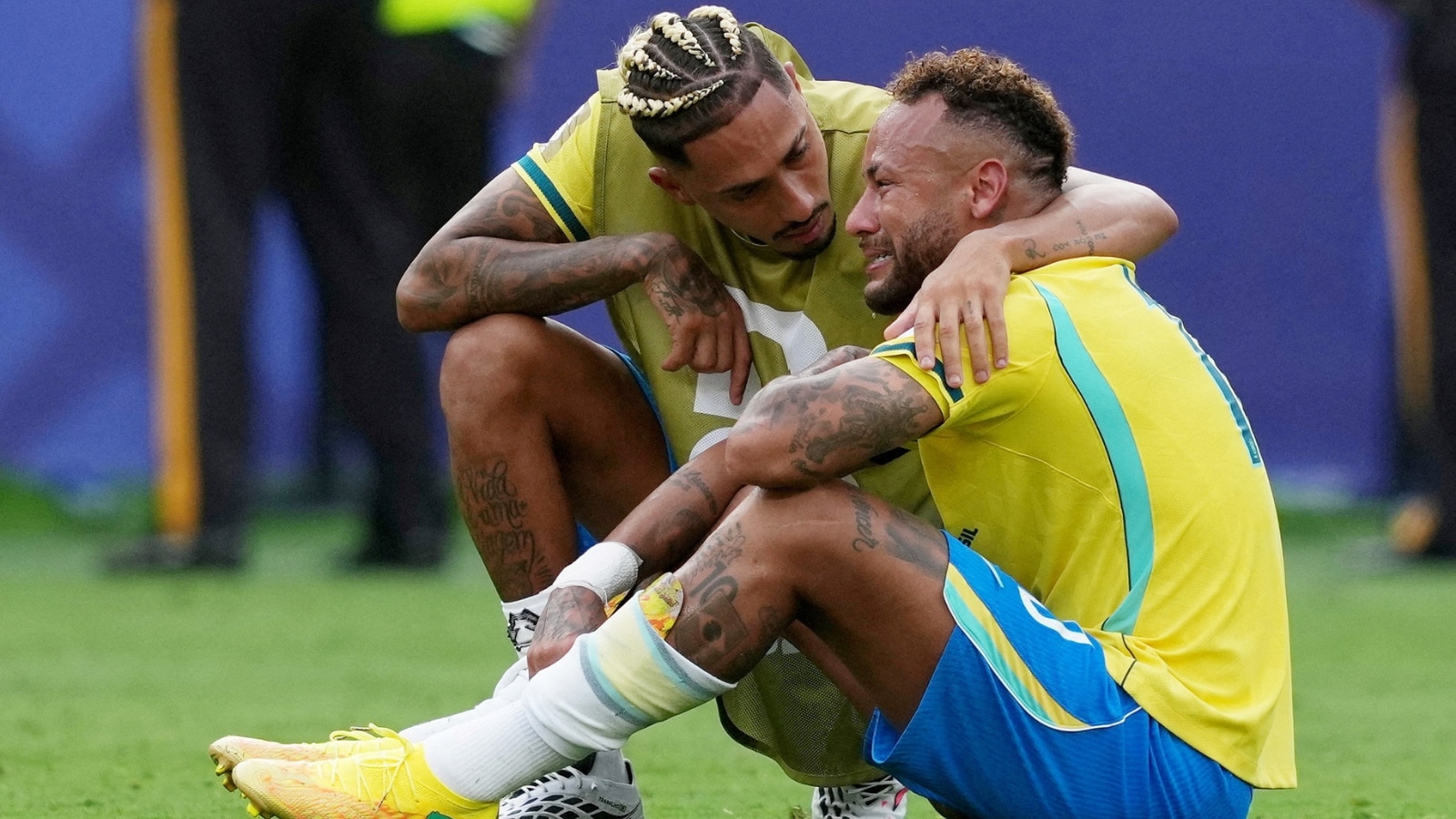
Brazilian players collapsed onto the grass, burying their faces in their shirts to hide the tears. They knew the reception that awaited them back home. They knew the newspaper headlines would be merciless. The beautiful game had been solved, figured out by a pragmatic machine from the north.
But the real story wasn't just Brazil’s failure; it was Norway’s triumph of belief.
A small nation of just over five million people had just knocked the undisputed kings of football off their throne. They did it without trickery, without diving, and without luck. They did it through a relentless commitment to a game plan and a striker who refuses to believe in ghosts.
As the Norwegian players took their lap of honor, Haaland walked slightly behind them, a flag draped over his massive shoulders. The world of football had shifted on its axis. The old hierarchies were crumbling, replaced by a new reality where power, pace, and unflinching execution reign supreme.
The giant had broken the spell.