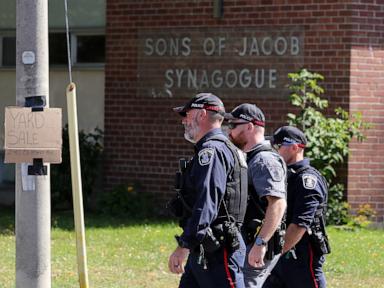
Fear has a very specific sound. It is not the theatrical screech of a cinematic monster or the roaring bass of an explosion. It is the dry, metallic click of a deadbolt sliding home in the dark. It is the sudden, breathless silence that falls over a dining room table when a brick shatters a front window. It is the cold realization that the distance between ordinary life and historical catastrophe is measured in inches and seconds.
On a quiet street outside an Ontario synagogue, that distance vanished entirely.
The air was still. The kind of stillness that settles over a suburban neighborhood long after the school buses have parked and the porch lights flicker on. Inside, sanctuary lamps cast long, amber shadows across wooden pews. Families had gathered earlier, exchanging quiet pleasantries, the murmur of Hebrew prayers blending with the ordinary cadence of Canadian life. Outside, the night belonged to the wind rustling through bare maple branches.
Until the shouting started.
It cut through the heavy evening air with a raw, jagged edge. A voice, warped by a fury that defied reason, hurled a targeted antisemitic threat into the emptiness. Then came the unmistakable crack of gunfire.
Bullets do not care about brickwork, or stained glass, or the fragile architecture of human coexistence. They tear through drywall and shatter the quiet assumptions we make about safety. In that single, violently fractured moment, an abstract statistic—a rising curve on a hate-crime graph—became a visceral, smoking reality.
Consider what happens next in the minds of those inside.
Time splinters. A parent instinctively pulls a child downward, pressing small bodies against a cold floor, whispering frantic reassurances that even they do not believe. Every instinct honed by generations of ancestral memory screams a singular, terrifying warning: It is happening again.
We live in an era that desperately wants to believe in the linear progression of civilization. We tell ourselves that humanity has outgrown its darkest impulses, that education and digital connectivity have inoculated us against the ancient virus of bigotry. We build our societies on the fragile scaffolding of laws, treaties, and polite discourse. We assume that the iron gates we erect around our houses of worship are relics of a paranoid past rather than necessities of the present.
That assumption is a luxury paid for by those who stood outside the Ontario synagogue that night.
Hate is not a stray ember drifting on the wind. It is an engineered blaze, fed by dry kindling that accumulates quietly in the dark corners of the internet, in anonymous chat rooms, and in the casual cruelties whispered across dinner tables. When a gunman steps out of the shadows and pulls a trigger, he is rarely acting in an isolated vacuum. He is the culmination of a long, deliberate erosion of empathy. He is the physical manifestation of words that were allowed to fester without consequence.
To understand the weight of this event, one must look beyond the police report. Police blotters are cold, clinical instruments. They record bullet calibers, suspect trajectories, response times, and charges filed. They reduce human trauma to alphanumeric codes. But they miss the trembling hands of a rabbi locking the heavy oak doors. They miss the children who will now look at a synagogue entrance not as a threshold of peace, but as a potential choke point. They miss the profound, exhausting grief of a community that asks a simple, agonizing question: Why must we constantly guard our right to exist?
History is not something that happens safely behind the glass of a museum exhibit. It is happening right now, written in real-time by the choices we make about what is acceptable to say, what is permissible to ignore, and who we decide to protect.
When a synagogue in Canada becomes a target for armed hatred, the shockwave ripples far beyond the Jewish community. It strikes at the heart of the social contract. Because the chilling truth about bigotry is that it never stops at a single door. It is a solvent that dissolves the bonds holding a pluralistic society together. If one house of worship can be shot at with impunity, then no sanctuary is safe, no identity is protected, and no citizen is truly free.
Yet, in the immediate aftermath of the gunfire, another human impulse emerged—one far quieter, but infinitely more resilient.
It was found in the neighbors who opened their doors to frightened strangers. It was found in the first responders who ran toward the sound of violence while everyone else fled. It was found in the unbroken solidarity of communities refusing to cower behind locked doors.
The gunman came with a weapon designed to terrorize, to silence, and to destroy. But as the smoke cleared and the flashing red and blue lights painted the night sky, something else remained. It was the stubborn, defiant refusal to disappear.
The night was cold. The threat was real. But the heavy iron gates, though scarred by lead, held firm.


