The screen was too bright. It was always too bright, casting a pale, clinical blue wash across the ceiling of a room that should have belonged to sleep.
My thumb twitched, swiping instinctively through a graveyard of open browser tabs, refreshing an inbox that held nothing urgent, scrolling past another polished illusion on social media. Somewhere beneath that digital noise lay a book. A physical book, its bookmark wedged stubbornly at page one hundred and forty-two, gathering dust while the minutes bled past midnight. I wanted to read. I told myself I loved reading. But my brain, fried by push notifications and infinite loops of algorithmic stimulation, refused to sit still long enough to let a sentence breathe.
We have built a world that makes it extraordinarily difficult to pay attention to anything longer than a traffic light.
Then came the paperback experiment, which failed because my apartment is small and my nightstands are cemeteries for unread paper. Then came the phone screen, which failed because every notification felt like a small, sharp tug on a fishing line, dragging me back out of the story and straight into the machinery of modern anxiety.
I needed something else. Not a gadget designed to keep me tethered to the grid, but an escape hatch disguised as a tool.
The modern e-reader looks simple enough from the outside. A slab of dark glass or matte plastic, a greyish screen mimicking wood pulp. But choosing one isn't just about picking screen sizes or checking storage capacities. It is a psychological negotiation with how you actually live your life, how tired your eyes are at the end of a punishing workday, and whether you are the kind of person who reads in the bathtub or strictly under the covers while a partner sleeps beside you.
Consider Elena.
Elena is a commuter. Twice a day, she descends into the subterranean veins of a major city, crushed into a train car where personal space is a myth and elbow room is earned through polite aggression. Her bag is already heavy with a laptop, a notebook, an umbrella, and a thermos of lukewarm coffee. When Elena told me she wanted to get back into reading, she bought a massive, hardcover biography. It lasted three days before her shoulder staged a revolt.
For Elena, weight is destiny. A device that tips the scales at over two hundred grams becomes a burden, not a sanctuary. She needed something light enough to hold with one hand while clinging to a subway pole with the other—something compact enough to slip into a coat pocket without tearing the lining.
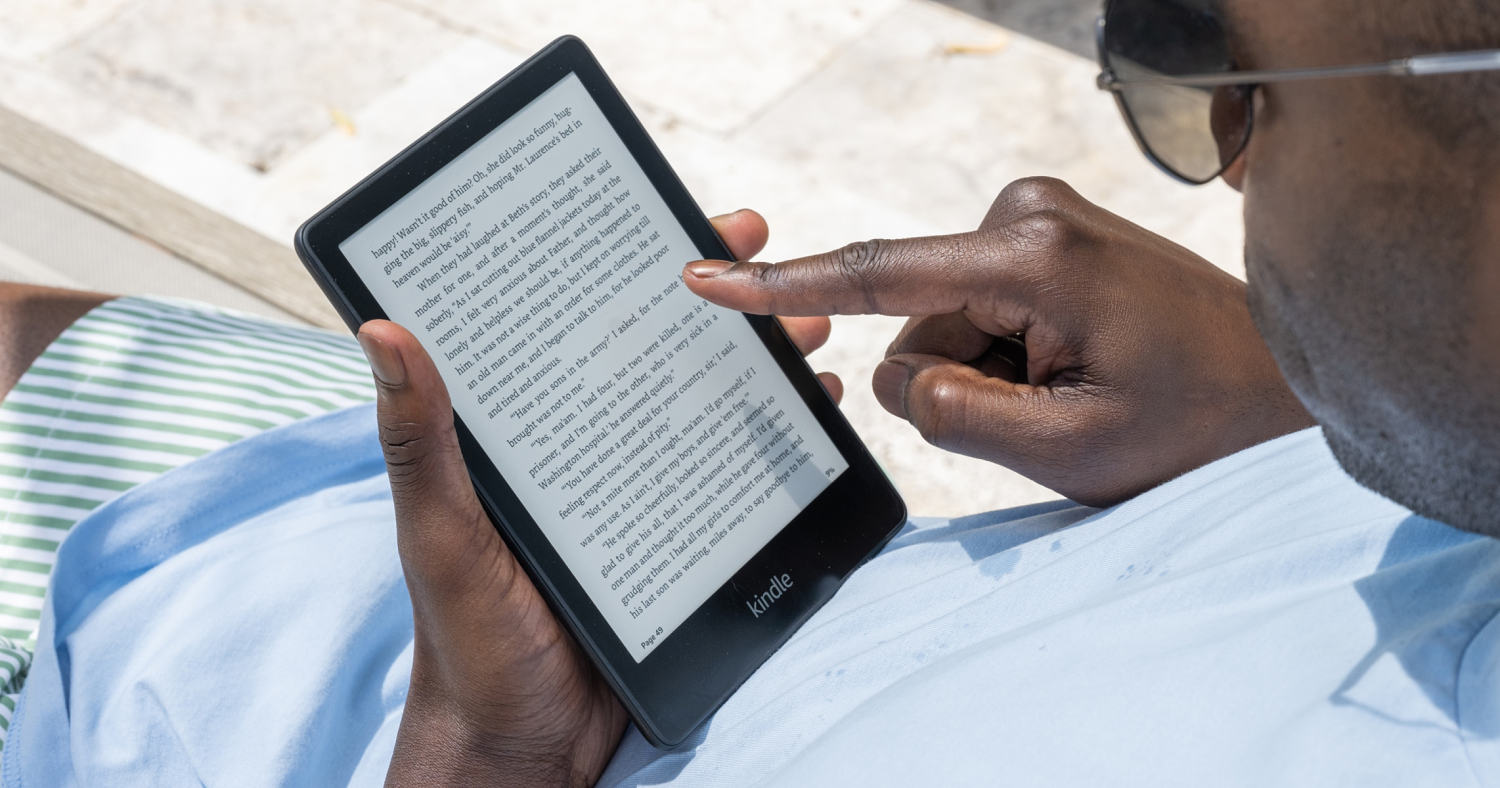
When you look at the entry-level options on the market, like the standard Amazon Kindle, you are looking at Elena’s salvation. Weighing in at around one hundred and fifty-eight grams, it disappears into a coat pocket. Its screen is crisp—typically three hundred pixels per inch on modern iterations—meaning the text doesn't look like jagged digital stairs, but sharp, clean ink printed on real paper.
Yet, the basic model comes with compromises. As a hypothetical scenario to illustrate the point: imagine sitting by a sparkling, sun-drenched pool on a Saturday afternoon. You pull out that basic e-reader, and instead of crisp text, you catch a mirror image of your own sunglasses staring back at you from a glossy screen. Older or cheaper panels often lack the flush-front, micro-etched glass that diffuses direct glare. You tilt your head left. You tilt your head right. You shift your chair three inches. The magic of the book evaporates, replaced by the mundane frustration of lighting logistics.
That is why the conversation shifts so quickly when you talk to people who read everywhere—on beaches, in dark tents, in bathtubs where a single slip means a watery grave for electronics.
Waterproofing is not a luxury feature for the careless. It is insurance for the human experience. Life happens. Coffee spills. Bathtubs beckon. Sudden thunderstorms roll in while you are reading on a park bench. When manufacturers build a device with IPX8 water resistance, they are acknowledging that books belong in the messy, unpredictable world, not just in sterile, climate-controlled libraries.
Then there is the color temperature of the light.
For years, e-reader screens glowed with a stark, ghost-white illumination. Turn it on in a pitch-black room, and it felt like staring directly into a miniature fluorescent bulb. Your brain, misinterpreting the blue-heavy spectrum as midday sun, halts melatonin production. You finish chapter twenty feeling wired, wide awake, and entirely unable to fall asleep.
The mid-tier and premium devices changed this equation by introducing adjustable warm lighting. Imagine shifting the screen from a sterile operating-room white to the warm, amber glow of an old incandescent bulb or a candle flickering on a wooden table. It is a subtle shift, but biologically profound. It lets you read in the dark without signaling to your endocrine system that it is time to go hunting for mastodons.
Let us talk about storage, because it is the most misunderstood metric in the digital reading ecosystem.
Manufacturers love to dangle thirty-two gigabytes of storage in front of consumers like a shiny trinket. They talk about it with breathless enthusiasm. Look at all this room! But let us look at the arithmetic of reality. A standard text-based EPUB or MOBI file takes up roughly two megabytes. Do the math. A single gigabyte holds roughly five hundred books. Even a modest eight-gigabyte device can comfortably house four thousand books—more than most human beings will read in three lifetimes.
Unless, of course, your reading habits lean elsewhere.
If you live in the dense, intricate world of graphic novels, manga, or heavily illustrated PDF textbooks, the calculus changes entirely. A single graphic novel can easily devour fifty to one hundred megabytes. Suddenly, eight gigabytes feels cramped. But for ninety percent of people—the fiction lovers, the memoir devotees, the thriller junkies—eight gigabytes is not just enough; it is an embarrassment of riches. Paying extra for thirty-two gigabytes just to store text books is like buying a semi-truck to carry a single grocery bag.
Battery life is another arena where expectations collide with physics.
We live in an age of battery anxiety. Every device we own—phones, watches, laptops, headphones—demands a nightly pilgrimage to a charging cable. When you hand someone an e-reader and tell them, "You only need to charge this once every six weeks," their brain stalls. It sounds like a marketing lie.
It works because of electronic paper technology, known commonly as E Ink. Unlike the organic light-emitting diode (OLED) or liquid crystal displays (LCD) on your phone, which must constantly refresh millions of tiny pixels sixty times a second to keep an image visible, an E Ink screen uses actual microscopic pigment particles. Tiny black and white capsules suspended in microcapsules move up or down when an electrical charge is applied. Once the page is rendered, the device uses zero electricity to keep it there. You are only spending battery power when you physically turn the page.
It is brilliant. It is elegant. And it fundamentally alters your relationship with the device. You forget where you put the charging cable because weeks pass without a reminder. You pack the reader for a three-week trip abroad, leave the charger at home, and return with fifty percent battery remaining.
Yet, this technology carries an invisible tax: speed.
If you try to scroll rapidly through a web page on an E Ink screen, you will experience a sluggish, ghosting stutter that feels like watching a movie through molasses. Animations smear. Pages flash black to clear residual ink particles.
This is why trying to use an e-reader as a general-purpose tablet is a recipe for deep, abiding frustration. If you want a device that streams video, checks email, plays immersive games, and occasionally lets you read a chapter of a novel, buy a tablet. You will hate an e-reader. But if you want a dedicated sanctuary—a digital monastery where notifications cannot reach you, where the internet is slow enough to be useless, and where the only thing competing for your attention is the author’s voice—nothing else will do.
Consider the physical dimensions of the reading experience itself.
Standard e-readers hover around six inches diagonally. It is the gold standard size, born from decades of pocket paperback publishing. It fits comfortably in the palm of a hand, resting lightly against your fingers.
Step up to the larger formats, however, and you enter a different psychological space. Devices with seven-inch or ten-inch screens introduce physical page-turn buttons. At first glance, buttons might seem like a nostalgic affectation—a cute nod to the past before touchscreens conquered the earth.
Spend an hour reading in bed with physical buttons, and you realize their true value. When you are lying on your side, tucked under heavy blankets on a freezing winter evening, moving your thumb a fraction of an inch to click a tactile button requires zero physical disruption. You don't have to break your grip or lift your arm to swipe the glass. It is an ergonomic luxury that sounds minor until you experience it, after which going back to pure touchscreen navigation feels like an unnecessary chore.
The larger screens also change how information is processed. For non-fiction readers—those who flip back and forth between maps in fantasy novels, endnotes in historical biographies, or complex charts in economics books—the extra screen real estate prevents the frantic bouncing back and forth that breaks your concentration.
Price, of course, casts a long shadow over all of this.
The market spans a wide financial canyon. At the lower end, you find ad-supported models where the manufacturer subsidizes the hardware cost by displaying gentle, non-intrusive book recommendations on your lock screen. For many, seeing a rotating banner of new releases is a small price to pay for a forty-dollar discount. For others, the mere presence of commercial messaging on a device dedicated to literary escape feels like a sacrilege—an intrusion of the marketplace into the temple.
Deciding where you fall on that spectrum requires brutal honesty about what bothers you. If lock-screen ads break your aesthetic peace, pay the ransom to remove them or buy the unadorned tier. If you view the ads as a harmless billboard you swipe past in half a second, pocket the savings and buy three physical paperbacks with the difference.
What about the ecosystem trap?
When you buy into a specific brand of e-reader, you are often stepping into a walled garden. Amazon’s Kindle ecosystem is a masterpiece of frictionless convenience. You see a book recommendation, click buy, and ten seconds later it materializes on your screen via cellular or Wi-Fi magic. But that convenience comes with proprietary formatting chains. Moving your library out of that ecosystem can feel like trying to emigrate from a country with strict border controls.
Alternative ecosystems, like Kobo or open-source Android-based e-readers, offer more freedom. They let you borrow books directly from public libraries through built-in integrations like OverDrive, or load your own files downloaded from independent bookstores without converting formats through proprietary software pipelines. If supporting local independent bookstores or public infrastructure matters to your ethical framework, an alternative ecosystem isn't just a technical choice; it is a values alignment.
We buy these devices because we are searching for a lost version of ourselves.
We remember what it felt like to be twelve years old, lying on a rug with a flashlight under the covers, completely oblivious to the passing of hours. We remember the sweet vertigo of falling into a story so deeply that the room around us dissolved.
The technology doesn't create that feeling. It cannot. No amount of pixel density, warm backlighting, or gigabyte expansion can manufacture wonder.
What a well-chosen e-reader can do, however, is clear away the wreckage. It removes the glare. It banishes the text message notifications. It lightens the load on your tired shoulder during a crowded morning commute and protects your eyes from the harsh blue frequencies of the modern day. It creates a quiet, impermeable boundary between your attention and the chaos of the world outside.
You do not need the most expensive device on the shelf. You do not need thirty-two gigabytes of storage you will never fill, or color screens that dilute the crisp contrast of black ink on grey stone.
You only need the tool that disappears.
Find the one that weighs less than your excuses, lights up the dark without burning your sleep, and stays out of your way until the only thing left in the room is you, the author, and the quiet turning of a page that never was.