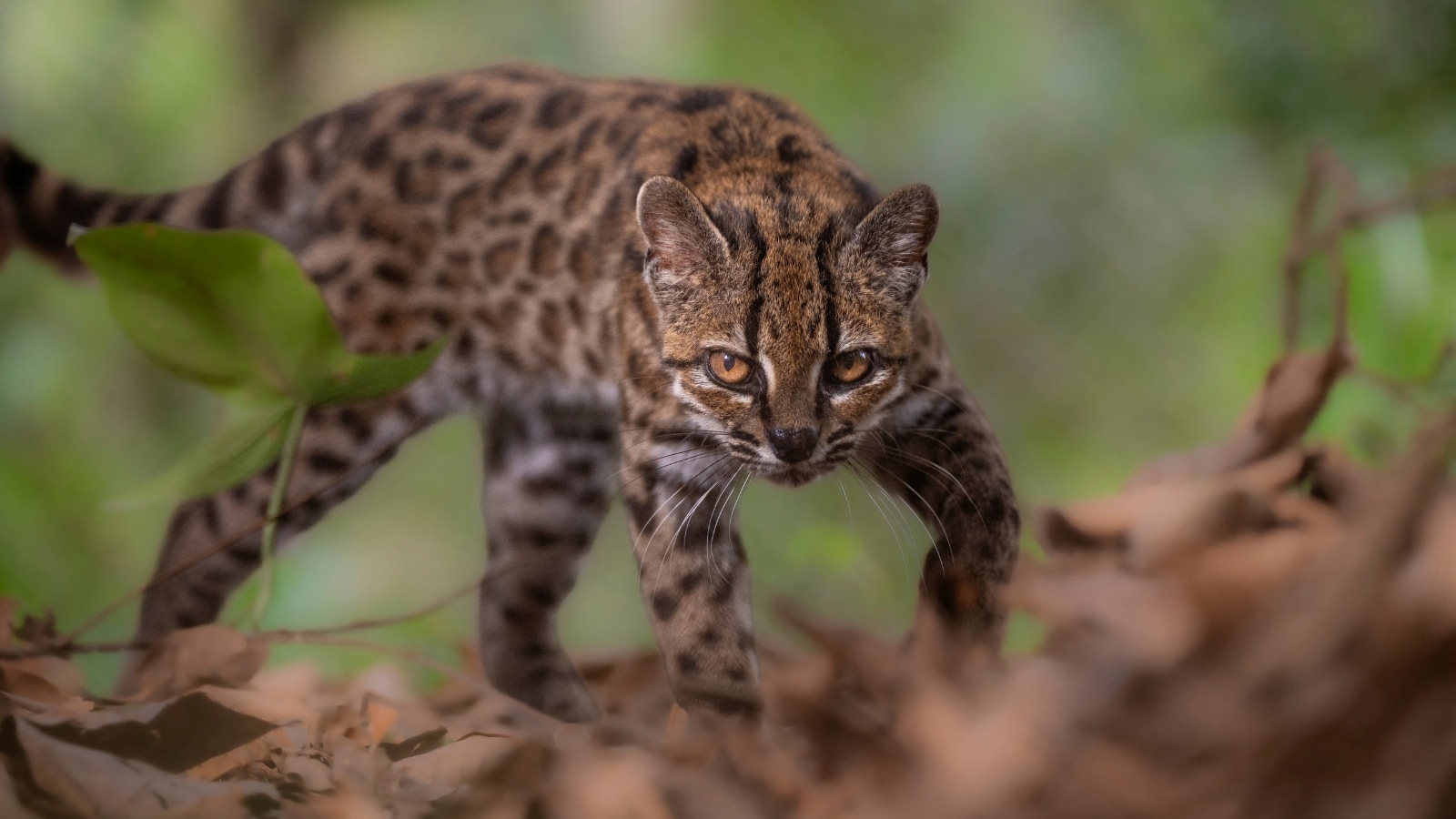
For over a century, science assumed we had already found every living species of wild cat on Earth. That assumption just shattered in the cloud forests of Bolivia. Researchers using advanced genomic analysis and museomics have officially identified a brand-new feline species, the Leopardus tilcayo, commonly known as the tilcayo. Weighing a mere three pounds and sporting striking leopard-like rosettes, this tiny creature is the first living cat species described by scientists in over a hundred years.
If you think big discoveries only happen in the deep ocean or dense jungles with giant mammals, think again. The most exciting zoological find of the decade is smaller than your average house cat.
How a Pet Cat Became a Scientific Breakthrough
The story of the tilcayo reads like a wild mystery. Years ago, a small spotted cat was brought to the Senda Verde wildlife sanctuary in Bolivia’s Yungas region after being kept as a pet by someone who mistakenly thought it was a normal domestic feline. Bolivian biologist and National Geographic Explorer Paola Nogales-Ascarrunz visited the refuge and spotted the unusual animal.
She noticed something strange. The cat's coat pattern did not match any known species of tiger cat from neighboring countries like Brazil. The rosettes were much larger, darker, and differently shaped.
Nogales-Ascarrunz took dozens of photographs, sparking a multi-year collaborative scientific investigation. Alongside geneticists and researchers, her team analyzed DNA from museum specimens and living sanctuary animals—including a male tilcayo named Tigrino. The genomic data confirmed what visual anomalies hinted at: this population wasn't just a regional variation of an existing cat. It was entirely distinct.
The Mystery of the Cryptic Species
Why did it take science this long to notice a completely unique cat species? The answer lies in what biologists call a "cryptic species."
Cryptic species are animals that look nearly identical to one another on the outside, hiding their true genetic divergence behind subtle physical similarities. The tilcayo belongs to the genus Leopardus, a group of small spotted cats native to Central and South America. Because tiger cats (often called oncillas) share similar body shapes, short round ears, and spotted coats, historical classifications relied heavily on surface-level traits.
Before this breakthrough, scientists recognized a few broad categories of tiger cats. The new genomic study shattered that tidy grouping, revealing that South America's tiger cats actually represent five distinct species, including the newly minted Leopardus tilcayo. One museum specimen previously misidentified as a margay was also reclassified during the research.
Listening to Indigenous Knowledge
One of the most refreshing aspects of this discovery is how the cat got its scientific name. Long before geneticists sequenced its DNA, local communities in the Bolivian Yungas cloud forests already knew the animal well. They called it the "tilcayo".
When researchers asked locals about the origin of the word, the response was delightfully grounded in tradition: older generations had always called it that, so the name stuck. Linguistic analysis later suggested the name may stem from local Aymara roots translating roughly to "tiny foot". By naming the species Leopardus tilcayo, the research team honored local wisdom rather than imposing a sterile laboratory moniker.
Science often ignores local populations who live alongside wildlife every day. This discovery proves that indigenous and local knowledge should serve as an immediate starting point for conservation biology, not an afterthought.
Surviving in the Yungas Cloud Forests
The habitat of the tilcayo is as dramatic as its genetics. Found at elevations around 1,570 meters in the mountainous Yungas region on the eastern slope of the Andes, these cats thrive in dense, humid cloud forests.
During ancient climate shifts, these montane forests acted as vital "climatic refugia," trapping moisture and isolating wildlife populations in pockets of stable habitat. That geographical isolation drove genetic divergence, allowing the tilcayo to evolve into its own unique lineage over millennia.
Despite this incredible evolutionary history, we still know frustratingly little about their daily lives. Researchers admit that basic ecological metrics—such as total wild population numbers, exact dietary requirements, reproductive rates, and home range sizes—remain largely unknown.
The Race to Protect What We Just Found
Finding a new species is only half the battle. In many ways, the hard part starts now.
Cloud forests across South America face mounting environmental pressures, from agricultural expansion to habitat fragmentation and climate change. Because the tilcayo occupies a very specific, restricted range in the Bolivian Andes, its population could be highly vulnerable to environmental shifts.
The International Union for Conservation of Nature (IUCN) has yet to formally assess the species. Conservationists stress that field studies must ramp up immediately to map the cat's true geographic distribution and determine whether it needs urgent protected status.
The tilcayo reminds us that our planet still holds massive secrets. If a spotted feline hiding in plain sight can evade formal scientific recognition for over a century, what else is waiting out there in the mist?