Life hates extreme heat. Proteins cook. Membranes melt. DNA shreds into useless soup. Biology follows strict thermodynamic rules, or at least that is what standard textbooks taught generations of students.
Then a strange microscopic organism from California changed the math entirely.
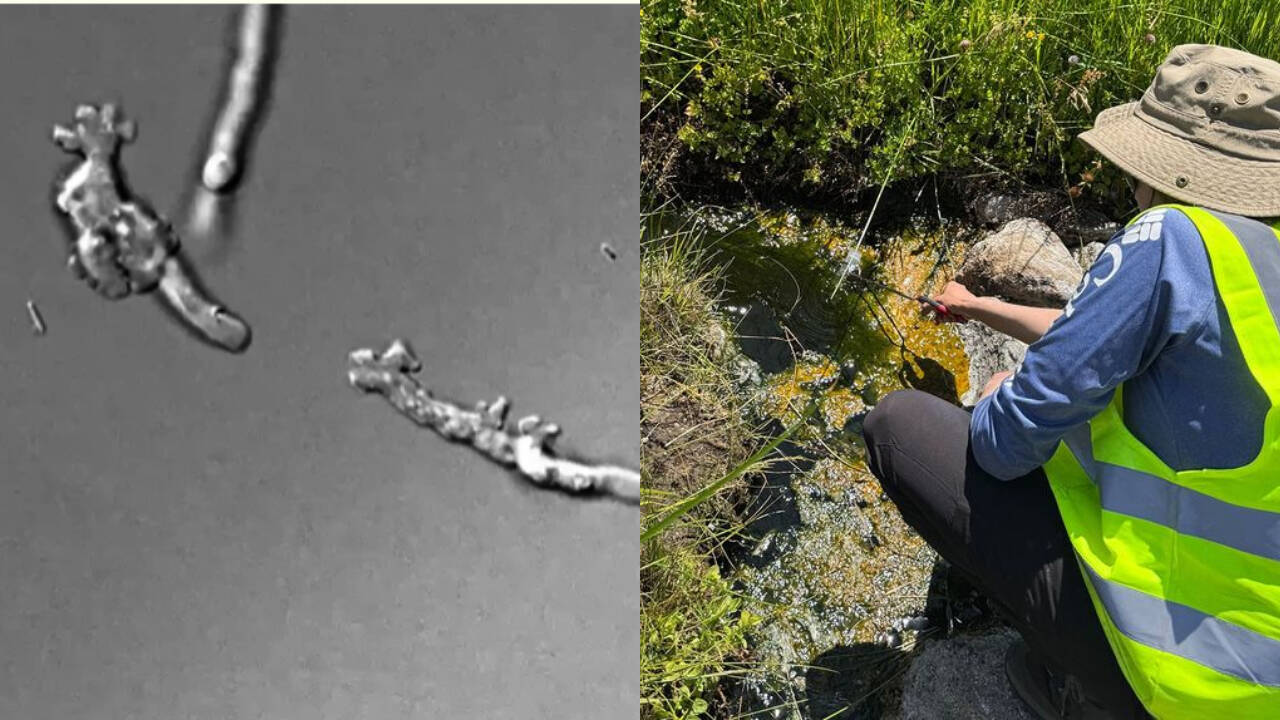
Researchers discovered a complex cellular organism surviving and thriving in waters heated to an astonishing 145 degrees Fahrenheit (63 degrees Celsius). We aren't talking about hardy bacteria or primitive single-celled archaea clinging to volcanic vents deep in the ocean floor. This is a complex amoeba, a eukaryote possessing a nucleus and complex internal machinery that theoretically shouldn't function anywhere near that temperature.
It breaks the established biological ceiling for complex life. It forces scientists to rethink how resilient living systems can actually get.
The Thermodynamic Wall We Thought We Could Never Climb
For decades, biologists drew a sharp line in the sand regarding thermal limits. Single-celled prokaryotes like bacteria can handle blistering heat because their structures are simple. They lack delicate organelles, complex chromosomes, and intricate cellular scaffolding that fall apart when thermal energy spikes.
Eukaryotes—the domain that includes everything from amoebas to humans, trees, and blue whales—were always considered thermal wimps. The absolute record for complex life sat significantly lower, usually hovering around 105 to 113 degrees Fahrenheit for specialized insects or desert plants. Pushing past 130 degrees was supposed to be strictly off-limits.
Proteins denature when they get too hot. Think of frying an egg. The clear albumin turns white and solidifies permanently because heat breaks the weak chemical bonds holding its complex folded shape together. Eukaryotic proteins face the exact same physical hazard.
So how does this California organism keep from cooking alive?
The answer lies in molecular adaptation that researchers are still rushing to decode. This amoeba likely produces a specialized suite of hyper-stable heat-shock proteins and modified lipid membranes that maintain structural integrity when normal cells would turn to mush. Instead of letting its cellular machinery fall apart, the organism built molecular armor.
Why This Discovery Rewrites Astrobiology
When scientists search for life on Mars, Europa, or scorching exoplanets light-years away, they use Earth as their baseline. If complex life can only exist in temperate zones between freezing and a hot bath, our search parameters narrow dramatically.
Finding a complex eukaryote surviving in 145-degree water blows those parameters wide open.
Space agencies look for habitable zones around distant stars largely based on surface temperatures that allow liquid water. But liquid water can exist at high temperatures under pressure, or in geothermal pools right here on Earth. If complex eukaryotic life can adapt to thermal extremes that were previously thought incompatible with complex cellular architecture, alien worlds that we wrote off as too hot might actually be teeming with sophisticated biology.
You have to look at subsurface oceans heated by tidal forces or volcanic activity with fresh eyes. Life doesn't just find a way; it finds ways we haven't even dreamed of yet.
What This Means for Biotechnology and Climate Adaptation
Beyond space exploration, this microscopic rebel offers massive practical applications right here at home. Industries lose billions of dollars every year because industrial enzymes and biological catalysts break down at elevated temperatures.
If we can reverse-engineer the molecular stability mechanisms inside this California amoeba, we unlock a new tier of industrial biotechnology.
Imagine manufacturing enzymes that operate at extreme heat without degrading. Think about biofuel production processes that run faster and hotter, chemical synthesis driven by biological catalysts instead of harsh petroleum solvents, or agricultural crops genetically fortified to withstand blistering heatwaves as global temperatures climb.
We are facing unprecedented climate shifts. Traditional agriculture is struggling to keep pace with scorching summers that bake soil and wither harvests. While this amoeba won't single-handedly save our wheat fields, studying its survival playbook gives geneticists a masterclass in thermal resilience.
The Real Danger of Underestimating Extremophiles
People often assume that life is fragile. We treat ecosystems like delicate glass sculptures that shatter at the slightest provocation.
Nature laughs at that assumption.
Every time we draw a hard scientific boundary, declaring that something is biologically impossible, a weird organism pops up to prove us wrong. We found worms living miles beneath the earth's crust in solid rock, bacteria thriving inside nuclear reactors, and now a complex amoeba treating a hot tub from hell like a luxury resort.
Biology is tenacious, messy, and infinitely more creative than our models predict.
Stop thinking of extreme environments as dead zones. They are simply laboratories where evolution runs experiments we cannot replicate in clean rooms. The California amoeba proves that the envelope of life is much larger than we thought.
Take a close look at the thermal limits in your own field or industry. Assume nothing is truly out of reach, because somewhere out there, nature has already broken the rule you are relying on.