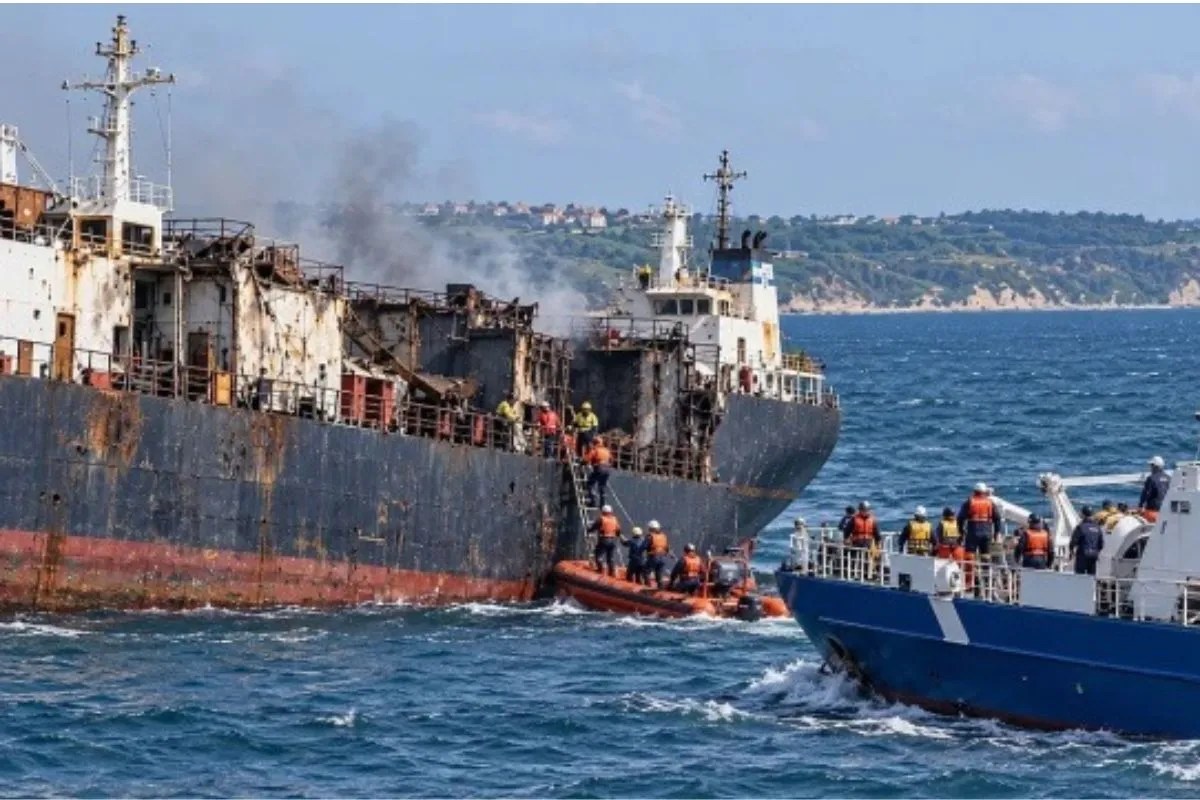
Three sea drones hit a container ship off Bulgaria. Cue the headlines. Cue the panic. Cue the lazy consensus that the Black Sea just became a death trap for commercial cargo.
Wrong. Dead wrong. Recently making headlines lately: Did Argentina Actually Help Bolsonaro Flee Brazil.
Every time an unmanned surface vessel clips a merchant hull near Bulgaria, headline writers reach for the same dusty playbook. Ships are under siege. Trade routes are collapsing. War has swallowed the sea lane whole. That lazy consensus mistakes noise for mechanics. It treats a single headline event like a permanent structural lock on maritime commerce.
I have spent years working around maritime risk, fleet routing, and war-risk underwriting. I have watched shipping desks and cargo owners blow millions chasing the wrong fix after a single strike. When a container ship takes a hit near Bulgaria, boardrooms panic and buy expensive overreactions while ignoring the real vulnerabilities sitting in plain sight: spoofed AIS transponders, thin hull plating near engine rooms, jammed satellite links, and crews exhausted by constant threat alerts. Further information into this topic are detailed by BBC News.
A sea drone hitting a container ship off Bulgaria matters. Nobody serious denies that. Unmanned surface vessels—low-profile, remotely piloted or semi-autonomous boats packing explosives or sensor payloads—have changed coastal security. Yet treating every strike in the Black Sea as proof that commercial shipping is doomed misses how modern maritime warfare actually works. Most naval drones are built for high-value warships, port infrastructure, or coercive signaling. A commercial container vessel is a different target with different physics, different economics, and a very different risk profile.
The Lazy Consensus Around Black Sea Strikes
Look at the standard story told whenever drones hit ships near Bulgaria. First, it assumes every strike signals a coordinated campaign to sink commercial trade. Second, it treats the Black Sea as an unnavigable zone where every hull has an equal chance of getting hit. Third, it pushes shipowners toward knee-jerk moves—halting voyages overnight, overpaying for reactive escorts, or obsessing over big-ticket hardware that does not fit a merchant budget.
That framing is lazy because it skips the basics of maritime economics and naval geometry.
A container ship is not a frigate. It does not carry Aegis radar, vertical launch cells, or dozens of point-defense gunners. It carries thousands of TEUs of steel boxes, a lean crew, high freeboard, and a schedule dictated by port slots and charter parties. When a sea drone hits a container ship off Bulgaria, the immediate shock is real—damage to plating, hull breaches, crew stress, insurance spikes, and delays. Still, a glancing blow or hull impact is not the same as sinking a deep-draft vessel or shutting down an entire basin.
War-risk underwriters in London—think Lloyd's Market Association listed areas and joint war committees—price risk based on pattern, exposure, and probability, not viral dread. When incidents cluster near specific corridors or coastal approaches, premiums jump and routes shift. When strikes look scattered, opportunistic, or tied to contested zones rather than a total blockade, markets adjust in steps rather than freezing forever. Headlines sell fear. Actuarial tables sell coverage.
What Most People Miss About Sea Drones and Merchant Hulls
Let us get precise on terms before we go further. A sea drone—technically an unmanned surface vessel (USV)—is a surface craft operating without a human crew aboard. Some are explosive one-way attack craft. Others carry reconnaissance gear, acoustic sensors, or decoys. Calling every one of them an unstoppable merchant-killer confuses capability with intent.
Here is the nuance the standard reporting misses: commercial ships rarely get hit because they are the primary military prize; they get hit because of proximity, misidentification, signal confusion, or gray-zone pressure.
In contested waters like the Black Sea, electromagnetic space gets messy fast. GPS and GNSS spoofing or jamming can push a vessel's reported position miles off course or blind navigation gear. Automatic Identification System (AIS) signals get turned off, altered, or faked. Small, low-freeboard USVs sit low in the water, blending into chop and clutter on standard shipboard marine radar, especially in rough sea states or poor visibility.
Imagine a scenario where a merchant master transits an active coastal corridor at night with intermittent GNSS drift, light clutter on X-band radar, and unannounced small craft operating without standard lighting or AIS broadcasts. Even a well-trained bridge team faces a compressed decision window. A strike can happen from tactical confusion, drifting mines or debris, or deliberate gray-zone harassment meant to rattle insurers and slow trade without triggering full-scale escalation.
There is another piece people overlook: container ships are built for volume, not survivability. Their double-hull designs in fuel spaces and cellular cargo holds give them structural mass, yet their sheer size and modest speed—often around 16 to 22 knots depending on vessel class and slow-steaming choices—mean they cannot simply outrun a fast surface drone in calm water. At the same time, their high sides make boarding harder than on a low-freeboard general cargo ship, and their sheer displacement means small charges often cause localized hull damage rather than instant sinking.
That nuance cuts both ways. A container ship off Bulgaria does not need to sink to disrupt a supply chain. A single damaged hull can force a diversion to Constanta or Varna, trigger a hull survey, tie up salvage or repair capacity, and cost a charterer hundreds of thousands of dollars in off-hire and delays.
People Also Ask: The Questions That Miss the Point
Are sea drones making commercial shipping in the Black Sea impossible?
No—and asking whether shipping is "impossible" sets up a false binary. Shipping is not a light switch that goes from safe to dead. It is a spectrum of risk managed through route adjustments, convoy or corridor protocols where available, hull inspections, and insurance pricing. Vessels keep moving when expected profit exceeds risk-adjusted cost, and pause when the math flips. Declaring the sea impossible ignores every cargo ship still completing runs between bursts of danger.
Why are ships targeted near Bulgaria instead of staying completely clear?
Geography does not care about comfort. Bulgaria sits on the western Black Sea coast, right along key approaches connecting regional ports, Bosphorus traffic flows, and eastern European trade routes. Cutting wide around every risk zone sounds great on a whiteboard until you calculate extra fuel burn, extra days at sea, crew fatigue, and missed berth windows. Ships hug practical corridors because fuel and time are real money every single hour.
Can merchant ships arm themselves or install heavy anti-drone gear?
On paper, slapping sensors, lasers, or heavy weapons onto a container ship sounds decisive. In the real world, it is a mess. Commercial crews are not trained naval gunners, rules of engagement in international and coastal waters are a legal minefield, port states regulate armed vessels tightly, and bolt-on military gear creates maintenance nightmares at sea. I have seen operators waste fortunes on flashy hardware that sat idle or broke down in salt spray while basic bridge discipline and early-warning lookouts got neglected.
How Smart Operators Actually Adapt (And Where My Approach Hurts)
If you run fleet operations, manage cargo risk, or advise maritime clients, stop reacting to single-incident shock and start hardening the things actually within your control.
- Audit bridge sensor fusion, not just radar. Train officers to cross-check radar returns against visual lookouts, VHF chatter, navigational warnings, and known GNSS interference zones rather than trusting a single screen.
- Drill for localized hull hits and navigation loss. Run tabletop and bridge drills for steering/navigation degradation and localized hull breaches near coastal approaches so crews do not freeze in the first ten minutes.
- Price delay and insurance volatility into contracts. Build realistic contingency buffers for rerouting, war-risk surcharges, and port congestion instead of pricing voyages as if waters near Bulgaria are peacetime millponds.
- Separate signal from noise. Track patterns over weeks—strike locations, vessel types hit, timing, and regional advisories—rather than overhauling an entire fleet schedule over one headline.
Now for the honest catch. My contrarian take has real downsides if you apply it carelessly.
First, downplaying threat urgency can make a complacent operator look reckless if a single strike hits a crewed vessel or sparks a sudden escalation. A statistic is cold comfort to a seafarer on watch or a family waiting for word after an impact. Second, waiting for "clear patterns" in a fast-moving conflict zone can leave you a step behind when tactical habits shift overnight. Third, relying on commercial resilience assumes adversaries want friction rather than total denial—an assumption that breaks the moment a belligerent decides to escalate from harassment to outright blockade.
Do not confuse a localized strike with the end of Black Sea trade, and do not confuse routine transit with immunity. Read the water, watch the mechanics, and protect the crew before the headlines catch up.