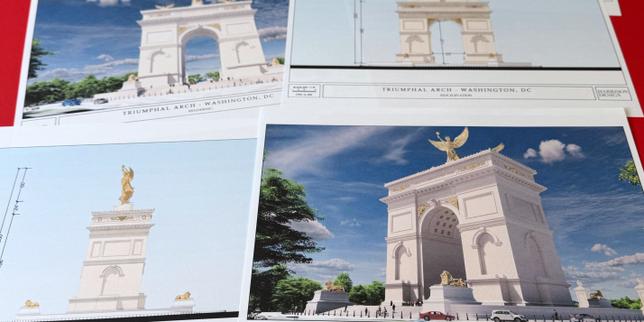
The architectural gossip mill is churning over the Trump administration’s proposal for a massive arch in Washington, D.C., supposedly modeled after the Arc de Triomphe. Critics are already lining up to call it a gaudy display of ego. Supporters are wrapping themselves in the flag, claiming it’s a long-overdue tribute to American exceptionalism. Both sides are missing the point so spectacularly it borders on the tragic.
Building a Roman-style triumphal arch in the 21st century isn't a bold statement of power. It’s a confession of creative bankruptcy. We are attempting to build a legacy by photocopying a Napoleonic monument that was itself a photocopy of Roman imperialism. If we actually wanted to signal American dominance, we’d stop raiding the bargain bin of 19th-century European aesthetics.
The Imitation Trap
Washington is already a city of neoclassical echoes. We have the columns, the domes, and the white marble. But there is a fundamental difference between the foundational architecture of the Founding Fathers—who used Greek and Roman motifs to signal a return to democratic and republican ideals—and dropping a literal French clone onto the National Mall in 2026.
The Arc de Triomphe works in Paris because it anchors the Place de l’Étoile. It is the literal center of a radiating web of avenues. It represents a specific moment in French history where imperial ambition met urban planning. Plunking a similar structure into the horizontal, sprawling logic of D.C. doesn’t create a "triumph." It creates a traffic nightmare and a visual non-sequitur.
When you see a developer build a "Tuscan villa" in the middle of a Florida suburb, you know instinctively that it’s fake. It lacks the soul of the soil. This proposed arch suffers from the same suburban logic. It’s "McMansion" urbanism on a federal scale.
The Logistics of Ego vs. Reality
Let’s talk about the actual engineering of "grandeur." The original Arc de Triomphe took 30 years to build. It was stalled by wars, regime changes, and technical hurdles. In the modern era of federal procurement, environmental impact studies, and partisan gridlock, a project of this scale is a recipe for a decade-long construction site that serves as a monument to bureaucracy rather than victory.
I have seen city councils and federal agencies burn through nine-figure budgets on "legacy projects" that end up being nothing more than expensive pigeons’ nests. The cost-to-utility ratio here is abysmal. If the goal is to honor veterans or celebrate American history, a giant block of stone is the least efficient way to do it.
Imagine a scenario where those hundreds of millions were diverted into revitalizing the actual infrastructure that veterans use. But no, we want the "grammable" moment. We want the silhouette. We are prioritizing the postcard over the person.
Dismantling the Triumphalism Myth
The core argument for the arch is that America needs a central symbol of "victory." But what does victory look like in the modern age? In 1806, victory was a line of infantry marching through a gate. In 2026, power is found in silicon, aerospace dominance, and economic resilience.
A stone arch is static. It is a dead object. It suggests that our best days are behind us and we are now in the "commemoration phase" of our civilization. Great powers build the future; declining powers build shrines to themselves.
If we want to disrupt the current architectural malaise in D.C., we should be looking at structures that defy gravity, not ones that lean into it with 100,000 tons of limestone. We should be commissioning architects who can translate the American spirit of innovation into glass, carbon fiber, and light.
The "People Also Ask" Delusion
People are asking: "Will it look like Paris?"
The answer is: "Who cares?"
Why is our benchmark for American greatness a city that hit its architectural peak under a monarch? This obsession with European prestige is a lingering colonial hangover. We don’t need to be "The Paris of the West." We are Washington.
Another common question: "Where would it even go?"
This is the real kicker. The National Mall is already crowded. Any new massive structure requires the demolition of green space or the obstruction of the existing sightlines between the Lincoln Memorial and the Capitol. To build this arch, you have to break the very thing that makes the Mall work: its openness. You are essentially putting a giant "Do Not Enter" sign in the middle of the nation’s front yard.
The Hard Truth About Monument Culture
Most modern monuments fail because they try to force a feeling rather than earning it. You cannot manufacture "awe" by simply increasing the scale of a project. The Vietnam Veterans Memorial is one of the most powerful sites in the world not because it’s big, but because it’s a wound in the earth. It’s intimate. It’s honest.
A giant arch is a shout. And as any seasoned communicator knows, if you have to shout to be heard, you’ve already lost the argument. This proposal is an architectural shout meant to drown out the complexities of modern American identity.
We are obsessed with the "greatest hits" of history. We want the Colosseum, the Parthenon, and the Arc de Triomphe. But those buildings were the "cutting edge" of their time. They were risks. Building a replica today isn't a risk; it’s a retreat. It’s the architectural equivalent of a movie studio releasing a reboot of a 50-year-old franchise because they’re too scared to greenlight an original script.
The Aesthetic Debt
Every time we build a fake historic building, we go further into aesthetic debt. we are telling future generations that we had nothing of our own to say. We are saying that in 2026, we were so bored and so uninspired that we just looked at what Napoleon did and said, "Yeah, that, but bigger."
The downside of my contrarian view? Sure, people like pretty things. They like things that look "traditional." They find comfort in the familiar. But comfort is the enemy of greatness. If the United States is to remain the world's primary cultural and political force, it needs to stop looking in the rearview mirror for its design cues.
Stop asking if we can build an arch. Start asking why we are so terrified of building something new.
Build a spire that touches the edge of the atmosphere. Build a bridge that connects more than just two banks of a river. Build something that doesn't require a history degree to understand. But for the love of everything actually American, stop trying to turn D.C. into a theme-park version of 19th-century Europe.
The Arc de Triomphe belongs to the French. It is their story. We should have the guts to write our own.