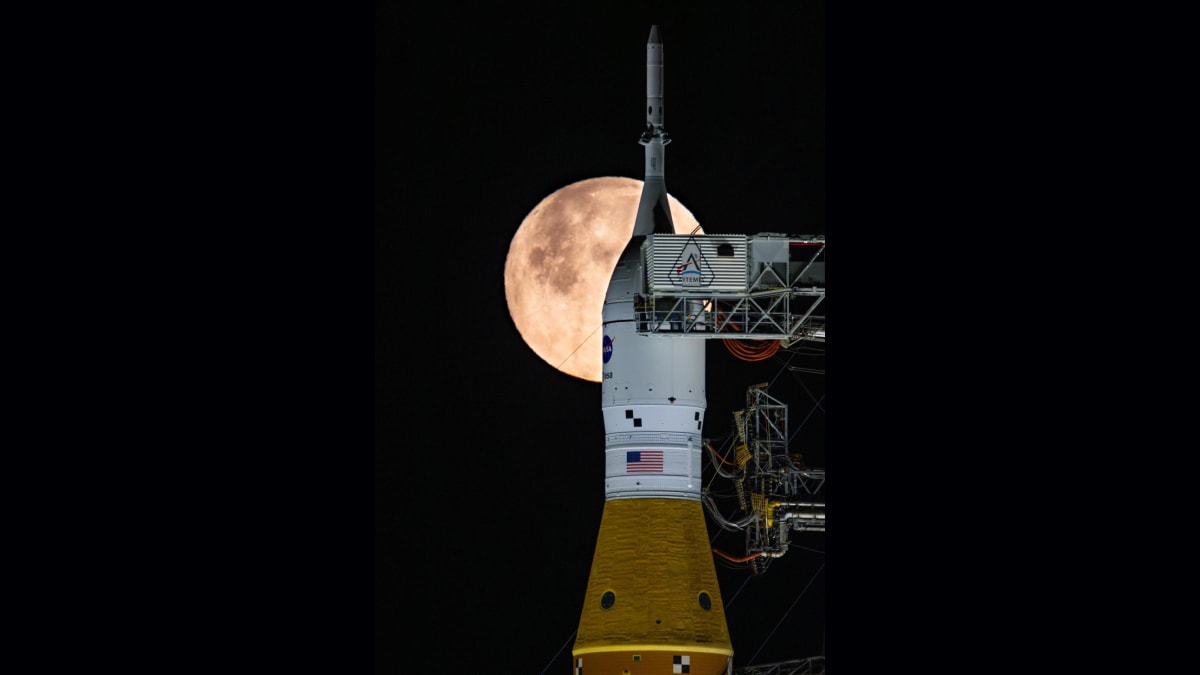
NASA is selling a comeback story, but they are actually peddling nostalgia at an astronomical markup.
The press releases for Artemis II read like a script for a Hollywood sequel nobody asked for. They want you to feel the 1969 magic. They want you to marvel at the four brave souls who will loop around the Moon and come straight back. They call it progress. In reality, Artemis II is a glorious, high-stakes lap of honor for a propulsion system that should have been retired decades ago.
While the "lazy consensus" in aerospace journalism treats this mission as a necessary stepping stone, the math suggests it is a PR-driven detour. We are spending billions to prove we can still do what we mastered during the Nixon administration, using refurbished Space Shuttle engines to launch a capsule that lacks a docking port for a lander that doesn’t exist yet.
The SLS is a Jobs Program in a Rocket Suit
The Space Launch System (SLS) is the heart of the Artemis program, and it is a technical dinosaur. Every time an SLS lifts off, we are burning four RS-25 engines. These are marvels of engineering, yes, but they are museum pieces. They were designed to be reusable. NASA is throwing them into the ocean after a single use.
Imagine buying a vintage Ferrari, driving it once to the grocery store, and then pushing it off a cliff. That is the SLS flight profile.
Industry insiders know the SLS wasn't built for efficiency; it was built for political geography. It’s a "Franken-rocket" stitched together from Shuttle-era components to keep specific contracts alive in specific congressional districts. When you prioritize keeping a factory open over the cost-per-kilogram to orbit, you aren't doing science. You’re doing high-altitude wealth redistribution.
The Orion Capsule is Overweight and Underpowered
NASA wants us to believe the Orion spacecraft is the apex of deep-space tech. Let’s look at the delta-v.
The European Service Module (ESM), which provides the "go" for Orion, has a shockingly thin margin for error. In its current configuration, Orion cannot actually get into a low lunar orbit and get back out on its own power. This is why NASA invented the "Near-Rectilinear Halo Orbit" (NRHO). They didn't choose that orbit because it was the best place to be; they chose it because it’s the only place the Orion can reach without running out of gas.
If you are building a deep-space exploration vehicle that can't actually maneuver into a standard orbit around your primary target, you haven't built a scout ship. You’ve built a buoy.
The Myth of the Necessary Stepping Stone
The most common defense of Artemis II is that we "need" to test the life support systems with humans on board before going to the surface. This sounds logical until you realize we’ve been keeping humans alive in Low Earth Orbit (LEO) for over twenty years on the ISS.
The risk-to-reward ratio of Artemis II is skewed. We are risking four lives to verify oxygen scrubbers and heat shields in a high-radiation environment—tasks that could be largely validated through uncrewed long-duration missions and advanced telemetry. We are sending humans because humans generate headlines, and headlines generate budgets.
The "People Also Ask" sections of the web are filled with queries like "Why hasn't NASA gone back to the moon?" The answer isn't a lack of technology. It's a lack of a coherent architecture. Artemis II is a "Free Return" trajectory. The crew won't even enter orbit. They will swing around the far side of the moon and let gravity whip them back toward Earth. It is a ten-day flyby. It is the world’s most expensive tourism package, funded by people who were told we were "colonizing" the moon.
The Starship Elephant in the Room
While NASA spends $2 billion per launch on the SLS, SpaceX is iterating on Starship at a fraction of the cost.
The contrast is embarrassing. NASA is building a single-use, billion-dollar disposable camera. SpaceX is trying to build a digital cinema rig that you can recharge. Even if Starship fails to meet its most ambitious timelines, its existence proves that the SLS architecture is a dead end.
The nuance that the mainstream media misses is the "opportunity cost." Every dollar spent maintaining the SLS supply chain is a dollar not spent on nuclear thermal propulsion, orbital fuel depots, or actual lunar habitats. We are so obsessed with the "how" of getting there that we have completely ignored the "what" we do once we arrive.
Radiation: The Problem We Are Ignoring
Artemis II will take the crew through the Van Allen belts and into deep space radiation for a week and a half. NASA will tell you the shielding is "robust." (Apologies, I mean "sturdy.")
In reality, we are still guessing at the long-term biological impact of galactic cosmic rays (GCRs) on human tissue outside the Earth’s magnetic field. Artemis II isn't long enough to provide meaningful data on chronic exposure, but it’s just long enough to be dangerous if a solar weather event occurs. We are playing a game of atmospheric Russian roulette for a mission that doesn't even touch the lunar dirt.
Stop Asking If We Can Go and Start Asking Why
The premise of the Artemis program is flawed because it treats the Moon as a destination rather than a resource.
If we were serious about a permanent presence, we wouldn't be launching capsules. We would be launching robots to mine polar ice to create fuel. We would be building the infrastructure for a "tugboat" economy in space. Instead, we are repeating the Apollo architecture with better computers and worse funding.
Artemis II is a political shield. It is designed to be "too big to fail" so that the next administration can't cancel it. It’s not about the Moon. It’s about the contracts.
The Hard Truth
I’ve seen programs like this before. They start with grand visions of "Sustained Presence" and end up as "Flag and Footprints" 2.0.
We are currently on a path where we will land on the Moon, take a few high-definition photos for Instagram, and then realize we can't afford to stay because our delivery truck costs $2 billion a trip.
Artemis II isn't the beginning of a new era. It’s the final gasp of the old one. We are sending four people to look at the Moon through a window because we aren't brave enough to admit that our current rocket technology is a financial black hole.
We don't need a flyby. We need a fundamental shift in how we exit the atmosphere. Until we stop throwing away our engines and start refueling in orbit, we are just playing at being a spacefaring civilization.
The Moon isn't 238,000 miles away. It’s forty years of bad policy away.
Stop celebrating the flyby and start demanding a reusable architecture that doesn't treat the taxpayer like an ATM for the 1970s aerospace industry.