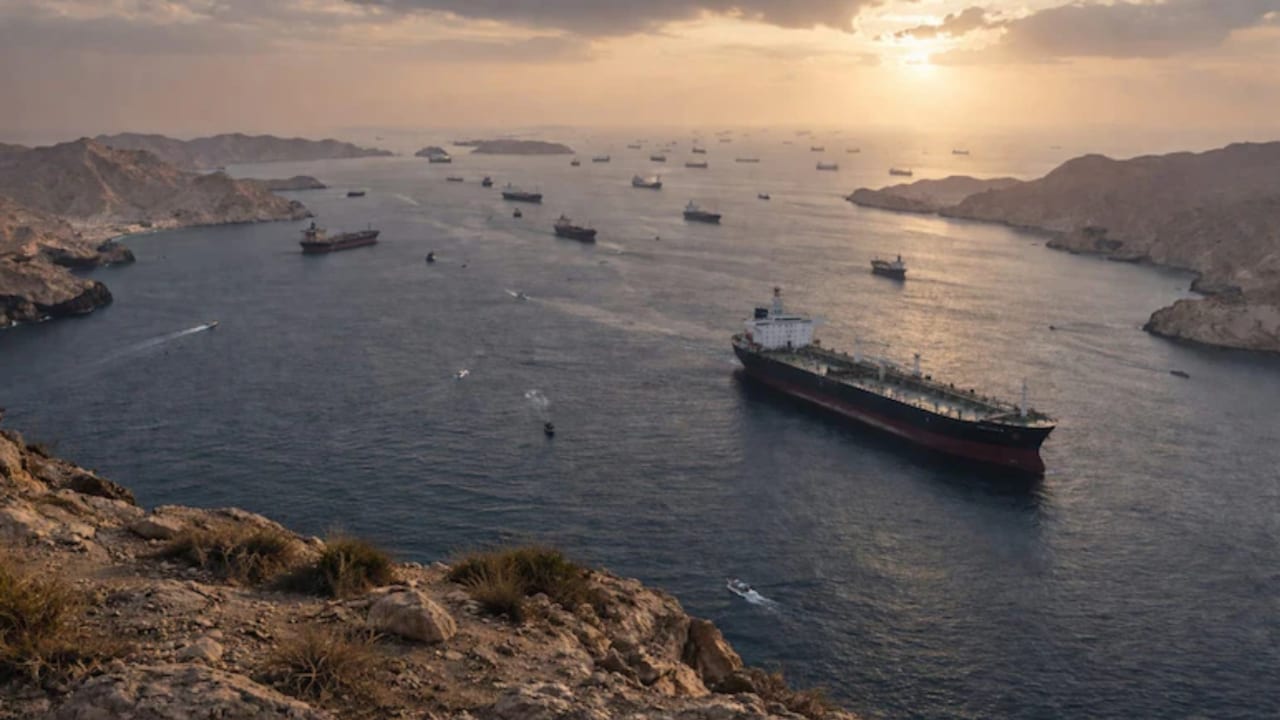
Salt air sticks to the skin in the Strait of Hormuz. It carries the heavy scent of burning crude, diesel exhaust, and an ancient, baked dust that blows off the jagged peaks of the southern coast. Stand on the deck of a container ship crawling through those twenty-one miles of water, and you feel entirely small. The water is a flat, hyper-saline blue, glittering under a sun that offers no mercy.
To the north lies Iran, its mountains rising like sleeping beasts out of the haze. To the south, the concrete-and-glass ambition of the Arabian Peninsula glimmers across the horizon. Between them runs a watery bottleneck that carries a fifth of the petroleum consumed on this earth.
Everything depends on this narrow slot. Your morning commute. The plastic dashboard of your car. The fertilizer that fed the wheat for your breakfast toast. The global economy is tethered to a tightrope, and right now, someone is bouncing on it.
The Geography of Anxiety
Consider the geometry of survival. The Strait is twenty-one miles wide at its absolute broadest point, but the inbound and outbound shipping lanes are each just two miles wide. Sandwiched between them is a three-mile-wide buffer zone designed to keep massive supertankers from ramming into each other in the dark.
It is a marine highway built for giants. A fully loaded Very Large Crude Carrier displaces hundreds of thousands of tons. It cannot stop quickly. It cannot turn on a dime. It requires miles of forward momentum to alter its course by a few degrees.
And everyone knows it.
For decades, the strategic calculus of the region rested on a grim, predictable balance. Iran held the northern shore, studded with missile batteries, fast attack craft, and coastal defense networks. The United States Navy maintained a steady, heavy presence in the Persian Gulf, a floating iron shield meant to guarantee that the oil kept flowing. It was a cold peace built on mutual deterrence. Diplomacy was the fragile language spoken in Geneva or Vienna, while gunboats stared each other down across the salt water.
Lately, the grammar of that conversation has frayed.
When diplomacy stalls—when sanctions bite deeper, when talks in distant capitals break down over enrichment percentages and regional proxies—the pressure has to go somewhere. Physics dictates that energy cannot be created or destroyed; it merely changes form. In geopolitics, when political energy can no longer move forward through negotiation, it cascades downward into threat and counter-threat.
Tehran’s recent posture is not born in a vacuum. It is the product of closed-door meetings where officials look at stalled negotiations and calculate their leverage. If the economic tourniquet tightens around Iran, the calculation goes, the Islamic Republic can tighten a tourniquet of its own around the global energy supply.
They do not need to conquer territory. They only need to threaten the lane.
The View From the Bridge
Imagine Captain Sarah Al-Harthy standing on the navigation bridge of a flagged tanker, her eyes fixed on the radar screen. It is 3:00 AM. Outside, the night is pitch black, broken only by the navigation lights of distant vessels and the steady amber glow of the ship's instrumentation.
She has made this transit a dozen times. Normally, she listens to the steady thrum of the two-stroke diesel engine beneath her feet, a reliable heartbeat that reassures the crew. Tonight, the silence on the bridge feels heavy.
On channel 16, the maritime radio crackles with routine chatter, but underneath it lies an electric tension. Everyone is listening for the hail. Everyone is waiting to hear if a Revolutionary Guard fast boat is cutting across their bow without its transponder on, testing the reaction time of the bridge crew.
"They come out of the grey," Sarah says quietly, describing a reality known to every mariner who plies these waters. "You see a fiberglass hull bouncing over the chop at forty knots. They have heavy machine guns mounted on the front. They don't answer the radio immediately. They just get close enough to make you feel the heat of their engines, and then they veer off at the last second."
It is psychological warfare executed at sea level.
When Iranian officials state that they are prepared to take the offensive in Hormuz if diplomatic efforts with Washington completely fail, they are speaking the language of maritime disruption. They are reminding the world that their geographic position gives them a natural veto over global commerce.
The threat is multifaceted. It involves sea mines dropped discreetly in the dead of night. It involves swarms of armed speedboats designed to overwhelm radar systems through sheer volume. It involves anti-ship cruise missiles capable of turning a floating fortress into a blazing torch.
The goal is not necessarily to start a protracted total war. The goal is to raise the cost of insurance, spike the price of a barrel of oil, and inject a paralyzing dose of uncertainty into the global supply chain until foreign capitals come back to the table on Tehran's terms.
The Cost of a Closed Valve
We forget how fragile our modern life is because we have engineered away the inconvenience of distance. We flip a light switch, and coal or natural gas burns miles away. We turn a key, and refined crude moves our metal boxes down the asphalt.
Price is the nervous system of the market. When the Strait of Hormuz sputters, the nervous system convulses.
Insurance rates for ships transiting the Persian Gulf skyrocket overnight. Underwriters sitting in London or Singapore look at the satellite feeds, calculate the risk of a missile strike or an impoundment, and add millions of dollars to a single voyage's premium. Those costs do not get absorbed by shipping conglomerates. They trickle down, drop by drop, into the cost of plastic, fertilizer, jet fuel, and gasoline.
A single confrontation in those narrow waters can ripple through a grocery store checkout lane in Ohio, a manufacturing plant in Germany, and a power grid in Japan within forty-eight hours.
This is the invisible leverage that Iran holds. It is a form of asymmetric gravity. While the United States possesses unmatched military might—aircraft carriers that act as floating cities, stealth aircraft, and global surveillance networks—it cannot easily protect every single commercial hull from the chaos of a disrupted choke point. You can park an armada in the region, but an armada cannot stop a determined adversary from dropping a mine in a shipping lane under the cover of a moonless night.
The Human Element in the Crosshairs
Behind the strategy papers and the press releases from foreign ministries are ordinary people trying to do their jobs.
Consider a young engineer in the engine room of a Liberian-flagged bulk carrier, a twenty-four-year-old thousands of miles away from his family in the Philippines. He doesn't read the daily intelligence briefs on regional stability. He only knows that his contract is for nine months, that his father's medical bills depend on his remittances, and that the air conditioning down in the lower decks is humming with a slightly different vibration tonight because the ship is steaming at maximum speed to clear the danger zone.
Or consider the naval officers on American destroyers patrolling the Gulf of Oman, subsisting on coffee and lack of sleep, tracking dozens of surface contacts simultaneously. They are trained to make life-or-death decisions in fractions of a second. A misjudged radar blip, a misread signal from an Iranian patrol craft, or a communications failure can spark an escalation that no one in Washington or Tehran actually wants.
Wars rarely start because two nations wake up and decide to destroy each other. They start because a series of small, volatile miscalculations accumulate until retreat becomes politically impossible.
The Limits of Iron
For decades, the default response to regional friction has been more steel. Send another carrier group. Deploy more fighter jets to regional airbases. Issue stronger warnings.
Yet, steel cannot solve a diplomatic impasse. It can deter, it can defend, and it can retaliate, but it cannot forge a durable peace. Every time a warship steams into the Persian Gulf to answer an Iranian threat, the baseline level of tension ratchets upward. The sea becomes more crowded. The margins for error shrink.
Diplomacy is messy. It requires talking to adversaries, offering concessions that feel bitter to domestic constituents, and enduring agonizingly slow negotiations where progress is measured in millimeters. But the alternative—the offensive posture in the Strait of Hormuz—is a shortcut to catastrophe.
When leaders talk about taking the offensive in narrow waters, they are playing a high-stakes game of chicken where both vehicles are careening toward the edge of a cliff. They assume the other driver will swerve first.
The danger is that both drivers might believe their own rhetoric until it is too late to turn the wheel.
The Quiet Watch
Back out on the water, the sun begins to rise over the Hajar Mountains, washing the limestone cliffs in a pale, bruised violet. The night shift on the bridge of the container ship changes over. Coffee is poured. The radar screens continue to sweep, painting green lines across darkened displays, searching for anything that does not belong.
The world hundreds of thousands of miles away goes about its morning routine, blissfully unaware of the twenty-one miles of salt water where the global pulse beats.
The ships keep moving, one after another, nose-to-tail down the narrow lanes. They carry our energy, our goods, and our fragile stability through a corridor guarded only by watchfulness and the hope that cooler heads will prevail before the rhetoric turns into fire.
The surface of the gulf remains flat, hiding everything beneath its brilliant blue skin.


