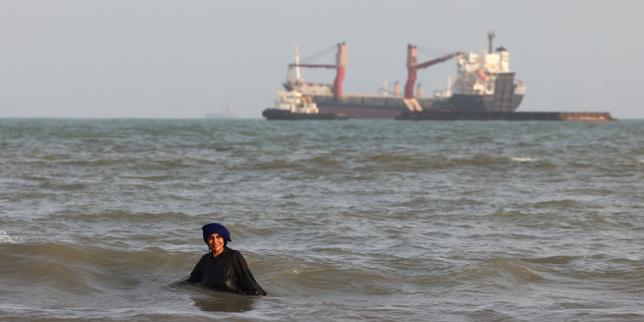
Salt crusts the corners of a sailor's eyes long before the sun clears the jagged peaks of the Musandam Peninsula. Dawn in the Strait of Hormuz does not arrive with gentle light. It burns through the violet haze like a welding torch, turning the Gulf of Oman into a sheet of hammered brass.
Here, the water is crowded. Massive tankers, their hulls swollen with millions of barrels of crude oil, plow slow and deliberate paths through channels no wider than a country lane. On the bridge of one such vessel, operated by the Emirati shipping giant Adnoc, the hum of the engine room is a steady, reassuring heartbeat. Or at least, it was.
Then comes the rupture.
Imagine, if you will, standing on that bridge as the afternoon shadows stretch long and thin across the deck. You are tracking the horizon on radar, watching the blips of fishing skiffs and container ships. Suddenly, the air changes. A metallic screech tears through the quiet, followed by a concussive thump that rattles teeth and sends coffee splashing across the console. Smoke begins to boil up from the starboard side.
This is not a mechanical failure. It is the third time in less than twenty-four hours that a shadow has reached out from the dark corners of these chokepoints to strike a passing ship.
When we talk about geopolitical flashpoints in corporate boardrooms thousands of miles away, we speak in the antiseptic language of supply chains, futures contracts, and basis points. We look at spreadsheets. We track the price of Brent crude with clinical detachment. But supply chains do not bleed. Ships bleed. Crews bleed. Real people, standing watch in the oppressive humidity of the Persian Gulf, face the terrifying realization that the narrow strip of water separating Oman and Iran has transformed into a gauntlet.
Consider the geography. At its narrowest point, the Strait of Hormuz is just twenty-one miles wide. Within that restricted corridor lies the shipping lanes through which roughly a fifth of the world's petroleum consumption passes daily. It is the jugular vein of global energy. When a hand tightens around that neck, the pulse of the entire planet stutters.
Within a single frantic twenty-four-hour window, three separate vessels found themselves in the crosshairs. For the Adnoc tanker crew, the attack was not a breaking news alert on a glowing smartphone screen. It was fire, alarm bells, and the frantic scramble to assess hull integrity while praying the cargo tanks would hold. It was the sudden, sickening realization that routine transit had become a high-stakes gamble.
Why does this happen here?
History offers a grim template. Narrow waters have always tempted those who wish to disrupt empires without facing them in open battle. From the Barbary corsairs to modern asymmetric skirmishes, geography has been weaponized. When tension rises between regional powers, the Strait becomes the primary instrument of economic leverage. It is a choke point where a handful of actors can hold hostage the energy security of nations continents away.
The mechanics of the disruption are deceptively simple. You do not need an armada to paralyze trade. You only need uncertainty. Insurance rates skyrocket overnight. Shipowners hesitation turns into anchored standstills off the coast of Fujairah. Crews refuse to sign contracts for Gulf routes. And just like that, the invisible friction of fear costs millions of dollars per hour, long before a single drop of oil is actually lost to fire or flood.
Let us step back for a moment from the radar screens and the tanker traffic to examine the human cost of this maritime volatility.
On a vessel like the Adnoc carrier, the multinational crew represents a cross-section of the global maritime workforce. Engineers from South Asia, officers from Eastern Europe, deckhands from coastal villages thousands of miles from the Persian Gulf. They left home for predictable reasons: to send children to university, to build a house, to secure a future. They did not sign up to become frontline combatants in a silent economic war.
When a ship is struck, the trauma ripples outward in concentric circles. It reaches the families waiting by phones in quiet coastal towns. It reaches the port authorities frantically rerouting traffic. It reaches the commodities traders in London and Singapore who watch the ticker tape spike with every rumor of smoke on the horizon.
Yet, life on the water demands a peculiar brand of stoicism.
Hours after an attack, once the fires are extinguished and the damage is cataloged, the survivors must keep watch. The engines cannot simply be turned off. The ship must steer clear of hazards. The global machine requires constant feeding. This is the paradox of modern logistics: we demand seamless, invisible abundance while relying on exposed human beings navigating the most dangerous waters on Earth.
We often miscalculate the vulnerability of our modern systems. We build massive economies predicated on the assumption that energy will always flow, that routes will always remain open, that the invisible hand of the market will smooth out every tremor. But the hand is connected to an arm, and the arm is vulnerable.
When three tankers are struck in rapid succession in the Strait of Hormuz, it is not merely an isolated incident of regional maritime insecurity. It is a stress test for the global nervous system. It reminds us that civilization is a thin veneer stretched over miles of open ocean and volatile politics.
The smoke clears slowly over the Gulf of Oman. The damaged hulls are towed to safe anchorages for inspection and repair. Investigators comb through charred steel for forensic clues, trying to determine the exact vector and origin of the strikes.
Out in the channel, another tanker enters the strait. The captain adjusts his cap, squints into the blinding glare of the morning sun, and watches the radar sweep in a steady, hypnotic circle. The world needs the oil. The cargo must get through. And so the human story of courage and vulnerability continues, suspended precariously between the vastness of the sea and the narrowness of the passage.