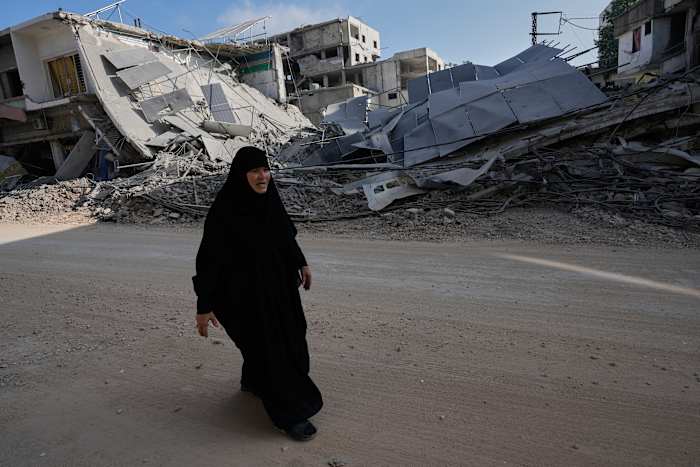
Mainstream war reporting operates on a lazy, predictable playbook. When a truce is signed, reporters stand at a border crossing, count three families driving a beat-up sedan packed with mattresses, and file a story about "shattered lives failing to return." The recent US-Iran brokered cessation of hostilities is receiving the exact same superficial treatment. Pundits look at Nabatiyeh—a critical hub in southern Lebanon—see empty streets, and conclude that the truce is an empty shell because localized skirmishes persist nearby.
They are asking the entirely wrong question. They ask why people aren't returning, assuming the metric of a successful diplomatic framework is an immediate, naive stampede back into a zone of friction. In related updates, we also covered: Why the Media Is Completely Misreading Iran's Red Lines in Lebanon.
They are missing the tactical reality of survival. The empty streets of Nabatiyeh are not a sign of diplomatic failure. They are evidence of a highly sophisticated, deeply calculated risk-management strategy honed by a population that has survived over forty years of asymmetric warfare.
The Myth of the Automated Homecoming
Western newsrooms love the narrative of the desperate refugee rushing home the second the ink dries on a piece of paper in Washington or Tehran. It makes for clean television. But it ignores the structural reality of how southern Lebanon functions. NPR has also covered this fascinating issue in extensive detail.
When a truce is declared, the corporate media expects an all-or-nothing response. If people stay in Beirut or the Chouf mountains, the truce is labeled a failure. If they return, it is a success. This binary framework is childish.
The reality is a staggered, heavily engineered tribal deployment. Families do not pack up the kids and the elderly on day one. Instead, they send a single scout—usually a young or middle-aged male family member. This scout goes back to assess three concrete variables that no international journalist can capture from a hotel balcony in Beirut:
- Structural Integrity: Is the concrete compromised, or is it just superficial shrapnel damage?
- Utility Infrastructure: Corporate media reports on "fighting nearby," but the real dealbreaker is whether the local water pumping station is operational and if the local generator cartel has fuel.
- Local Supply Chains: A city cannot repopulate if the local bakeries and pharmacies do not have a reliable route to restock from the Bekaa or Beirut.
To look at Nabatiyeh, note the low population density three weeks after a truce, and claim the truce is failing is to mistake tactical caution for total abandonment. I have covered conflicts across the Levant for fifteen years, and this pattern repeats with mathematical precision. The population waits. They calculate the burn rate of their savings in temporary rent versus the physical risk of a stray artillery shell. It is a cold, business-like optimization problem, not an emotional reaction to geopolitical headlines.
Dismantling the Bored Pundit Architecture
Go look at the standard queries popping up on search engines regarding this conflict. "Why is Nabatiyeh still empty?" "Is the US-Iran truce holding?" "Is it safe to travel to southern Lebanon?"
These questions rest on a flawed premise. They assume safety is a binary toggle switch. In a region defined by proxy warfare and fluid frontlines, safety is a sliding scale.
Let’s answer the common question brutally honestly: Is the truce holding if there is fighting nearby?
Yes, because this is a localized containment framework, not a grand peace treaty. The US-Iran agreement was never designed to turn southern Lebanon into Switzerland overnight. It was designed to establish a macro-level ceiling on escalation—to prevent a multi-front regional conflagration that drags global energy markets into chaos. Localized border skirmishes, artillery duels between non-state actors, and tactical positioning are expected byproducts of a cold peace.
To expect a complete cessation of every single kinetic event is to misunderstand the limits of diplomatic leverage over decentralized militias. The heavy hitters—the diplomats in DC, the strategists in Tehran, and the high commands of the respective armed forces—measure success by the absence of ballistic missile salvos hitting major population centers, not by whether a farmer can safely harvest tobacco two kilometers from the Blue Line.
The Real Estate Paradox of Nabatiyeh
There is a dark economic reality that the "human interest" style of journalism completely glosses over. The delay in return is deeply tied to property economics and remittance flows.
Southern Lebanon is heavily subsidized by the diaspora. Millions of dollars flow monthly from West Africa, Michigan, and the Gulf straight into these towns. This creates an economic cushion that allows displaced families to wait out a conflict indefinitely. They are not trapped in squalid tents with no options; many have secondary apartments in the mountains or relatives with deep pockets.
Therefore, the decision to remain displaced is an economic luxury that the mainstream narrative fails to recognize. If a family has the financial runway to stay in a safe rental in Mount Lebanon for another three months to see if the truce solidifies, they will do exactly that. The working class and the agrarian laborers return first because they have to get their hands back into the dirt or reopen their shops to survive. The middle and upper-middle classes—disproportionately represented in towns like Nabatiyeh through diaspora wealth—can afford to wait.
What looks like fear and instability to an outside observer is actually financial resilience.
The Danger of Our Counter-Intuitive View
Let’s be completely transparent about the downsides of this perspective. By acknowledging that a staggered, slow return is normal and that localized fighting doesn't equal a broken truce, we risk normalizing a state of perpetual low-level conflict. It provides a cynical cover for politicians and international bodies to say "the situation is stable enough" while people are still dodging mortar fire on the outskirts of town.
It is an uncomfortable truth. It means accepting that for the people of Nabatiyeh, normal life includes an acceptable threshold of violence. But ignoring this reality and pretending that every truce must result in an immediate, flawless repatriation only leads to bad policy, flawed humanitarian responses, and cyclical disappointment when the media's unrealistic expectations aren't met.
Stop looking at the empty highways heading south as proof of a failed diplomatic mission. Start looking at them as a mirror of a population that knows exactly how international agreements work: they are written in water, signed by hypocrites, and verified only by the passage of time. The people will go back when their own scouts say it's time, not when a spokesperson in Washington says it's safe.