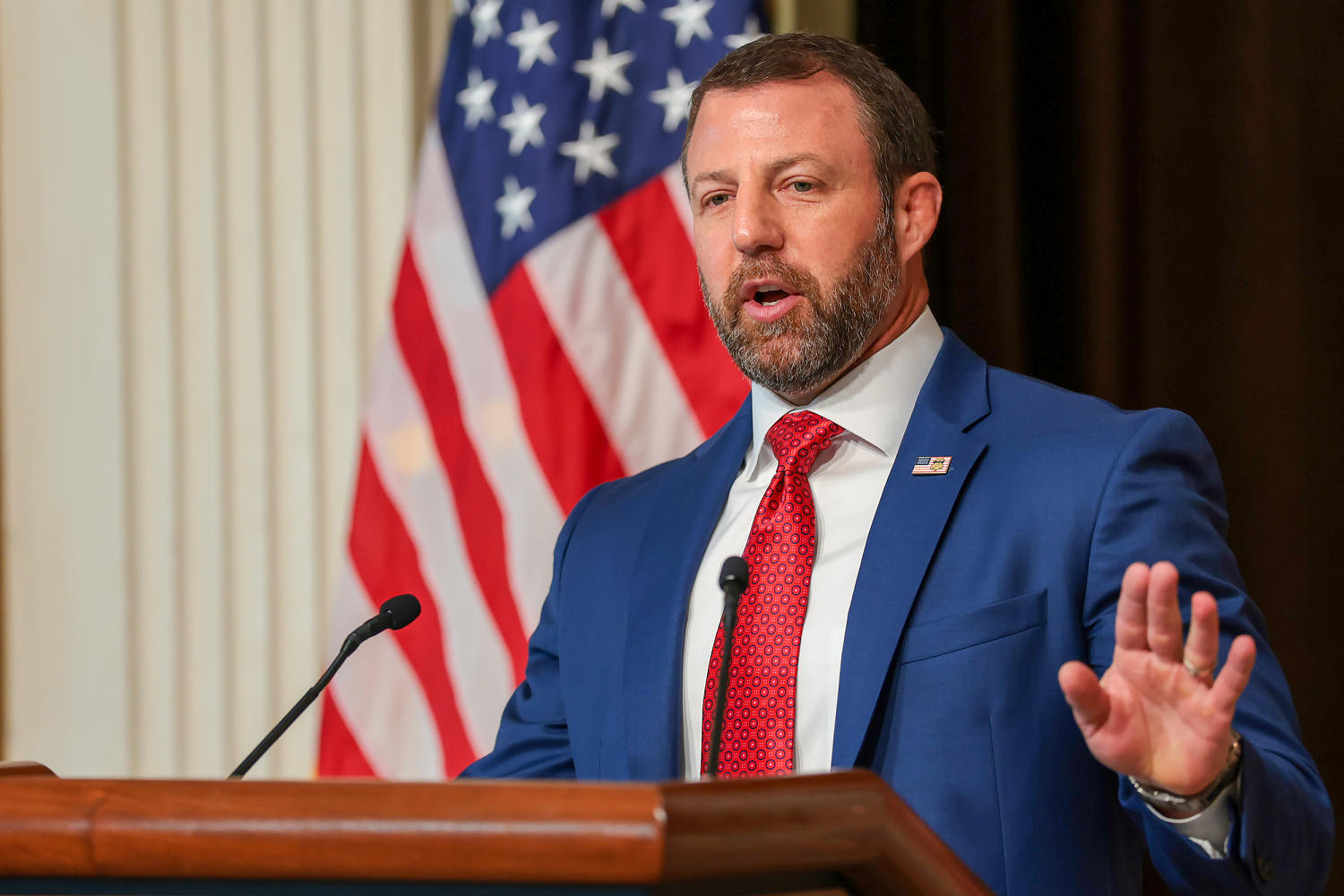
The media freakout over Homeland Security Secretary Markwayne Mullin demanding states scrub their voter rolls is a masterclass in missing the point.
Pundits are screaming that the federal government is launching an unprecedented coup against state election sovereignty. They want you to believe that checking voter registration lists against a federal database is a threat to democracy itself.
They are wrong. They are hyperventilating over standard data hygiene because it fits a convenient political narrative.
The real story isn’t an authoritarian power grab. It is an administrative data-matching disaster waiting to happen, disguised as a constitutional crisis.
The Lazy Consensus on Election Sovereignty
The core argument filling current headlines is simple: the Constitution gives states the sole authority to run elections, so the Department of Homeland Security has no business looking at voter rolls. Anyone repeating this is fundamentally misunderstanding how federal-state infrastructure actually works.
I have spent years watching government agencies attempt to share data. The federal government blackmails states into compliance every single day. They do it with highway funding. They do it with education grants. They do it with Medicaid. Mullin’s threat to withhold federal grant funding from states that refuse to secure their voting infrastructure is not a legal anomaly. It is the standard operating manual for Washington, D.C.
To argue that states should operate their voter registration systems in a complete silo is to advocate for willful blindness. Every corporation in America cleans its databases. If a bank kept records as messy as the average state’s voter rolls, federal regulators would shut them down by Friday afternoon.
The Real Crisis is the SAVE Database
The mainstream narrative focuses entirely on Mullin's aggressive rhetoric. But if you want to understand the actual failure here, you have to look at the tool he is forcing states to use: the Systematic Alien Verification for Entitlements (SAVE) database.
This is where the contrarian truth lies. The problem isn't that DHS is auditing voter rolls. The problem is that the SAVE database is structurally incapable of doing what Mullin claims it can do.
Why SAVE Fails at Election Auditing
- It’s a Snapshot, Not a Stream: SAVE was built to verify eligibility for federal benefits, like housing or Medicaid. It tracks noncitizens who interact with immigration services. It is not a real-time ledger of who is a citizen today.
- The Naturalization Lag: When a legal immigrant becomes a U.S. citizen, the administrative paperwork can take months, sometimes years, to update across every interconnected federal system.
- False Positive Disasters: Because of this built-in lag, running millions of state voter names through SAVE naturally flags hundreds of thousands of completely legal, naturalized citizens as "noncitizens".
When Mullin claims that DHS found 250,000 noncitizens registered across California, New Jersey, Nevada, and Pennsylvania, he isn't lying about the data output—he's misinterpreting it. He is looking at a pile of naturalized citizens whose status changes haven't cleared the federal bureaucracy and calling them illegal voters.
Why Activist Judges are Actually Right on the Law
Mullin lashed out at what he called "activist judges" who barred DHS from using the database to force voter removals. He is attacking the wrong target. The courts aren't blocking these scrubs because they hate election security; they are blocking them because the National Voter Registration Act (NVRA) explicitly forbids systematic voter purges within 90 days of a federal election.
Imagine a scenario where a state runs its list through SAVE sixty days before an election. The system flags 50,000 naturalized citizens due to a clerical delay in DHS paperwork. Those voters are stripped from the rolls. They show up on election day and are forced to cast provisional ballots that may never be counted.
That isn't security. That is administrative incompetence masquerading as enforcement.
The Hypocrisy of State Election Chiefs
The outrage from state election officials isn't entirely pure, either. Both Democratic and Republican secretaries of state are pushing back on these letters because they know their own backend data architectures are fragile.
Many state voter rolls are held together by digital duct tape and prayer. They don't want the federal government poking around because it exposes how poorly they manage their own lists. They change their criteria for voter maintenance depending on which way the political wind blows.
If states were actually serious about maintaining clean lists, they wouldn't need a threat from a DHS Secretary to do it. They would have built cross-state data-sharing consortiums that work, rather than abandoning programs like the Electronic Registration Information Center (ERIC) over political theater.
Stop Asking if it’s Legal and Start Asking if it Works
The debate over Mullin’s speech is stuck in a loop about whether a DHS chief can legally threaten local election workers. That is the wrong question.
The question we should be asking is why the federal government possesses the data to verify citizenship for taxes, employment, and passports, but lacks a clean, centralized mechanism to help states verify it for voting.
We have a massive structural disconnect. The federal government owns the citizenship data. The states own the voter lists. The bridge connecting them is a broken, outdated benefits database called SAVE.
If Mullin wants to secure an election, he needs to stop threatening secretaries of state with jail time and start fixing the broken data pipelines inside his own building. Until the federal government can guarantee its own immigration records are accurate up to the minute, forcing states to use them as a blunt instrument isn't fixing the system. It's just breaking it differently.