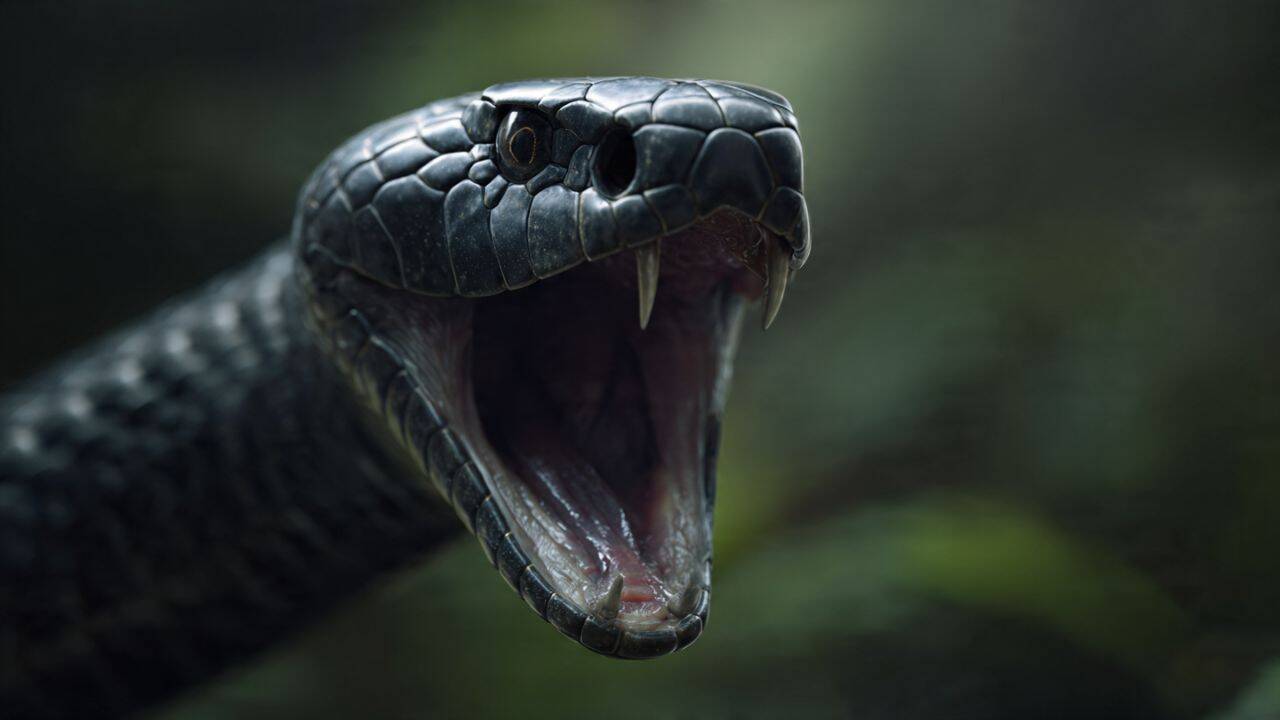
Ask anyone outside of sub-Saharan Africa to name the continent's most terrifying animal, and the black mamba usually wins the vote. Tabloid journalism thrives on turning Dendroaspis polylepis into an omnipresent phantom, a cartoonish villain waiting behind every bush from the Cape of Good Hope to the Horn of Africa. Casual travel articles love to rank countries by supposed mamba density, as if wildlife conservation boards keep a precise census of every scaly resident slithering through the acacia scrub.
The reality of where the black mamba lives is far more complex than a simple listicle of hotspots. True geographic distribution is dictated by ecological niches, shifting human footprints, and hard environmental limits rather than arbitrary national borders. Understanding the actual expanse of this legendary elapid requires stripping away sensationalism to examine how topography and habitat shape its true strongholds across the African continent.
Mapping the Sub-Saharan Range
The black mamba is not evenly distributed across Africa, nor does it occupy every nation within sub-Saharan boundaries. It is fundamentally a creature of savannas, open woodlands, rocky hillsides, and dry river valleys.
Nations possessing vast tracts of low-lying, semi-arid bushveld and rocky outcrops naturally host the highest density of established populations. South Africa, Zimbabwe, Kenya, Tanzania, and Zambia frequently dominate discussions of black mamba encounters because their specific biomes align perfectly with the snake's evolutionary requirements.
However, counting individual snakes by country is an exercise in futility. Herpetologists do not have reliable population metrics for wild elapids spread across thousands of square miles of dense brush. Instead, researchers map presence zones based on ecological suitability.
South Africa's lowveld regions, particularly within provinces like KwaZulu-Natal and Limpopo, provide ideal conditions. Yet, move into the hyper-arid deserts of the Kalahari or high-altitude mountain peaks, and the black mamba disappears entirely. It is a creature bound by altitude ceilings and moisture floors, rarely thriving above 1,800 meters or deep inside closed-canopy tropical rainforests where its cousin, the Jameson's mamba, takes over.
The Ecological Pressures Driving Distribution
Why do mambas concentrate where they do? The answer lies in prey availability and thermal regulation.
As ectotherms, black mambas rely entirely on external ambient heat to manage their metabolic rates. Open savannas and rocky outcroppings offer an abundance of sun-baking sites alongside deep, stable retreats like abandoned termite mounds, rock crevices, and hollow tree trunks. These permanent lairs are vital. Unlike nomadic hunters, a undisturbed black mamba returns to the same home base for years.
Furthermore, the distribution maps mirror the migratory pathways and population densities of small mammals and avian species. The snake's diet consists primarily of rock hyraxes, bushbabies, mice, rats, and tree-roosting birds. Where agricultural expansion creates disturbed ecotones—edges where farmland meets wild bush—rodent populations explode.
This human-induced environmental shift accidentally rolls out a welcoming mat for opportunistic predators. Far from retreating into untouched wilderness, black mambas frequently adapt to rural agricultural zones, drawn in by the very pests that follow human grain stores.
The Human Factor in Mamba Hotspots
A high concentration of black mambas in a given country does not automatically translate to a high rate of human fatalities, but it does amplify the friction of coexistence. In nations like Eswatini, Zimbabwe, and rural parts of Kenya, encounters often happen near homesteads bordered by overgrown brush or rocky kopjes.
Yet, the danger is frequently overstated by popular myth. The black mamba possesses an undeserved reputation for unprovoked aggression. Field biologists who have tracked Dendroaspis polylepis for decades describe a remarkably nervous animal. When cornered, its defensive display—gaping its jet-black mouth and raising its hood—is a desperate warning designed to scare away threats, not an opening gambit for an unprovoked strike.
The real crisis in high-mamba regions is infrastructural, not behavioral. The disparity in survival rates between a farm worker bitten in a remote Zimbabwean district and a suburban resident bitten near Pretoria comes down entirely to the speed of medical evacuation and the availability of polyvalent antivenom. In many rural pockets across the snake's range, basic emergency transport remains scarce.
The geography of risk is ultimately drawn by healthcare access. A mamba living deep inside a protected national park in Tanzania poses zero threat to humanity until human infrastructure encroaches upon its domain. As expanding agricultural projects and housing developments carve deeper into sub-Saharan bushveld, the overlap between human activity and mamba habitat intensifies.
The countries with the most black mambas are simply those where vast, unaltered landscapes still accommodate one of the planet's most formidable predators. Respect for the species requires acknowledging its ecological place rather than reducing its range to a checklist of fear.

.png?itok=1mb05mKJ)

