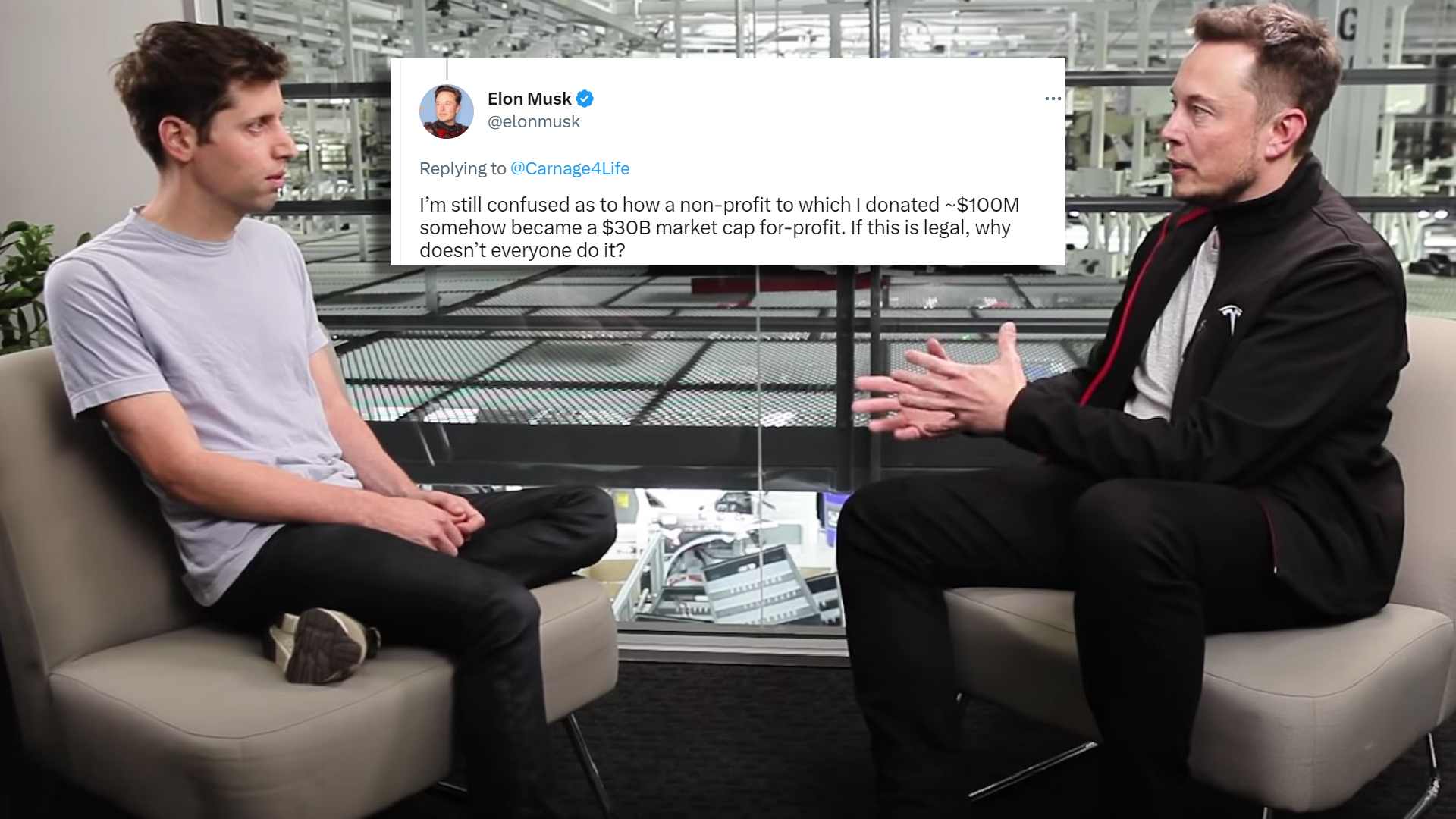
Elon Musk’s legal assault on OpenAI has moved past simple breach-of-contract grievances into a full-scale character assassination of Sam Altman. As the trial begins, the central allegation is no longer just about open-source code or profit margins; it is about the alleged "theft" of a non-profit mission. Musk claims Altman systematically stripped a charitable organization of its intellectual assets to build a private empire, effectively turning a "gift to humanity" into a proprietary goldmine for investors. This isn't just a corporate dispute. It is a fundamental reckoning for the venture capital model that governs the most powerful technology ever built.
OpenAI started in 2015 as a safe haven from the perceived dangers of corporate-controlled artificial intelligence. The pitch was simple: a non-profit research lab that would share its findings with the world to prevent a single company—specifically Google—from monopolizing the future. Musk provided the initial capital and the brand power. Altman provided the operational grit. Today, that non-profit is a footnote to a multi-billion-dollar commercial entity that serves as the backbone of Microsoft’s software suite. Musk’s lawsuit argues that this transition was a premeditated bait-and-switch. Discover more on a related subject: this related article.
The Charitable Shell Game
To understand the weight of the "stolen charity" claim, one must look at the specific legal mechanics of how OpenAI evolved. In 2019, the organization created a "capped-profit" subsidiary. The logic presented to the public was that the non-profit couldn't raise enough money to pay for the massive compute power required to train large models. They needed billions, and donors weren't writing checks that big.
Musk’s legal team intends to prove that this structure was a Trojan horse. By moving the most valuable intellectual property—the weights and architectures of models like GPT-4—into the for-profit arm, the non-profit board was effectively neutralized. The lawsuit alleges that the original donors’ money was used to de-risk the early research, only for the results to be privatized once the technology became commercially viable. More reporting by Mashable delves into related perspectives on this issue.
This is the "theft" Musk is screaming about. It’s a claim that the non-profit status was used as a tax-advantaged incubator for a private product. If the court finds that Altman and his associates breached their fiduciary duties to the non-profit, the consequences reach far beyond OpenAI. It would call into question every "hybrid" non-profit/for-profit structure in the tech industry.
The November Coup and the Microsoft Connection
A critical piece of evidence in this trial involves the short-lived firing of Sam Altman in late 2023. When the non-profit board ousted him, they cited a lack of transparency. Musk’s filing leans heavily on this event, suggesting the board realized the mission had been compromised. The subsequent reinstatement of Altman—driven by employee threats and pressure from Microsoft—marked the moment the non-profit mission officially died.
Microsoft’s role is the elephant in the courtroom. With a $13 billion investment, the Redmond giant isn't just a partner; they are the primary beneficiary of the pivot to profit. Musk argues that the "Open" in OpenAI is now a lie. GPT-4 is a black box. The research is secret. The technology is behind a paywall.
The Argument for Necessity
Altman’s defense rests on a cold, hard reality: the cost of chips. Developing Artificial General Intelligence (AGI) requires a level of capital that a 501(c)(3) cannot realistically manage. They will argue that without the for-profit pivot, OpenAI would have folded, and the talent would have scattered to Google or Meta. In their view, saving the mission required changing the math.
The defense will likely point to the fact that the non-profit board still technically oversees the for-profit entity. They will claim the mission is intact because the ultimate goal is still "safe AGI." However, the optics of a charity birthing the fastest-growing private company in history are difficult to scrub.
Why the Public Should Care
This trial isn't just two billionaires fighting over who gets more credit for a revolution. It is about the legal definition of a non-profit mission. If a charity can raise funds under the guise of public good and then flip those assets to a private company once they become profitable, the entire non-profit sector faces a crisis of credibility.
Musk’s primary weapon is the "Founding Agreement," a document he claims outlined the non-profit commitment. OpenAI’s lawyers have argued this agreement doesn't formally exist as a single signed contract. This technicality is where the case may be won or lost. If the court views the "agreement" as a collection of emails and verbal promises rather than a binding legal document, Musk may struggle to prove a breach.
The Problem of Definition
The trial will also grapple with the definition of AGI. OpenAI’s contract with Microsoft specifies that Microsoft loses access to the technology once AGI is achieved. Who decides when that happens? The OpenAI board. By replacing the skeptical board members with individuals more aligned with the commercial mission, Musk argues that Altman has ensured AGI will never be "officially" reached, or that the definition will be moved to keep the Microsoft revenue flowing.
It is a circular logic that protects the bottom line at the expense of the original charter.
The Culture of Silicon Valley on Trial
For years, the valley has operated on a "move fast and break things" ethos. This trial suggests that "breaking things" might include breaking the law regarding charitable assets. The discovery phase of this trial is expected to unearth internal communications that could be devastating. We are talking about the private logs of some of the most influential people in tech.
If Musk wins, he could force OpenAI to open-source its models or return to its original non-profit structure. Such a move would be a meteor strike for Microsoft and the dozens of startups built on the GPT API. If Altman wins, it cements the "capped-profit" model as the standard blueprint for turning social enterprises into trillion-dollar titans.
Tactical Realities of the Litigation
Musk has a history of using the legal system as a megaphone. Even if he loses the verdict, he may win the narrative. By framing Altman as a greedy opportunist who betrayed a noble cause, he erodes the moral authority OpenAI has used to lobby governments for regulation.
The strategy is to make OpenAI look like just another big tech company. If they are just another Google, they lose the "trust us with the future of humanity" card they’ve played so effectively in Washington.
The Credibility Gap
The trial will force a public accounting of the 2015-2018 era. During these years, OpenAI was the underdog. The emails from this period will show exactly what was promised to the early engineers and donors. If those promises contradict the current corporate reality, the "theft" narrative gains teeth.
Investors are watching closely. If the court sides with Musk’s interpretation of non-profit law, every "AI for good" startup currently courting VC cash will have to rewrite their bylaws. The risk of litigation from early donors would become a standard due diligence item.
The Myth of the Benevolent Founder
The heart of the matter is the cult of personality. Sam Altman has positioned himself as the statesman of the AI age. Elon Musk is the self-appointed guardian of the future. Both men claim to be acting in the best interest of the species.
The trial strips away that veneer. It reveals a world of ego, board-room coups, and the relentless pursuit of scale. OpenAI didn't just happen to become a commercial juggernaut; it was steered there through a series of choices that systematically sidelined the original public-interest goals.
The Economic Consequences
A ruling against OpenAI could trigger a massive re-valuation of the company. If the "capped-profit" structure is deemed a violation of non-profit law, the entity's ability to return capital to investors could be frozen. We are looking at a potential collapse of one of the most significant private valuations in history.
This isn't just about code. It’s about the billions of dollars tied up in equity that relies on OpenAI remaining a private, profit-generating machine.
Technical Transparency versus Commercial Viability
The defense will argue that open-sourcing the models—as Musk demands—would be dangerous. They will claim that putting GPT-4 into the wild without safeguards would lead to unprecedented levels of misinformation and cyber warfare.
This is the "safety" shield. It is a powerful argument in a courtroom. However, Musk’s counter-argument is that "safety" is being used as a convenient excuse for "secrecy." He will argue that you cannot verify the safety of a system that is hidden behind a corporate wall.
The jury—or the judge, depending on the phase—will have to decide if OpenAI is keeping its models secret to protect the world or to protect its stock price.
The Long Road of Discovery
The trial is likely to drag on for months, if not years. Each day brings a new leak, a new email, or a new testimony that chips away at the polished image of the AI elite. The real damage to OpenAI may not be the final judgment, but the process of getting there.
A non-profit's most valuable asset is its reputation. Once that is traded for a high valuation, it can never be bought back. The trial is merely the public recording of a transaction that happened years ago.
The Final Reckoning for the Mission
If you strip away the legal jargon, the case is about a fundamental betrayal. Musk believes he was sold a vision of a public utility and ended up funding a private competitor. Altman believes he took a dying non-profit and gave it the resources it needed to actually change the world.
There is no middle ground here. Either the mission was stolen, or it was evolved. The court will decide the legality, but the market has already decided the value.
The tragedy of the OpenAI story is that the very thing that made it successful—its massive scale—is exactly what required it to abandon its original soul. You cannot build the most expensive technology in human history on the back of bake sales and billionaire hobbies. The move to profit was an admission that the original non-profit dream was a financial impossibility.
The question for the trial is whether that impossibility justifies the deception. If the "Founding Agreement" is found to be a myth, Musk’s case falls apart. But if there is a single signed page or a clear email chain that proves a binding commitment to keep the technology open, OpenAI as we know it is finished.
The era of the "charitable" tech giant is over. The trial of the century has just begun, and the first casualty is the idea that AGI will belong to everyone.
Go back to the filings. Look at the dates. The transition wasn't a sudden pivot; it was a slow, deliberate migration of assets that left the non-profit as an empty shell. Whether that is a crime or just "good business" is what the legal system is about to determine.
The tech industry is built on the idea that it is better to ask for forgiveness than permission. In the case of OpenAI, the "theft" might just be the price of progress. But for Elon Musk, it’s a bill he’s determined to collect.
The discovery phase continues. The depositions are being scheduled. The world is watching to see if the future of intelligence was bought, sold, or stolen in a room full of people who promised they were doing it for us.
Check the documents. The truth is usually buried in the fine print of the exit clauses.