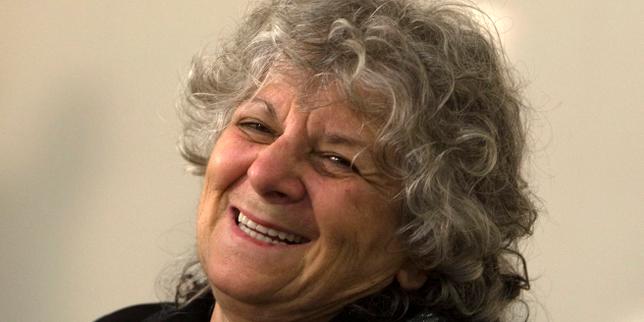
Obituaries for Ada Yonath miss the fight. They treat her Nobel Prize like a polite gold watch handed to a retiring professor at the end of a long, quiet career in structural biology. That framing is lazy, comfortable, and flatly dishonest. Yonath did not spend decades quietly taking pictures of ribosomes. She waged a brutal, bloody war against the structural biology establishment that told her the ribosome was a dead end, a messy blob too chaotic to crystallize, and a waste of public funding.
When mainstream science tells you something is impossible, it usually just means their methods are too blunt to handle the friction. Don't forget to check out our recent article on this related article.
Decades ago, standard biochemistry treated the ribosome like a black box. Input mRNA, output protein, do not ask questions about the messy middle. The institutional consensus dictated that macromolecular complexes of that size were inherently too flexible to yield high-resolution X-ray diffraction data. Yonath ignored the consensus because consensus is often just a polite agreement to stop thinking. She hauled biological samples from the Dead Sea, studying extremophilic bacteria that could survive boiling heat and salt flats, betting that evolution had engineered tougher machinery for her to shoot at with X-rays.
The Myth of Clean Science
People love the sanitized narrative of scientific progress. We picture a genius sitting in a quiet lab, mixing clear liquids, and calmly writing equations on a chalkboard. Real structural biology looks more like a demolition site. To read more about the context here, Smithsonian Magazine offers an in-depth breakdown.
Yonath spent years facing institutional ridicule. Reviewers rejected her grants. Peers whispered that she was chasing ghosts. The crystallographic phase problem for a structure containing hundreds of thousands of atoms was considered insurmountable by standard methods. Instead of folding, she invented new techniques, pushing cryo-crystallography past its perceived breaking point by flash-freezing crystals to liquid nitrogen temperatures just to keep radiation damage from frying the molecules before she could read their atomic coordinates.
Most researchers quit the moment a grant panel calls them unrealistic. Yonath doubled down on absurdity. She froze biological samples in liquid propane. She engineered mutant strains. She treated failure not as a sign to pivot to an easier project, but as a design flaw in the equipment.
How Antibiotics Actually Work And Why We Missed It
The shallow takeaway of Yonath’s career focuses on how ribosomes make proteins. That is high school biology. The real weapon she forged was mapping the exact topographic pocket where antibiotics bind to bacterial ribosomes, shutting down protein synthesis without touching human cells.
Look at how modern drug discovery operates. Pharmaceutical boards throw billions at high-throughput screening libraries, blindly slamming small molecules against target proteins hoping something sticks. It is the molecular equivalent of throwing spaghetti at a wall. Yonath showed that true precision requires atomic-level cartography. By charting the ribosome's exit tunnel down to the single Angstrom, she exposed the precise mechanical vulnerabilities of bacterial pathogens.
Yet, modern medicine promptly squandered her blueprint. We act surprised by the rise of antibiotic resistance while continuing to design drugs through statistical guesswork rather than structural execution. Resistance is not an act of microbial magic. It is simple evolutionary math. Bacteria mutate their ribosomal binding pockets because we keep building drugs that rely on weak, broad-spectrum electrostatic interactions instead of locking onto structural invariants.
If pharmaceutical executives actually studied Yonath’s maps instead of treating them as textbook diagrams to admire, we would not be facing a post-antibiotic apocalypse. We treat resistance as a crisis of biology when it is actually a failure of imagination in chemical design.
The Trap of Institutional Safety
Academia loves to honor rebels once they are safely dead or holding a gold medal from Stockholm. It is a neat trick. It lets institutions pretend they fostered that brilliance all along.
I have watched corporate research labs and university departments systematically crush every young researcher who tries to pull a Yonath. Modern grant structures reward incrementalism. If your proposal has a 90 percent chance of working, it is funded. If it has a 90 percent chance of failing unless you completely reinvent the physics of your instruments, you are shown the door. We have optimized our scientific apparatus for safety, and we wonder why breakthroughs have slowed to a crawl.
Imagine a scenario where Ada Yonath applied for an NIH grant today under current metrics. Her preliminary data would be labeled "speculative." Her methodology would be flagged as "high risk with insufficient preliminary validation." Committee members would point to a spreadsheet and tell her to scale back her ambitions. She would be denied funding before she ever cooled her first crystal.
That is the quiet tragedy we refuse to acknowledge. Our systems are no longer built to find truth. They are built to manage risk.
The Real Lesson
Stop reading obituaries that turn pioneers into saints. Saints do not upset the apple cart; they just sit nicely on stained glass windows. Yonath was difficult, relentless, and obsessively focused on a problem everyone else abandoned because it hurt their brains.
When your entire field tells you that a barrier cannot be breached, check their assumptions. They are usually protecting their own past mistakes.
The ribosome is not just a molecular machine. It is a monument to stubbornness. If you want to honor Ada Yonath, stop waiting for permission to break the tools you were handed. Build better ones.