The earth does not care about your schedule.
That was the first lesson carved into the stone of Pretty Rocks Bluff back in the summer of 2021. For nearly a century, a single ribbon of gravel wound its way deep into the heart of Denali National Park. It was ninety-two miles of wilderness access, a dusty artery carrying scientists, backpackers, and wide-eyed travelers toward the base of North America’s highest peak. People came from Tokyo, Berlin, and Ohio just to catch a glimpse of the great white mountain, trusting that narrow road to hold them. Meanwhile, you can read similar events here: Why The Backchannel Peace Talks Everyone Is Cheering Are Actually A Trap.
Then, the mountain slid.
It was not a sudden explosion of rock, but a slow, agonizing heave. Permafrost beneath the slope, frozen since the Pleistocene, began to thaw. The ground turned to soup. Day by day, foot by foot, the road began to drop into the canyon below, carrying guardrails and survey stakes with it. Maintenance crews fought it with gravel, dump trucks, and sheer stubbornness. They poured rock in, and the mountain swallowed it. To understand the complete picture, we recommend the excellent report by Associated Press.
By August 2021, the road was moving as much as an inch every hour.
Imagine standing on that edge. The air smells of wet shale and distant pine. Below you, a glacial river cuts a gray scar through the valley. Behind you, the road simply terminates in mid-air, a jagged concrete edge hanging over a void. That collapse severed the park in two. It cut off access to Kantishna, a historic mining district turned wilderness enclave at the end of the road. It stranded lodge owners, cut off backcountry rangers, and turned a ninety-mile journey into an abrupt dead end at mile 45.
For five long years, the far side of Denali became an island without water.
Logistics turned into a nightmare. Freight had to be flown in on small bush planes. Tourists were turned away at the midpoint, their dreams of seeing the deeper wilderness rewritten by a shifting slope of mud and rock. The silence at the end of the road grew heavy.
Enter the engineers.
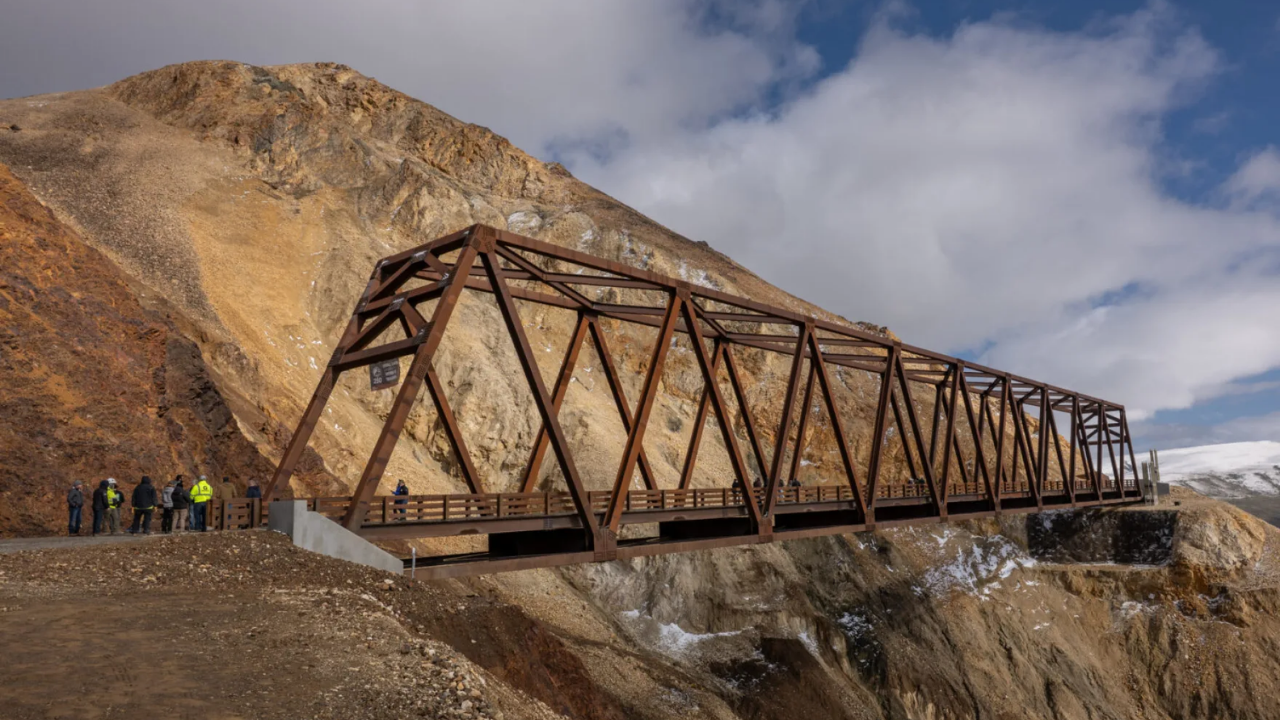
Building a bridge over a moving mountain is an act of engineering defiance. You cannot anchor a structure to something that refuses to stay still. The solution required a massive $230 million undertaking: the Pretty Rocks Bridge.
Consider what happens next: helicopters thrumming against the arctic wind, workers dangling from ropes against vertical cliffs, and steel beams hauled into the backcountry piece by piece. This was not just a construction project. It was a high-stakes chess match against gravity itself. Crews drove massive steel shafts deep into the stable bedrock far beneath the active slide zone, creating a foundation that could ignore the creeping earth above it.
To visualize this, imagine a massive steel highway floating suspended in the air, completely untethered from the crumbling hillside sliding beneath it. If the mountain moves, the bridge stands still.
Five years after that first catastrophic collapse, the project nears completion. The bridge spans the gap, a slender line of gray steel bridging the chasm at Pretty Rocks. It is a testament to human persistence, a stubborn refusal to let a mountain win an argument about access.
Yet, the reopening of the road carries a quiet warning.
The Arctic is warming faster than almost anywhere else on Earth. The permafrost holding up the northern wilderness is letting go. Pretty Rocks is not an isolated anomaly; it is a preview. Every mile of infrastructure built on frozen ground is now on borrowed time, waiting for its own moment of reckoning.
When the first buses finally cross that new bridge, rolling past mile 45 and heading deep into the untamed backcountry once more, the passengers will lean against the glass and stare at the towering peaks. They will marvel at the engineering feat suspended above the abyss. They will take their photographs and breathe in the vast, clean air of the North.
They probably won't look down at the gray mud shifting quietly beneath the footings.
They won't see the mountain holding its breath, waiting for the next thaw.