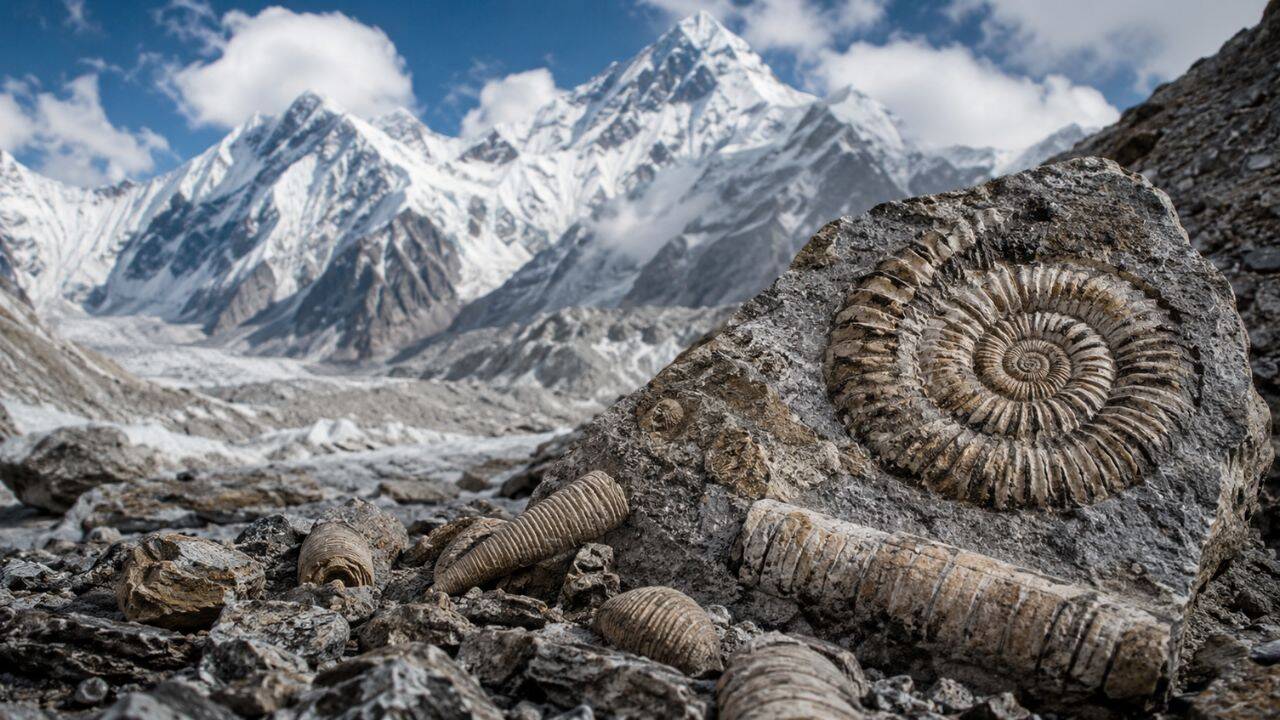
Pop science articles love a good fairy tale. They point to the Qomolangma Limestone at the peak of Mount Everest, find a few fossilized crinoids and brachiopods, and immediately spin a romantic yarn about a "vanished ocean" frozen in time. They treat the summit like a pristine underwater graveyard hoisted directly into the sky.
It is a neat, poetic image. It is also completely wrong.
The conventional narrative surrounding the Tethys Ocean fossils on Everest treats geology like a simple elevator ride. The lazy consensus goes like this: there was an ocean, India smashed into Asia, and the ocean floor got pushed straight up into the clouds. Tour guides and surface-level science writers talk about it as if you could scuba dive through history just by climbing the Death Zone.
This cartoonish view misses the entire mechanics of orogeny. The marine fossils at the top of the world are not evidence of a preserved seabed. They are the mangled, highly selective survivors of a brutal, chaotic tectonic conveyor belt that destroyed 99% of the original ocean crust.
The Myth of the Lifted Ocean Floor
To understand why the mainstream narrative falls apart, you have to look at what happens when continents collide. Ocean floors are made of dense basalt. Continental crust is made of lighter granite. When the Indian plate charged north into the Eurasian plate around 50 million years ago, the dense Tethys ocean floor did not get lifted gracefully into the air. It subducted. It dived straight down into the mantle to be melted into magma.
The rock at the top of Everest is limestone, not basalt. It was never the deep ocean floor. It was a shallow carbonate platform, a coastal reef system sitting on the northern edge of the Indian continent.
What we see at the summit today is not the seafloor that vanished; it is the absolute fringe of a continental shelf that got scraped off, squeezed, and folded under unimaginable pressure. Geologists call this an accretionary wedge, but even that term sanitizes the violence of the process.
Imagine shoving a rug against a wall. The wrinkles that bunch up near the wall do not represent the floor underneath; they represent the distorted, compressed material that had nowhere else to go. The Qomolangma Formation is that last wrinkle.
The Preservation Paradox
People frequently ask: "How can delicate marine shells survive a mountain-building event?"
The honest, brutal answer is that almost none of them did. The fossils hobbyists gawk at are the statistical anomalies.
The pressure required to lift rock to 29,029 feet creates massive tectonic shearing. In the High Himalayan Crystalline sequence, just below the summit limestone, the heat and pressure were so intense that sedimentary rocks metamorphosed into schist and gneiss. Any fossils there were utterly obliterated, cooked into unrecognizable mineral bands.
The summit limestone survived only because it was at the very top of the stack, shielded from the deepest crustal fires. Yet, mainstream articles present these fossils as a pristine archive. They ignore the fact that the vast majority of the Tethyan record was wiped clean by the very mountain-building process they are celebrating. We are looking at a heavily edited, fragmented anthology, not a complete history book.
Why the "Vanished Ocean" Narrative Fails Travelers and Geologists
Promoting the idea of a "vanished ocean" sitting intact on a mountaintop distorts our understanding of how the Earth works. It creates a static view of geology.
- It ignores active tectonics: Everest is not a static monument to a dead sea. It is actively moving. The collision is ongoing. India is still plowing into Asia at a rate of about two inches per year.
- It misinterprets elevation: The height of Everest is not a simple function of how much ocean rock got pushed up. It is a violent tug-of-war between tectonic uplift and brutal glacial erosion. The mountain is high because the crust underneath it is incredibly thick, forcing the light continental rock upward like an ice cube floating in water.
- It misunderstands the rock cycle: The limestone at the peak is currently dissolving. Rainwater mixed with carbon dioxide forms a weak acid that eats away at the calcium carbonate. The summit is shrinking from erosion even as it rises from tectonics.
I have analyzed geological surveys where field teams spent months mapping the detachment faults of the Himalayas. They do not talk about "vanished oceans" with romantic whimsey. They talk about normal faults, brittle deformation, and ductile shear zones. They see a machine, not a graveyard.
Dismantling the FAQs
The public interest in Everest's geology usually boils down to a few flawed questions found across search engines. Let us answer them directly without the fluff.
Can you find intact shells on the summit of Everest?
No. You will not find a perfect clam shell lying on the snow. You find highly compressed, fragmented imprints embedded within solid grey limestone. Most of these require a trained eye or a hand lens to properly identify. The idea that the summit is littered with loose seashells is a complete fabrication.
Did the top of Everest used to be the bottom of the sea?
Strictly speaking, no. It was a shallow, tropical marine environment near a coast, similar to the Bahamas today. The true "bottom of the sea"—the deep abyssal plains of the Tethys Ocean—is gone. It was swallowed by the Earth's mantle tens of millions of years ago.
Why does this distinction matter?
Because precision matters. When we tell people the ocean floor was simply raised up, we obscure the real magic of plate tectonics: subduction, recycling, and crustal thickening. We trade an extraordinary mechanical reality for a mediocre magic trick.
Stop Looking for a Dead Sea
The obsession with the Tethys Ocean fossils misses the real story written in the Himalayan rock. The miracle of Mount Everest isn't that ocean life once existed there. The miracle is that sedimentary rock, born in a calm, warm, sunlit sea, was subjected to a planetary-scale car crash, survived the crushing descent of subduction, escaped being melted in the mantle, and was thrust into the sub-zero vacuum of the upper troposphere.
The fossils are not a monument to a vanished ocean. They are the battered debris of a continent that refused to sink. Stop looking at the summit as a preservation site. It is a wreckage zone.