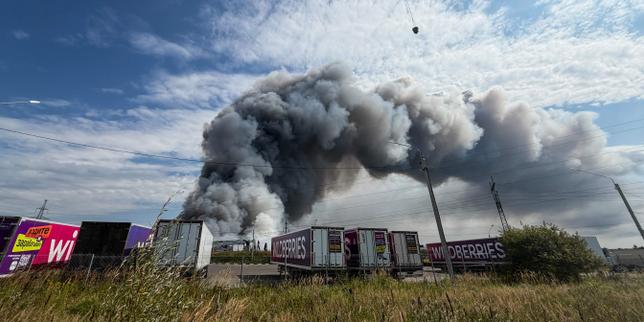
Mass drone saturation attacks against metropolitan centers represent a fundamental shift in modern asymmetric warfare, moving beyond tactical engagement into the domain of structural attrition. When the administration of Moscow reports hundreds of inbound uncrewed aerial vehicles launched in a single operational window, the metric of interest is not merely the raw numerical output. The metric of interest is the stress imposed on command-and-control architectures, interceptor inventory depletion rates, and civil infrastructure resilience. This dynamic exposes a severe economic asymmetry: low-cost loitering munitions force high-cost kinetic expenditure, creating an unsustainable fiscal imbalance for defending states.
The Economic Asymmetry of Interception
The primary objective of a saturation strike is not necessarily structural destruction at the terminal point, but rather the systematic exhaustion of defensive resources. Air defense networks operate on finite missile inventories, radar tracking channels, and battery reloading cycles. Every kinetic interceptor deployed against a low-cost platform degrades the defender's total operational readiness.
To model this dynamic, one must examine the cost function of modern air defense. Interceptor missiles involve complex guidance systems, rocket motors, and specialized manufacturing tolerances that scale exponentially in cost compared to commercial-grade airframes outfitted with basic guidance modules. When a capital region faces waves of hundreds of incoming systems, the defender confronts a triage dilemma. Permitting projectiles to strike core urban areas risks political instability and physical damage, whereas expending high-value surface-to-air assets against inexpensive vectors drains strategic stockpiles faster than industrial supply chains can replenish them.
This creates a structural vulnerability. Defenders cannot sustain a one-to-one economic exchange ratio where a low-cost drone requires an exponentially more expensive interceptor. Consequently, military planners must introduce electronic warfare, kinetic gun systems, and directed-energy platforms into the defensive mix to alter the cost curve. However, transitioning from missile-centric defense to layered electronic suppression requires time, capital allocation, and extensive technological retrofitting of urban perimeters.
Air Defense Architecture and the Saturation Threshold
Defending a sprawling urban expanse like Moscow presents severe geometric and technical constraints. A city of thousands of square kilometers cannot maintain uniform air defense density. Instead, defenders establish high-priority exclusion zones around critical political, command, and logistical nodes, leaving peripheral residential and commercial sectors reliant on outer-ring detection nets and mobile fire teams.
[Incoming Drone Swarm] ---> [Outer Radar Net] ---> [Electronic Suppression]
                                                        |
                                            (Residual Vectors Leak)
                                                        v
                                          [Inner Kinetic Interception]
When attack volume exceeds a certain threshold, the radar tracking architecture experiences target saturation. Modern fire control systems possess a finite capacity to simultaneously acquire, track, calculate intercept trajectories, and guide effectors against multiple targets. If the inbound density surpasses the processing bandwidth of the local battery command posts, tracking latency spikes. Targets that appear simultaneously from different vector headings force radar operators to prioritize threats based on predicted impact coordinates, allowing secondary and tertiary vectors to slip through gaps in the coverage polygon.
Furthermore, low-altitude routing exploits radar horizons and ground clutter. Urban topography provides extensive radar shadowing, allowing incoming systems to mask their approach until the terminal phase of flight. This compresses the reaction window for local tactical defense units, shifting the burden from automated tracking networks to manual or semi-automated optical and acoustic sensors.
Civil Infrastructure Resilience and Behavioral Adaptation
The psychological and operational impact of persistent aerial saturation extends directly to civilian response mechanisms and municipal continuity. When hundreds of uncrewed systems target a metropolitan hub, commercial aviation, ground transit networks, and emergency services face mandatory operational freezes. Temporary airspace closures disrupt regional supply chains, divert commercial flights, and require coordinated shelter-in-depth protocols for millions of residents.
Urban resilience in this context relies on two primary variables: early warning latency and structural redundancy. Early warning systems must provide accurate trajectory predictions without inducing systemic panic or perpetual disruption. If alarm thresholds are calibrated too low, frequent false positives or distant interceptions paralyze economic activity. If calibrated too high, structural damage mounts before protective measures execute.
Municipal authorities adapt through decentralized emergency response staging, localized medical triage readiness, and rapid-repair engineering battalions capable of clearing debris and restoring power grids within hours of an impact. The resilience of the civil sector thus acts as a shock absorber for military shortcomings. If the air defense network leaks 5 percent of incoming vectors, the civil infrastructure must absorb those impacts without cascading failures in utilities, communications, or public order.
Electronic Warfare as the Primary Friction Layer
Relying exclusively on kinetic interception against mass drone attacks is mathematically untenable over prolonged conflict horizons. Consequently, electronic warfare emerges as the primary mechanism for degrading saturation efficiency. Jamming, spoofing, and navigation denial systems do not require expensive interceptor missiles; instead, they target the digital nervous system of the attacking platform.
GNSS spoofing distorts positioning data, causing autonomous guidance systems to miscalculate their coordinates and drift off course or expend fuel circling empty sectors. Command-link jamming severs the connection between remote operators and manual-control airframes, forcing systems onto pre-programmed inertial navigation pathways that lack terminal precision.
However, attacking forces continuously iterate their guidance algorithms to counter electronic suppression. The integration of autonomous optical target recognition, terrain-contour matching, and inertial backup systems allows modern uncrewed platforms to operate in heavily jammed environments without relying on external satellite signals. This creates a perpetual technological feedback loop: defenders upgrade electronic suppression yields, while attackers deploy hardening measures and autonomous redundancy protocols.
The strategic trajectory points toward a prolonged contest of industrial output and technological adaptation. The side that optimizes its supply chain for low-cost manufacturing while simultaneously expanding multi-layered, non-kinetic defensive depth will dictate the operational tempo of metropolitan security for the foreseeable future.