The frost in Washington County, Maine, does not melt so much as it grudgingly retreats. On a Tuesday morning in late autumn, the air smells of salt pine and woodsmoke. It is the kind of quiet that makes you feel like the only person left on earth.
In the small town of Milbridge, where the economy runs on the grueling rhythm of lobster boats and wild blueberry barrens, a man named Tomas was warming up his pickup truck. His headlights cut through the heavy coastal fog, illuminating the gravel driveway of the modest rental home he shared with his wife and three American-born children. Tomas had lived in this corner of Maine for fourteen years. He paid taxes with an Individual Taxpayer Identification Number. He coached youth soccer. He repaired his neighbors' roofs after the brutal winter nor'easters.
He was, by every metric of human community, a neighbor.
Then came the headlights in his rearview mirror. Not the familiar rusted grill of a local fisherman’s Ford, but the sterile, polished front of an unmarked dark SUV.
Two men in tactical vests stepped out into the freezing mud. They did not knock on his door. They did not present a warrant signed by a judge. Within ten minutes, Tomas was in the back seat, his wrists bound by plastic zip-ties, watching his kitchen window recede into the fog. His oldest daughter, twelve years old, was just waking up for school. She would find his lunchbox still sitting on the counter, packed with two ham sandwiches and an apple.
This is not a hypothetical scenario. It is the reality of immigration enforcement in the modern American north, where a quiet campaign of arrests by Immigration and Customs Enforcement (ICE) is tearing at the fragile social fabric of rural New England.
To those living in major metropolitan areas, the immigration debate is an abstract war of words played out on cable news. It is a matter of statistics, policy papers, and campaign slogans. But in the quiet towns of Maine, the arrival of federal agents is a physical shockwave. It is a sudden, violent subtraction. One day a man is standing at the conveyor belt of a seafood processing plant, and the next day there is simply an empty space where he used to be.
The anger left behind in these communities is not just political. It is deeply personal.
The Invisible Border That Covers an Entire State
To understand why ICE operations in Maine provoke such intense local fury, one must first understand a piece of legal geography that most Americans are entirely unaware of.
Under federal regulations established decades ago, the government designates a "100-mile border zone." Within this boundary, federal immigration agents possess extraordinary authority. They are permitted to set up checkpoints, board buses, and stop vehicles without the standard "reasonable suspicion" required in the rest of the country.
But look at a map of Maine.
The state is bordered by Canada to the north and east, and the Atlantic Ocean to the south and west. Because the coast counts as a border, the entire state of Maine falls within this 100-mile zone. Every single inch of it.
This means that a family driving to a grocery store in Bangor, or a worker walking home from a diner in Portland, is subject to a level of federal surveillance that would be deemed unconstitutional in Ohio or Kansas. It turns an entire state into a borderland, where the basic protections of the Fourth Amendment are permanently blurred.
The friction this creates is palpable. Maine is a state fiercely proud of its independent streak and its deep-seated aversion to federal intrusion. Local law enforcement officers often find themselves caught in the middle. Many police chiefs and sheriffs in rural counties have quietly expressed frustration with ICE operations. They spend years building trust with immigrant communities, convincing victims of domestic abuse or wage theft that they can speak to local police without fear of deportation.
When a white van sweeps through a town and snatches a father from his driveway, that trust evaporates in an instant. The local police are blamed, even if they had no prior knowledge of the raid.
Consider the practical fallout. When immigrants withdraw into the shadows out of fear, they stop driving. They stop going to prenatal doctor appointments. They stop reporting crimes. The entire community becomes less safe, less stable, and more divided.
The Real Cost of a Empty Chair
The economic argument for immigration is often told through spreadsheets, but in Maine, it is told through the desperation of local business owners.
The state has the oldest median population in the nation. Its traditional industries—fisheries, forestry, agriculture—are physically demanding and suffer from a chronic shortage of labor. For decades, immigrant workers have filled these gaps. They are the backbone of the overnight cleaning crews, the lobster processing lines, and the seasonal agricultural harvests.
When ICE targeted a well-known worker in a small coastal town last year, the local seafood dealer who employed him did not celebrate a victory for the rule of law. He went to the docks and wept.
"I can't replace him," the business owner said, speaking on the condition of anonymity for fear of targeting by federal authorities. "I've advertised that job for six months. No one else applied. He was faster, more reliable, and worked harder than anyone I’ve ever hired. Taking him away doesn't protect American jobs. It just makes it harder for my business to survive."
The loss ripples outward. The money Tomas earned did not disappear into a vacuum. It was spent at the local hardware store, the independent grocery store, and the gas station down the street. When you remove a worker from a fragile local economy, you are not just deporting an individual; you are pulling a thread from a sweater that is already unraveling.
But the financial calculations pale in comparison to the psychological toll exacted on the children left behind.
These children are American citizens. They speak English with the distinct, flat cadence of a Down East Maine accent. They watch the same television shows, eat the same cereal, and harbor the same dreams as their classmates. Yet they live with a quiet, chronic terror that their parents might not come home from work.
In the days following an ICE arrest in a small town, school attendance rates among immigrant children plummet. Teachers report students sitting at their desks in a state of catatonic silence, unable to focus, waiting for the school phone to ring with bad news.
We must ask ourselves what kind of citizens we are creating when we subject children to the trauma of seeing their parents treated like high-profile fugitives.
The Language of Erasure
The bureaucracy of deportation relies heavily on sterile language.
Agents do not "arrest" people; they "detain" them. They do not "shatter families"; they "execute administrative removals." The human beings caught in this system are reduced to "case numbers" and "alien registration files."
This language is designed to make the process feel clean, orderly, and necessary. It hides the messy, painful reality of a mother trying to explain to her six-year-old why Dad won't be there to tuck him in tonight, or for the next ten years. It ignores the panic of a family suddenly unable to pay rent because their primary breadwinner is locked in a detention facility three states away.
There is an old saying in Maine that you aren't truly "from here" unless your family has lived in the state for at least three generations. It is a culture that can be slow to accept outsiders. Yet, when the federal government comes to claim these new residents, the reaction from lifelong Mainers is often one of fierce defense.
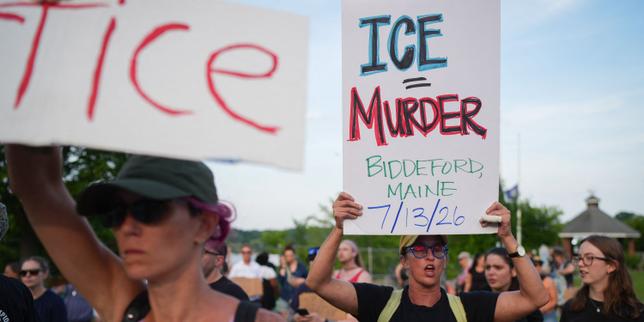
In church basements, town halls, and community centers across the state, neighbors are organizing. They are forming rapid-response networks to provide legal aid, delivering groceries to families hiding in their homes, and standing on street corners with handmade signs protesting the actions of a federal agency they see as overreaching and cruel.
These are not radical activists. These are retirees, small business owners, and librarians who have looked at their communities and realized that decency matters more than documentation.
What Remains in the Fog
The sun eventually climbs high enough to burn off the fog over Milbridge, revealing the rugged beauty of the rocky coast. But the warmth does not reach the kitchen where Tomas’s family sits in silence.
His boots still sit by the back door, caked with the dry clay of the fields he worked. The television hums quietly in the living room, broadcasting a morning talk show that feels like it is coming from a different planet.
The debate over immigration will continue to rage in Washington, fueled by rhetoric, fear, and political ambition. It is a conflict characterized by loud voices and simple answers.
But the truth of the matter is not found in a legislative chamber or on a campaign trail. It is found in the quiet terror of a child looking out a window, waiting for a pickup truck that will not return, while the cold Maine wind rattles the glass.