The coffee is bitter. The zinc counter is cold beneath elbows that have typed code, signed eviction notices, and scrolled through infinite loops of digital despair. Outside, Paris is waking up not with a roar, but with a grey, stubborn sigh.
For decades, the story written about this city—and about France writ large—was one of quiet emptying. Pews gathered dust. Old stone churches smelled of damp wool and fading memory. The priests grew scarce, their hair whitening in empty sanctuaries while the secular republic celebrated its rigorous, immaculate separation of church and state. Laïcité was the air people breathed, crisp and uncompromising. You might also find this connected story useful: The Invisible Fracture Breaking Yemen Beyond the Headlines.
Then came the numbers.
They arrived not as thunderclaps, but as ledgers quietly filled by parish priests across the country. Adults. Young professionals. Students with ink-stained fingers and glowering disillusionment. People who had grown up in apartments where God was never mentioned, or was mentioned only as a historical artifact, were suddenly lining up at baptismal fonts. As discussed in recent articles by Al Jazeera, the effects are widespread.
And now, the Pope has arrived.
Leo XIV stands on French soil, looking out at a nation that intellectual elites insisted had moved past faith. He does not see a museum. He sees a nursery. His voice, carrying across the tarmac and into millions of radios, holds a note of genuine wonder. He is astonished by the sheer volume of souls stepping forward from the secular fog, asking for water, asking for a name, asking for a anchor.
Consider Julien.
Julien is thirty-two. He lives in a cramped fourth-floor apartment in Belleville with a balcony just big enough for a dead geranium and a rusted bicycle. By day, he engineers algorithms for a logistics startup, turning human movement into rows of numbers on a dashboard. By night, he listens to sirens wailing down Rue de Belleville and wonders why his chest feels hollow despite a salary that covers rent and artisanal sourdough.
Six months ago, Julien did something that shocked his friends at the local bistro. He walked into Saint-Germain-des-Prés, not to admire the timber or take a photograph, but to speak with a man wearing a black cassock. He wanted water poured over his head. He wanted a sacrament.
He was not alone. Across France, dioceses reported staggering spikes in adult baptisms. Young adults, many in their twenties and thirties, making up a swelling tide that caught sociologists and commentators completely flat-footed. In a culture built on rationalism, Cartesian logic, and an almost militant skepticism, something ancient and wild was stirring underground.
The Vatican took notice. And now, the Champs-Élysées is preparing for a spectacle of epic proportions.
The grand avenue, usually choked with snarling traffic, honking delivery vans, and tourists clutching shopping bags from luxury boutiques, has been scrubbed and silenced. Metal barriers snake along the sidewalks like silver vines. Giant white screens are being hoisted into the autumn air, positioning themselves to catch the light for a crowd expected to stretch from the Arc de Triomphe down to the Place de la Concorde.
Concorde. The very name vibrates with irony and historical blood.
It was here, beneath the shadow of the guillotine, that the revolution tried to sever France completely from its sacred past, rolling heads into baskets in the name of reason, liberty, and fraternity. For centuries, the French state and the Catholic Church have danced a violent, passionate tango of embrace and exile. Kings were crowned and anointed; priests were hunted and driven underground; churches were turned into temples of human intellect.
And now, a giant open-air altar rises on that exact square.
The juxtaposition is staggering. Steel scaffolding clamps against stone that has witnessed centuries of ideological warfare. Workers in high-visibility jackets haul cables across cobblestones where royals and revolutionaries once bled. The city is holding its breath.
Critics murmur of intrusions, of the delicate balance of laïcité trembling on a tightrope stretched over the capital. Editorial boards churn out anxious columns about the public display of private devotion in a secular republic. They wonder if this is a fleeting cultural quirk, a nostalgic aesthetic choice by disaffected youth seeking vintage authenticity in an era of digital ephemera.
They miss the point.
Walk down the side aisles of any Parisian church on a Tuesday afternoon, far from the flashbulbs and political debates, and you will see what the critics refuse to name. You will see silence. Real silence. Not the absence of sound, but a heavy, protective blanket that muffles the relentless demand for productivity, efficiency, and constant connectivity.
People are tired.
That is the hidden engine of this revival. The modern promise—that if you work hard enough, consume smartly enough, and optimize every minute of your existence, you will find contentment—has cracked. The cracks let in cold air. People look around at a world hurtling toward ecological collapse, geopolitical friction, and algorithmic alienation, and they feel a profound, acute homelessness.
Faith, once dismissed as an outdated operating system, is suddenly rediscovered as a wilderness shelter.
The preparation for the Concorde mass reflects this cultural pivot. It is not merely a diplomatic visit or a ceremonial photo opportunity. It is the visible peak of an invisible mountain. The thousands of catechumens who received baptism during the Easter vigils across France—typified by urbanites, teachers, nurses, and tech workers—represent a generational swing away from hollow neutrality.
On the avenue, the air smells of wet asphalt, roasted chestnuts from a stray cart, and the metallic tang of heavy machinery. Police vans idle quietly on side streets, their blue lights muted in the pale November sun. Shopkeepers along the route are adjusting their awnings, some grumbling about lost revenue from closed streets, others gazing out with cautious curiosity.
A group of tourists stops near the Petit Palais, pointing smartphone cameras at the massive wooden crucifix being raised onto the central platform. They are speaking English, bewildered by the scale of the operation, trying to fit a Catholic mass on the Champs-Élysées into their mental map of a thoroughly secularized Paris.
They do not understand the French appetite for theatre.
France does nothing halfway. When it secularizes, it secularizes with the fervor of religious zealots. When it questions its identity, it does so with national existential angst. And when it returns to the altar, it does not slip in through a side door; it sets up a cathedral under the open sky, right down the middle of its most famous boulevard.
Leo XIV understands this theatricality. In his private remarks to church leaders behind closed doors, he urged them not to gloat, not to treat the demographic uptick as a political victory over secularism. Instead, he spoke of listening. He spoke of wounds. He framed the resurgence not as a conquest, but as a hospital opening its doors to the walking wounded.
Consider the young woman sitting on a bench near the Tuileries Gardens, holding a worn copy of Bernanos. She is twenty-four. She works in digital marketing, crafting engagement strategies for cosmetic brands. Two years ago, she didn't know the difference between a psalm and a parable. Last month, she was baptized in a chilly stone basin in the Marais, her hair damp, her heart pounding with a strange, terrifying sense of arrival.
Why?
"Everything online is so weightless," she says, her fingers tracing the edge of the paper cover. "Nothing stays. You post a photo, it gets likes, and then it vanishes into the scroll. I wanted something that wouldn't dissolve when I closed my eyes. I wanted something heavy enough to hold me down."
That is the gravity pulling people toward the Concorde.
The state can pass laws governing headscarves and crucifixes in classrooms. Intellectuals can write dense treatises on the triumph of enlightenment over superstition. But human beings are creatures of longing, built with an intractable shape that cannot be filled by algorithms, career milestones, or wellness apps.
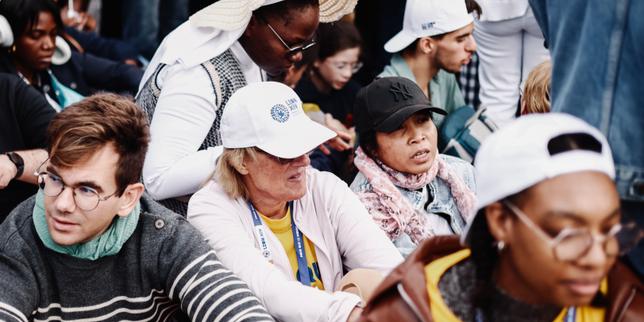
As twilight begins to pool over the Seine, turning the water the color of slate and bruises, the lights along the Champs-Élysées flicker to life. The giant white screens cast a ghostly glow against the limestone facades of Haussmannian buildings. Scaffolding towers stand like silent sentinels guarding the empty space where hundreds of thousands will soon gather to pray, to sing, to stand shoulder-to-shoulder in the crisp autumn air.
The city hums around them, indifferent and eternal.
Tomorrow, the bells will ring out across the rooftops of Paris, echoing over chimney pots and café terraces. The Pope will raise his hands at the foot of the obelisk, and a vast, quiet sea of faces will look up, seeking something that cannot be measured on a dashboard or coded into a spreadsheet.
They are searching for an anchor in a world drifting away from itself. And for one extraordinary morning, the capital of modern reason will become, quite simply, a place of prayer.
The wind rustles the bare plane trees along the avenue. A siren wails in the distance, sharp and brief, before fading into the vast, darkening sky above the dome of the Invalides.
The cobblestones wait.