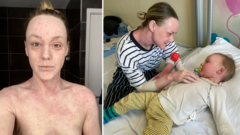
Imagine feeling like something is crawling under your skin every single second of the day. You look down and see tiny, brightly colored fibers—blue, red, or black—poking out of open sores that won't heal. You go to your GP, desperate for help, only to be told you're imagining it. You're handed a prescription for antipsychotics instead of antibiotics. This isn't a horror movie plot. It’s the daily reality for thousands of people living with what they call Morgellons disease.
For years, the medical establishment has largely dismissed these patients. The official stance from most major health bodies is that this is "delusional parasitosis." Basically, they think it's all in the head. But if you talk to the people suffering, they'll show you physical evidence that's hard to ignore. The BBC recently reported that hundreds of people reached out sharing these exact "hellish" experiences. The disconnect between patient experience and clinical diagnosis is a massive, gaping wound in modern medicine.
We need to talk about why this divide exists. It’s not just about a "mystery" condition. It’s about how we treat people when their symptoms don't fit into a neat little box.
What is Morgellons anyway
Most people haven't heard of Morgellons until they, or someone they love, starts showing symptoms. It usually starts with an intense itching or stinging sensation. Patients describe it as "formication"—the feeling of insects crawling across or under the skin. Then come the lesions. These aren't just typical scabs. They often contain filaments or fibers that look like they've been woven into the tissue.
The term Morgellons was coined in 2002 by Mary Leitao. She was a biologist whose son had sores on his lip that produced strange fibers. When doctors couldn't explain it, she dug through historical medical texts and found a 17th-century description of a similar ailment in French children called "The Morgellons."
Since then, the community has grown. It’s a group of people united by a shared trauma of being ignored. They aren't just "unwell." They’re often socially isolated because their skin looks frightening to others. They lose jobs. They lose friends. Some even lose their homes because they spend every penny on "cures" that don't work.
The Great Medical Divide
On one side, you have the mainstream dermatological community. Their argument is straightforward. They say the "fibers" found in the skin are actually just textile fragments—lint from clothes or carpets—that got stuck in self-inflicted wounds. They argue that the patient, driven by an obsessive itch, creates the sores themselves. This is known as "Ekbom Syndrome."
A famous 2012 study by the Centers for Disease Control and Prevention (CDC) backed this up. They looked at over 100 patients and found no infectious cause. They concluded the fibers were mostly cotton. For many doctors, that was the end of the story. Case closed.
But on the other side, a small but vocal group of researchers says the CDC got it wrong. They argue that Morgellons is actually a physical manifestation of a systemic infection, specifically linked to Borrelia burgdorferi. That’s the same bacteria that causes Lyme disease.
The Lyme Connection
Researchers like Dr. Marianne Middelveen and organizations like the Charles E. Holman Morgellons Disease Foundation have published studies suggesting these fibers aren't lint. They claim the filaments are actually made of keratin and collagen, produced by the body’s own skin cells in response to infection.
I’ve seen the microscopic photos they put out. They don't look like cotton threads. They look like biological structures growing from within the dermis. If these researchers are right, then we're looking at a bizarre, multi-systemic illness that dermatologists aren't equipped to handle on their own.
It's a classic standoff. You have the "Delusional" camp versus the "Infectious" camp. And in the middle? The patient is suffering while the experts argue over the definition of reality.
Why the CDC Study didnt settle the debate
If a massive government agency like the CDC does a study, you'd think that would be the final word. It wasn't. Critics point out several flaws in that 2012 research. For one, the study only looked at people who were already members of a specific health plan in Northern California. It wasn't a representative sample of everyone reporting symptoms worldwide.
Also, science moves fast. The tech we had in 2012 for analyzing skin biopsies has been eclipsed by newer methods. If you use a hammer, everything looks like a nail. If you only look for textile fibers, that’s what you’re going to find. The CDC didn't find a "cause," so they defaulted to a psychological explanation.
This happens a lot in medical history. Look at stomach ulcers. For decades, doctors told patients they had ulcers because of "stress" or "spicy food." Then, Barry Marshall and Robin Warren proved it was actually a bacterium called H. pylori. They were mocked for years before they won the Nobel Prize. Morgellons feels like it's stuck in that "mockery" phase.
The psychological toll of being dismissed
The mental health aspect of this is a bit of a "chicken or the egg" situation. Does the patient have a mental health crisis that causes skin picking? Or does having a terrifying, unexplained skin condition cause a mental health crisis?
Honestly, if I had fibers growing out of my arm and my doctor told me I was crazy, I’d probably start acting a bit "delusional" too. The trauma of medical gaslighting is real. When a professional tells you that what you see with your own eyes isn't there, it breaks your trust in the entire system.
Many patients end up in "echo chambers" online. Some of these groups are helpful, providing tips on how to manage the pain. Others can be dangerous, pushing bleach baths or industrial-strength pesticides as a way to "kill the bugs." This is what happens when people feel abandoned by science. They turn to whatever gives them hope.
How to navigate a potential Morgellons diagnosis
If you’re dealing with these symptoms, you need a strategy. Walking into a doctor’s office and shouting "I have Morgellons" is often a one-way ticket to being labeled a "difficult patient."
Here is how you should actually handle it.
First, stop searching for "Morgellons" specifically and look for "Lyme-literate" doctors. Since there's a proven statistical link between the two, a doctor who understands the complexities of tick-borne illnesses is much more likely to take your skin symptoms seriously. They won't just look at the surface; they’ll look at your immune system and your bloodwork.
Second, keep a meticulous diary. Don't just talk about the itching. Document your fatigue, joint pain, and "brain fog." If this is an infectious process, those systemic symptoms are the key to getting a doctor to look beyond the skin.
Third, ask for a punch biopsy. Not just a surface swab. You want a piece of tissue taken from an active lesion and sent to a lab that specializes in dermatopathology, specifically asking them to look for spirochetes (the corkscrew-shaped bacteria).
Fourth, be open to a multidisciplinary approach. Even if the cause is 100% physical, the stress is 100% mental. Taking an antidepressant or seeing a therapist doesn't mean you're "crazy" or that your sores aren't real. It means you're treating the collateral damage this illness has caused in your life. It’s about survival.
Dealing with the skeptics
You’re going to meet skeptics. They’ll tell you that you’re just stressed. They’ll tell you to stop "Googling your symptoms." Ignore them.
The history of medicine is littered with "hysterical" illnesses that turned out to be very real physiological conditions. Chronic Fatigue Syndrome (ME/CFS) went through this. Fibromyalgia went through this. Long COVID is going through it right now.
The fact that hundreds of people contacted the BBC with the same story tells us something is happening. These people don't know each other. They live in different countries. Yet, they describe the exact same blue fibers and the exact same "crawling" sensation. Mass delusions usually require some level of social contagion, but many of these patients were isolated long before they found the Morgellons community.
We don't have all the answers yet. Maybe it’s an environmental toxin. Maybe it’s a new mutation of a common bacteria. Maybe it’s something else entirely. But dismissing it as "all in the head" is a lazy out for a medical system that’s too busy to deal with mystery.
If you’re suffering, don't give up. Find a practitioner who listens. Insist on thorough testing for co-infections. Focus on supporting your immune system through diet and sleep while you search for answers. The tide is turning, and more researchers are starting to look at the "fiber" evidence with fresh eyes. You aren't crazy, and you aren't alone in this hell.