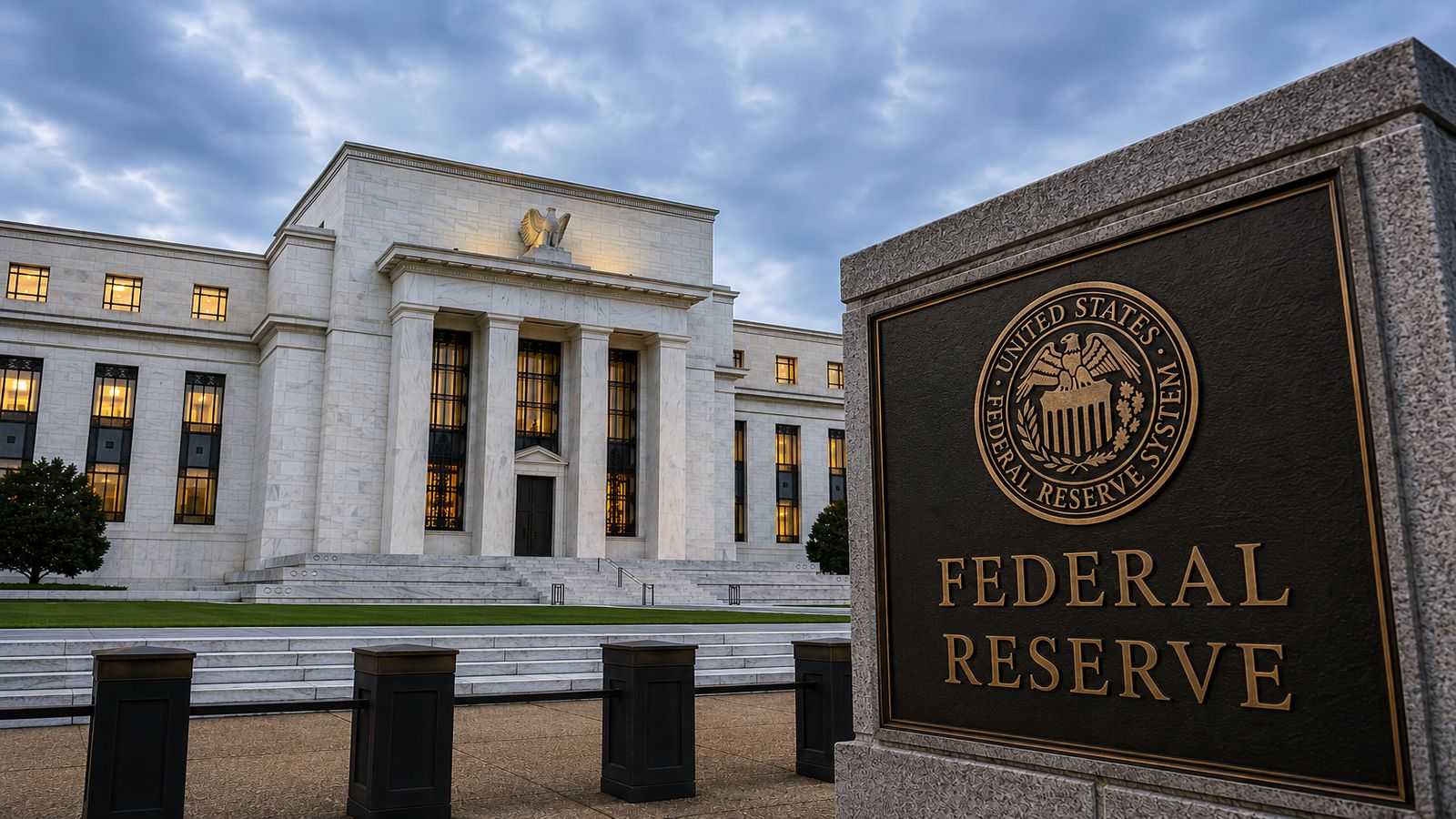
Federal Reserve interest rate decisions rarely arrive in a state of absolute harmony, yet the emergence of a multi-official dissension signals a profound shift beneath the surface of official communiques. While the Federal Open Market Committee officially maintained the federal funds rate within its established band, the public defection of three distinct officials advocating for an immediate rate hike shatters the illusion of a monolithic monetary policy committee. This fracture is not merely a procedural footnote; it represents a fundamental diagnostic disagreement regarding the current trajectory of inflation risks, labor market dynamics, and the terminal velocity of economic cooling.
To understand why this divergence matters, we must deconstruct the mechanics of central bank consensus. Modern monetary administration relies heavily on forward guidance and predictable signaling to anchor long-term expectations across debt and equity markets. When consensus frays publicly, market participants are forced to reprice tail risks that econometric models often fail to capture. The core debate centers on whether persistent price pressures represent structural rigidities within the economy or lagging statistical artifacts of past monetary expansions. By examining the operational mechanisms driving these three dissenting votes, we can map the exact transmission channels where monetary policy is currently failing to achieve its intended deceleration.
The Tripartite Divergence Framework
The split within the committee cannot be understood as a random distribution of opinions. It reflects three distinct analytical frameworks regarding macroeconomic vulnerability. Each dissenting perspective targets a different point of failure in the prevailing economic model used by the central bank.
The Velocity of Core Inflation
The first pillar of dissent focuses on the stubbornness of service sector inflation and shelter costs. Traditional monetary theory dictates that raising the benchmark borrowing rate suppresses demand-driven price spikes by increasing the cost of capital for both corporations and consumers. However, the transmission mechanism has stalled in specific asset classes. Corporate balance sheets accumulated substantial low-cost debt prior to the hiking cycle, insulating many large enterprises from immediate refinancing pain. Consequently, input costs continue to drift upward because pricing power remains concentrated among dominant market players who can pass higher expenses directly to end-users without destroying sales volume. Officials holding this view argue that maintaining status quo rates functions as an implicit easing of monetary strictness as consumer savings cushions slowly reconstitute.
Labor Market Resilience as an Inflationary Engine
The second structural argument revolves around employment metrics. Standard economic models, specifically the Phillips Curve framework, assume an inverse relationship between unemployment and inflation. Yet, the post-pandemic labor market has demonstrated remarkable structural friction. Labor hoarding by employers who struggled to hire during the recovery phase has kept layoffs historically low, even as job openings moderate. Wage growth, while off its cyclical peak, continues to outpace long-term productivity gains. Dissenters within this camp contend that a resilient labor market prevents the output gap from widening sufficiently to crush secondary inflationary impulses. Without an intentional rise in the cost of money to force capital reallocation, labor costs will continue to sustain a baseline inflation floor that sits uncomfortably above the two percent target.
Term Premium and Financial Conditions Easing
The third mechanism driving the push for a rate hike involves the premature loosening of broader financial conditions. Whenever equity markets rally or corporate credit spreads compress in anticipation of upcoming rate cuts, the actual restrictiveness of monetary policy diminishes. The central bank faces a perverse feedback loop where the mere promise of policy relaxation undoes the tightening work already accomplished. Officials advocating for a preemptive hike argue that financial markets are pricing in a dovish pivot that fundamentally contradicts incoming data. Allowing asset prices to inflate without constraint risks triggering a secondary demand surge that would require an even more aggressive, growth-destroying monetary contraction later.
Evaluating the Transmission Mechanism Breakdown
To determine whether the three dissenting officials are reading the economic indicators correctly, we must analyze the structural breakdown of monetary transmission. Monetary policy does not operate via a direct remote control; it works through interest-sensitive sectors such as housing, commercial real estate, and consumer durables.
In the housing sector, the lock-in effect has created an unprecedented anomaly. Millions of homeowners secured sub-four percent mortgages during the preceding decade, rendering them immune to subsequent rate increases because moving would necessitate taking out a new loan at double the interest rate. This behavioral shift paralyzed housing turnover, suppressed inventory, and kept home prices buoyant despite borrowing costs doubling. Traditional rate hikes, therefore, failed to cool residential asset values in the expected manner.
Similarly, corporate debt structures have mutated. The widespread adoption of long-dated, fixed-rate debt in 2020 and 2021 delayed the pain of higher interest rates for large corporations. While smaller businesses dependent on variable-rate bank loans experienced immediate margin compression, the broader corporate sector sailed through the tightening cycle with insulated cash flows. This bifurcation explains why aggregate macroeconomic indicators show surprising resilience while specific commercial segments display acute distress.
The Cost Function of Premature Easing
The primary fear motivating the three dissenting officials is the historical precedent of premature policy pivots. Economic history offers numerous cautionary tales from the inflationary cycles of the 1970s, where central banks lowered interest rates in response to nascent economic softening, only to watch inflation rebound with greater ferocity, necessitating a far more punishing cycle of tightening.
Monetary Pivot Sequence:
[Premature Rate Cut] -> [Financial Conditions Ease] -> [Asset Prices Rebound] -> [Inflation Re-acceleration] -> [Terminal Shock Required]
When policy is relaxed before inflation is permanently eradicated from the psychological expectations of wage earners and corporate pricing departments, credibility erodes. Credibility is a non-linear asset for a central bank; once lost, restoring it requires pushing the economy into a deep contraction to prove resolve. The dissenters are calculating that the short-term political and economic pain of holding or raising rates is vastly inferior to the long-term systemic damage of a twin-peak inflation cycle.
Reassessing Price Stability Indicators
To navigate this environment, analysts must discard lagging indicators like headline Consumer Price Index prints and focus on forward-looking structural metrics. The divergence within the committee highlights the inadequacy of relying on smoothed consensus averages when structural shifts are underway.
Market participants tracking these developments must monitor specific leading indicators to gauge whether the dissenting faction's thesis is gaining empirical validation:
- Employment Cost Index Trajectory: Measuring total compensation changes, including benefits, to isolate underlying wage pressures from compositional shifts in employment.
- Commercial Real Estate Refinancing Walls: Tracking the volume of debt maturing over the next four quarters against current property valuation haircuts to measure banking sector stress.
- Breakeven Inflation Rates: Analyzing Treasury Inflation-Protected Securities spreads to determine whether long-term inflation expectations are unmooring from the two percent baseline.
- Credit Spread Widening: Monitoring high-yield corporate debt spreads to identify the exact threshold where restrictive monetary policy begins to restrict capital availability for marginal borrowers.
The debate within the Federal Open Market Committee is not merely an academic disagreement over basis points. It is a fundamental conflict over risk management philosophy under uncertainty. One faction prioritizes guarding against maximum employment degradation, while the dissenting minority prioritizes the preservation of purchasing power stability through preemptive calibration.
Strategic Allocation Under Policy Fracture
Navigating an economic environment characterized by internal monetary policy division requires a fundamental shift in portfolio construction and corporate planning. When central bank consensus breaks, volatility naturally increases across all asset classes, as market pricing oscillates between opposing interpretations of incoming economic data.
Corporations must abandon any operational planning that assumes a return to ultra-low cost capital regimes. Capital allocation strategies should be stress-tested against a higher-for-longer baseline where debt service costs remain a permanent drag on unoptimized balance sheets. Organizations must prioritize organic cash flow generation and operational efficiency over debt-fueled expansion, ensuring that liquidity buffers can absorb unexpected cost shocks in labor and supply chains.
Investors facing this fractured landscape should reduce exposure to assets whose valuations depend entirely on falling discount rates. Instead, capital should flow toward enterprises with strong pricing power, pristine balance sheets devoid of near-term refinancing cliffs, and business models capable of generating real economic value regardless of macroeconomic turbulence. The structural fractures visible within the central bank indicate that the easy monetary cycle is definitively closed, and economic actors must adapt their strategies to a regime dictated by rigorous capital discipline.