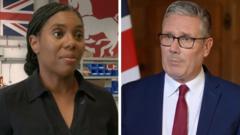
The green benches of the House of Commons are usually an arena of noise. PMQs is a spectacle of orchestrated fury, a theater where words are weaponized and every breath is calibrated for the evening news broadcast. But there are rare days when the oxygen seems to leave the room all at once.
It happened on a damp afternoon, the kind where London grime seems to stick to the stone walls of Westminster. Keir Starmer sat at the dispatch box, his papers arranged with his characteristic lawyerly precision. Across the table, Kemi Badenoch watched, ready to pounce on the slightest vulnerability. Then, the note arrived. Meanwhile, you can find related events here: The Thin Glass Line Between Life and the Void.
Politics operates on a delay. The public sees the polished statement, the edited clip, the carefully drafted tweet. What they miss is the agonizing friction of the real world breaking through the bubble. When a major crime investigation breaches the gates of government, it does not arrive as a press release. It arrives as a whisper, a sudden huddle of advisors in the corridor, and a sudden, terrible shift in the atmosphere.
The Slip of the Mask
Watch the footage closely. You can see the exact second the reality of a fresh murder investigation registers on the faces of the country’s most powerful figures. To understand the complete picture, we recommend the detailed report by Al Jazeera.
Starmer’s shoulders dropped. The rigid, prosecutorial posture he spent years developing vanished, replaced by the heavy, slouched weight of a man suddenly reminded of the darkness he used to confront as Director of Public Prosecutions. Badenoch, usually a fireball of confrontational energy, went utterly still. Her eyes widened, losing their sharp, debating-chamber focus.
For a fleeting moment, they were not the Prime Minister and the Leader of the Opposition. They were just two people processing horror.
This is the hidden tax of leadership. We demand our politicians be unfeeling machines capable of managing billions of pounds and navigating complex legislative webs. Yet, the moment a tragedy occurs, we demand they immediately manifest profound, authentic human grief. It is an impossible tightrope. Walk it too coldly, and you are branded detached. Show too much emotion, and you are deemed unstable.
Consider the hypothetical life of a detective arriving at that specific crime scene while the politicians are being briefed. The detective does not care about parliamentary schedules. They are standing in the cold, dealing with the brutal, physical reality of a life cut short. They are bagging evidence, setting up blue tents, and preparing to knock on a door to break a family's heart.
Meanwhile, less than a mile away, the machinery of state must figure out how to talk about it.
The Insufficiency of Language
The language of modern governance is broken. It relies on bureaucratic phrases designed to say everything and nothing all at once. "Our thoughts are with the families." "We have full confidence in the police." "No stone will be left unturned."
When Starmer spoke, the words were familiar, but the delivery was fractured. The shock was clear in the cadence of his voice. He stumbled slightly, a rare occurrence for a man who lived his life in courtrooms.
"When you see the details of an investigation like this, it reminds you of the fragility of the peace we take for granted."
Badenoch’s response mirrored that gravity. The usual partisan edge was entirely absent. There were no points to be scored here. No political advantage to be gained from a body in the ground.
But the real problem lies elsewhere. The collective shock of our leaders reveals a deeper, more unsettling truth about the world we live in. We rely on these figures to keep us safe, to maintain the illusion of order. When a crime so shocking occurs that it forces a total ceasefire in the relentless war of Westminster politics, it signals to the public that the protective walls are thinner than we want to believe.
The human brain is not wired to process statistics. We read that crime rates are up or down, and the numbers slide off our minds like rain on a window. But when we see two fierce rivals stand side by side, united by nothing but sheer, unadulterated dismay, the reality hits home.
The Long Road Back to the Script
The unity never lasts. It cannot. The system is designed to conflict, to question, and to divide.
Even as the shock hung in the air, the invisible gears of the political machine were already spinning. Advisors were calculating the policy implications. Journalistic pack lines were being formed. Before the day ended, the questions would shift from what happened to who is to blame. Was it a failure of policing? A failure of mental health services? A failure of the justice system?
That transition is jarring to watch, but it is necessary. If politicians stayed trapped in the emotion of the moment, the country would grind to a halt. They must harden their hearts again. They must put the masks back on, pick up their briefing folders, and return to the theater.
But for those few minutes on a gray London afternoon, the theater was closed. The cameras captured something rare: the vulnerable, frightened core of leadership.
The blue lights of the police cars continued to flash outside, casting long shadows against the ancient brick of a city that has seen too much blood, while inside, the people chosen to lead it could do nothing but watch, and feel entirely helpless.